US and Ecuador forces launch operation to fight drug trafficking

 Reuters
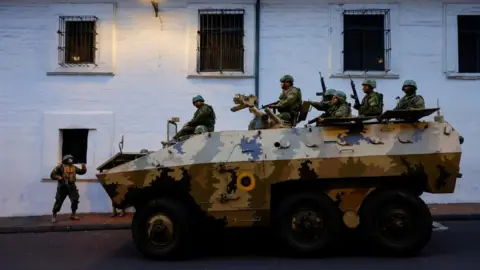
Ecuadorean and US forces have carried out joint operations in the South American country targeting drug trafficking, the US military's Southern Command has said.
The US embassy in Quito announced that US forces, working with their Ecuadorean counterparts and European international police agency Europol, had dismantled a large-scale drug-trafficking network linked to the Los Lobos gang.
The announcement came a day after Ecuador's President Daniel Noboa said the US was among "regional allies" taking part in a "new phase" of Ecuador's war on the drug cartels.
Noboa says around 70% of the world's cocaine now flows through Ecuador's huge ports.
Ecuador's location, sandwiched between Colombia and Peru, the world's two largest producers of cocaine, makes it a lucrative location for drug-trafficking gangs.
The US embassy in Quito said in a statement that 16 suspects had been arrested, including what it described as a "high-value target".
Europol added that more than 100 police officers and law enforcement from Belgium, the Netherlands and Ecuador were involved in the operation.
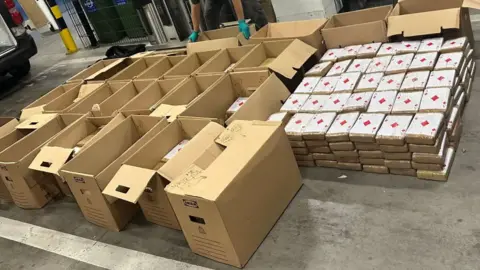
During the investigation, which began in January, police seized 3.7 tonnes of cocaine in the Netherlands, more than three tonnes in Belgium and more than half a tonne in Ecuador, the statement said.
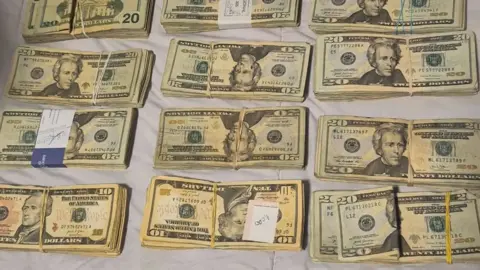
Officers also secured $810,000 (£605,000) in cash.
 Europol
The drugs had been hidden in containers with fruit for export to Europe, according to officials.
Europol found that Ecuadorean drug smugglers belonging to the Los Lobos gang were working with an Albanian trafficking organisation to ensure that, once the cocaine shipments had reached ports in Europe, they were "rapidly divided, transported inland and distributed across multiple countries".
Last year, the US declared Los Lobos as a Foreign Terrorist Organisation (FTO), accusing it of "terrorising and inflicting brutal violence on the Ecuadorean people".
The latest operation comes four months after Ecuadoreans dashed US hopes of expanding its presence in the eastern Pacific region by voting against allowing the return of foreign military bases in the country.
The referendum result was a blow for Noboa, a close ally of US President Donald Trump, who is trying to fight organised crime and reduce soaring violence.
 Europol
The country has become one of the world's biggest drug-trafficking hotspots in recent years.
On Monday, Noboa held talks in Quito with US Southern Command chief Francis Donovan and Mark Schafer, head of US special operations in Central and South America and the Caribbean.
During the meeting, they discussed plans for information sharing and operational co-ordination at airports and seaports, Noboa's office said in a statement.
"Together, we are taking decisive action to confront narco-terrorists who have long inflicted terror, violence, and corruption on citizens throughout the hemisphere," the US Southern Command said on Tuesday.
The announcement comes three months after the Washington announced a temporary deployment of air force personnel to the former US base in the port city of Manta.
Tackling drug trafficking in the region is a key priority for the US.
The Trump administration has carried out more than 40 lethal strikes on alleged drug boats in the Caribbean Sea and Pacific Ocean since September.
In January, the US seized Venezuela's then-President Nicolás Maduro, who they accuse of "narco-terrorism" and enabling the transport of "thousands of tonnes" of cocaine to the US.
And last month, Trump met his Colombian counterpart, Gustavo Petro, at the White House after months of rising tensions between the pair.
Trump has repeatedly accused Petro and his administration of failing to stem the flow of drugs to the US, suggesting that expanded strikes could also target Colombia.