New airport links could include trams or light rail

 Weca
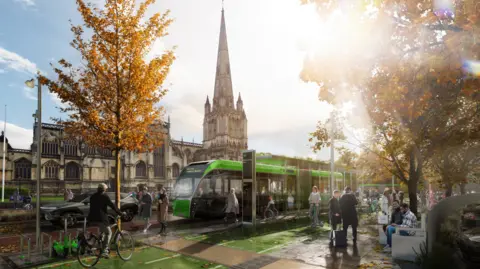
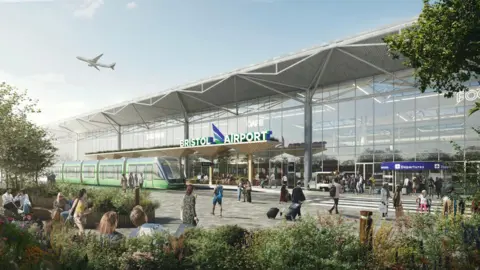
WecaNew public transport links between Bristol city centre and Bristol Airport could include bendy buses, an electric-powered tram or a light railway.
The airport in North Somerset is the largest in the UK without a mass transit link with passengers having to drive, get a taxi, a coach, or use the Airport Flyer bus.
The West of England Combined Authority (Weca) has announced that the North Somerset Gateway - which includes Bristol Airport - will be one of the key focus areas in its transport vision.
West of England Mayor Helen Godwin said: "Together, we can and must deliver the integrated transport system that people need and deserve."
Godwin was joined by council leaders as Weca's transport plans for the area were announced at Ashton Gate Stadium in Bristol earlier.
Bristol Airport links
Last year, a new £60m transport interchange with thousands of parking spaces and space for more buses and coaches was opened at Bristol Airport in a bid to encourage the use of public transport.
However, the site is only served by the A1 and A3 Airport Flyers from Bristol and Weston-super-Mare, the A4 Air Decker from Bath and national coach services.
Weca said mass transit between Bristol and the airport could come in the form of an electric-powered tram or a light rail solution. Another option could be bendy buses that run on segregated roads with low floors and additional decks with their own entry and exit points.
 Weca
WecaBus improvements
Weca said it had ambitions to improve the bus network in the area.
It said it aimed to introduce one ticket that will allow passengers to use all buses across the region as well as affordable tickets to support vulnerable communities, including disadvantaged and young people.
It also said it wanted to amend timetables to add new routes, longer operating hours, improve reliability and create additional services to rural areas.
Rail improvements
Bristol's rail network has been improved in recent years with the new Portway Park and Ride and Ashley Down stations. There are also plans to reopen the line to Portishead to create a new link for more than 50,000 people.
Elsewhere, Weca said it aimed to open stations at Charfield, North Filton and Henbury, while continuing to explore the case for other stations to enhance the rail service in suburban areas.
Stations for the new town at Brabazon and the West Innovation Arc were among the plans too.
Weca said it hoped to work with the Department for Transport to improve service frequency and secure new trains that produced fewer emissions and improved journeys and passenger experience.
Active travel improvements
Plans to improve infrastructure for walking, wheeling and cycling have also been unveiled by Weca.
To do this, the authority said it would enhance the role of e-bikes and e-scooters, provide more cycle hangars and create a "dense" network of walking and cycling routes that connect with bus and rail stations.
Street improvements
Weca said it aimed to "enhance quality of life" and help people be "resilient to the impacts of climate change".
It said it planned to roll out electric vehicle charging points in more places more quickly as people switch from petrol and diesel.
Schemes that provided more green space, shade, biodiversity and better amenities would be supported, as well as the use of artificial intelligence and data analytics to make timetables work better.
The plans also include improvements to the quality of roads and pavements and investment in ongoing maintenance to reduce potholes and trip hazards.
The authority also said it would deliver Park and Ride and other interchange hubs to create safe and efficient places for passengers to switch transport options and open up choice in where they could travel.
When will the plans be delivered?
Although the authority received £752m from the government's spending review in 2025, Godwin said further investments would be needed to achieve the plans.
She added that Weca was working to develop a 15-year plan to deliver mass transit to the area, with an ambition to start delivery of the first projects within four to five years.
Follow BBC Bristol on Facebook, X and Instagram. Send your story ideas to us on email or via WhatsApp on 0800 313 4630.