Unemployment rate unexpectedly falls as fewer students look for work

 Getty Images
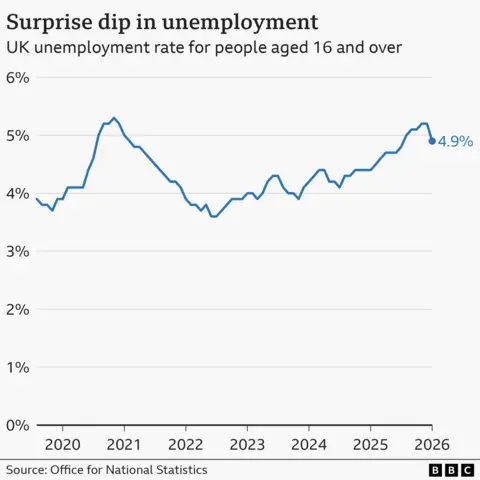
The UK's unemployment rate has fallen unexpectedly, partly due to fewer students looking for work while they study.
Unemployment fell to 4.9% in the three months to February, the Office for National Statistics (ONS) said, despite predictions it would remain unchanged at 5.2%.
The drop has been driven by a rise in those not actively seeking work as economically inactive people are not included in the jobless figures.
Meanwhile, wages rose at an annual pace of 3.6% between December and February, the weakest rate since late 2020. Despite the slowdown, pay is still rising faster than inflation.
Liz McKeown, director of economic statistics at the Office for National Statistics (ONS) figures, said: "Alongside falling unemployment, the number of people not actively seeking work increased, with data suggesting fewer students seeking work alongside their studies."
The inactivity rate – which measures the proportion of people unemployed but not looking for work – was 21% in the December to February period, up from 20.7%.
Most of the data released by the ONS was gathered before the outbreak of the US-Israeli war with Iran, which has led to a surge in energy prices.
If these energy prices remain high, economists have warned this could affect the jobs market in coming months.
The ONS said early estimates suggest the number of workers in payrolled employment slipped by 11,000 in March, the first month of the Iran war.
The figures also showed the number of job vacancies fell to their lowest level in almost five years, dropping to 711,000 for the January to March period.
Dean Watson runs the Youth Employment Hub in Peterborough, Cambridgeshire.
It is based at the city's football stadium and offers careers advice and training to help 16-24-year-olds get a job.
Dean says a lack of confidence is the biggest thing holding back those he's seen from applying for jobs.
"Confidence is number one, mental health, anxiety, nerves. Job searching is demoralising."

Twenty-year-old Leo has been attending the hub since January. He has been out of work for a little while and had been applying for roles in construction, but without luck.
"I was always sending out different applications, sending my CV to as many places I can. You only get some come back to you. You don't really hear much back."
He says attending the hub has helped widen his job prospects.
"Being here, I've realised I've got huge opportunities. I've been enrolled onto a sales and leadership course for the next six weeks".
Iran war impact
James Smith, an economist at ING, said the fall in the unemployment rate did not "appear to be because of a big shift into work".
"The details reveal the drop in the jobless rate is pretty much solely down to a rise in 'economic inactivity' – that is, people neither in work nor actively seeking it," he said.
"The Office for National Statistics notes that this was particularly visible for students."
Yael Selfin, chief economist at KPMG UK, said the UK's labour market "showed signs of stabilising in February, but a reversal may be on the horizon".
She added the fall in the unemployment rate was "consistent with survey evidence suggesting hiring activity was recovering before the conflict in the Middle-East".
"However, unemployment is likely to trend higher in the coming months as firms scale back on hiring in response to rising costs and weaker demand."
Last week, the International Monetary Fund (IMF) predicted that the energy shock from the conflict would hit the UK the hardest of the world's advanced economies.
As a result, the IMF cut its estimate for UK growth this year to 0.8%, from the 1.3% prediction made in January before hostilities began.
Forecasters have noted that as the UK is a net importer of energy, it is particularly sensitive to rapid rises in energy prices.
Official data released last week showed the UK's economy grew by a faster-than-expected 0.5% in February, indicating growth had been picking up ahead of the conflict.
Reacting to the latest jobs data, Work Secretary Pat McFadden said the figures showed an improvement at the start of the year "with unemployment falling below 5% and 332,000 more people in work than a year ago".
"But we cannot escape the effects of the war in the Middle East which are likely to feed through to prices and employment in the coming months. We will do everything we can to support the country through this period."
Shadow work secretary Helen Whately said: "This month's dip in unemployment is outweighed by the rise in people who are economically inactive, who have left the labour market altogether.
"Payrolled jobs and vacancies are down, too. Labour's taxes and red tape have killed opportunity for many thousands of people."
Additional reporting by Adam Woods

Sign up for our Politics Essential newsletter to keep up with the inner workings of Westminster and beyond.