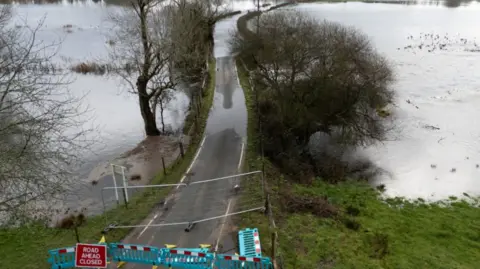
Parts of England and Wales braced for more downpours from midday

 PA Media
Heavy downpours are set to drench parts of south-west England and south Wales, which will be covered by a Met Office yellow warning coming into force at 12:00 GMT.
The Met Office said: "10-15mm (0.6in) of rain is likely fairly widely with 20-30mm in some places exposed to the strong south to south-easterly winds."
Dozens of flood warnings remain in force across England and eastern Scotland.
The Environment Agency said its teams were on the ground to reduce flooding impact and support affected communities.
Monday to Wednesday will be cloudy with intermittent rain for most areas. The heaviest downpours once again will be focussed around south-west England and south Wales where rain will fall on very saturated ground.
From midweek onwards, a trend to colder and drier conditions is expected.
Snow showers are likely over hills and mountains in Scotland and perhaps northern England for a time but most parts of the UK should see a return to drier weather and sunshine throughout Thursday and into Friday.
There were 104 warnings and 215 alerts in England as of Sunday evening. Most of the warnings are located in the south-west and the Midlands. There are currently six flood warnings and two alerts in Scotland and five alerts in Wales.
The Met Office has confirmed that rain fell every day of 2026 in south-west England and South Wales, with both areas seeing 50% more rainfall than usual.
 S Pace/BBC Weather Watchers
The UK was hit by a succession of three named storms in January, bringing heavy rain, strong winds and disruption.
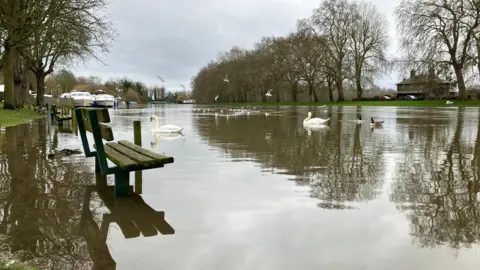
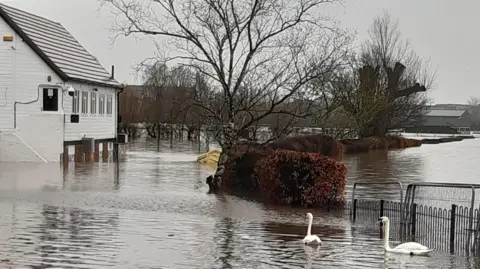
The Environment Agency estimated at least 300 properties had been reported as flooded on Sunday, with about 16,200 more now having been protected.
"We urge people not to drive though flood-water - it is often deeper than it looks and just 30cm of flowing water is enough to float your car," Sarah Cook, the agency's flood duty manager cautioned.
Flood warnings are clustered in Devon and Hampshire, as well as between Gloucester and Worcester. However, more than 200 flood alerts are scattered across much of England apart from the far north and East Anglia.
Warwickshire Fire and Rescue Service warned that flooding was "imminent" after "heavy prolonged rainfall" had caused local levels at the River Dene to rise.
During Monday's yellow weather warning for rain, 10-15mm (0.4-0.6in) of rain is likely, while some places could see 20-30mm depending on exposure to south to south-easterly winds, the Met Office said.
"There will be some heavy rain and the rain is falling on saturated ground so further flooding is possible, particularly as we move into the evening," Met Office meteorologist Tom Morgan said.
He added there was potential for "surface water on the roads" on Monday, which could cause disruption to travel.
 Saza/BBC Weather Watchers
Floods Minister Emma Hardy said her thoughts were with those affected as she urged residents to follow local advice over the coming days.
Northern Ireland has had its wettest January in 149 years, while County Down and Cornwall had the wettest January on record, according to the Met Office.
February has also seen similarly intense rainfall.
Provisional Met Office data shows some parts of the UK recorded more rainfall in the first five days of the month than it would normally expect over the course of the whole month.
Aberdeenshire has been one of the wettest places of all, with Aboyne receiving more than 130% of its normal February rainfall in just five days.
Last week, Storm Chandra brought flooding and travel disruption, and saw dozens of schools close.
It was the third named storm to batter the UK so far this year, after Ingrid and Goretti.