Botox and Brazilian butt lift law passed by parliament

 Getty Images
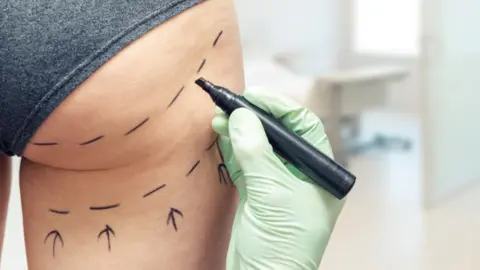
The Scottish government is to tighten rules on cosmetic procedures including botox injections and liquid Brazilian butt lifts.
A new law will ban non-surgical treatments for under-18s and restrict them to approved health settings.
Such procedures will only be allowed if overseen by a sufficiently qualified practitioner.
The Non-surgical Procedures and Functions of Medical Reviewers (Scotland) Bill was passed with 124 MSPs in favour and none against in a vote at Holyrood.
Currently, there is no requirement for people to complete training before delivering non-surgical procedures, with the Scottish government estimating that there could be up to 1,500 business carrying out unregulated procedures in Scotland.
Advice Direct Scotland recently warned that children as young as 15 were seeking help following botched botox treatments and dermal fillers.
Under the legislation, it will be an offence to deliver treatments to someone under the age of 18, or to perform it outwith a permitted premises, with a maximum fine of £20,000.
Non-surgical cosmetic procedures will only be allowed in NHS GP practices, dentists and pharmacies, as well as private hospitals and clinics if they are registered with Healthcare Improvement Scotland.
Procedures must be overseen by a sufficiently qualified practitioner. This could include a doctor, nurse, midwife, dentist or pharmacist.
The legislation will also give the government the power to set hygiene, qualification and safety standards.
What are Brazilian butt lifts?
Brazilian butt lifts, or BBLs, are used to enlarge buttocks. They are typically carried out with silicone-filled implants or fat injections.
However, cheaper non-surgical BBLs are carried with using hyaluronic acid - also used in dermal fillers.
If not performed safely, they can lead to serious health complications.
The regulations would also apply to chemical peels, in which chemical are used to remove skins cells, cellulite treatments and microneedling, which involves making tiny punctures in a person's skin.
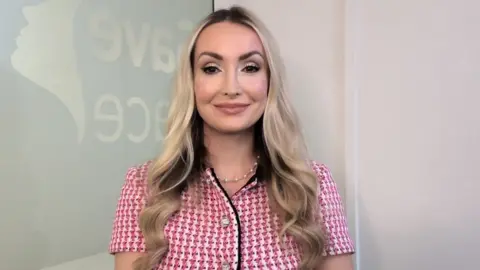
Ashton Collins is the director of Save Face, a register of approved cosmetic practitioners which has supported more than a thousand women affected by botched treatments, including dozens in Scotland.
She welcomed any action to improve regulation and prevent harmful procedures, particularly liquid BBLs.
"It's very hard to articulate how much these ruin people's lives," she told BBC Scotland News.
Save Face has supported women who have suffered heart attacks or sepsis after non-surgical BBLs.
Others have had large sections of their buttocks removed, leaving them unable to walk or work.
"The psychological ramifications of that are really, really significant," Collins said.
She added that any botched cosmetic procedure was "incredibly distressing" for the patient.
The campaigner said younger people were more likely to "fall foul" of unsafe practitioners due to cheap deals advertised on social media and limited funds to correct issues when treatments go wrong.
'Black market' fears
While she welcomed the bill, Collins cited concerns about the cost as well as the enforcement capabilities of Healthcare Improvement Scotland, the national agency which is to be given new powers allowing it to investigate unregistered practitioners.
She said: "Is this going to be effectively policed and enforced?
"Because if not, it's just another piece of paper that isn't taken very seriously, and people will continue to operate under the radar."
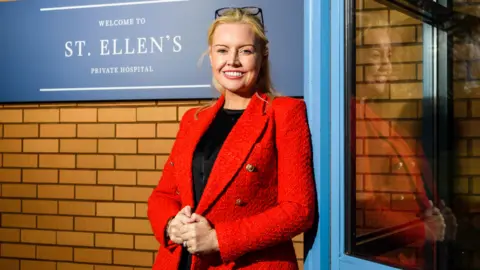
Gill Baird, the founder of Cosmedicare St Ellen's private hospitals in Glasgow and Livingston, also supports the bill but said more needed to be done to help non-medical practitioners get the training they need to comply with the new legislation.
However, she raised concerns about compliance with the law.
"If non-medics decide not to comply with the regulations that come in, there will be a black market," Baird told BBC Scotland News.
She said that educating patients was also key, adding: "If you are going to choose to go to an underground provider, you're really taking your health into your own hands."
Public Health Minister Jenni Minto said the bill would improve safety while protecting a "thriving sector".
She told MSPs she expected the government to work closely with the cosmetic industry to help businesses adapt to the legislation.
Conservative MSP Brian Whittle said the legislation was "much-needed" but called on the government to go further.
He said while the largely female-led non-surgical cosmetic sector was largely a "success story", it was operating in a "regulatory vacuum".
Whittle supported calls for a clear accreditation pathway for non-medical practitioners.
Labour's Carol Mochan said her party recognised good practitioners.
She told parliament: "However we currently have no way of identifying the good from the bad and there are clear cases where hygiene and safety standards are not being met.
"This is why this bill is so important."
Citing the concerns of those within the cosmetic industry, Mochan backed a phased implementation of the bill.