Who is Tom Homan, Trump's 'border tsar' deployed to Minneapolis?

 EPA
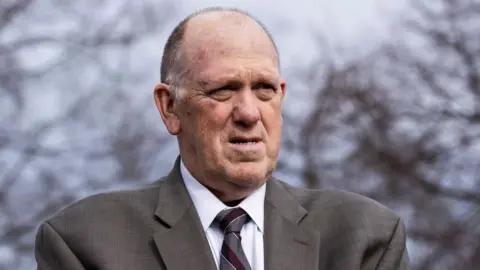
EPAUS President Donald Trump deployed his "border tsar" Tom Homan to lead on-the-ground immigration enforcement in Minneapolis in January, after two US citizens were shot dead by federal agents in the city in less than a month.
Roughly a week after he arrived, Homan announced he was cutting the number of federal agents in the city by a third and equipping officers with body-worn cameras.
He had taken took over command of "Operation Metro Surge" from Gregory Bovino, the US border patrol commander who had become the public face of the Trump administration's mass deportation drive in cities across the US.
Under Bovino, confrontations between immigration agents and bystanders had become increasingly hostile and agents shot dead US citizens Renee Good and Alex Pretti, sparking protests across the country.
Homan, 64, is seen both as a key Trump ally and someone with decades of experience in immigration policy across both Republican and Democratic administrations.
Homan is also one of the most vocal defenders of Trump's immigration policy and mass deportation drive.
A native of upstate New York, he began his career in law enforcement as a police officer before joining border patrol in 1984 in southern California.
He joined what was then called the Immigration and Naturalization Service four years later, climbing through the ranks of US immigration enforcement over multiple years.
By 2013 - under the Obama administration - he held a little-known but influential post heading the Enforcement and Removal Operations arm of Immigration and Customs Enforcement (ICE).
Homan had planned to retire in 2017, just days before Trump's first administration began.
An abrupt call at his retirement party from incoming Chief of Staff John Kelly changed those plans.
"I remember him saying, I know it was bad timing, but the president-elect wanted me to stay and run [ICE]," Homan recalled in an interview last year with the Daily Caller. "Monday morning, I called [Kelly] and said I want to come back."
A similar call, this time from current Chief of Staff Susie Wiles, again brought him out of retirement in 2024 ahead of the second administration.
While "border tsar" is an informal term and position, it refers to an executive-branch role overseeing border and immigration policy across multiple agencies. It is not Senate confirmed, and is a policy position directly appointed by the serving president.
So far in Trump's second term, Homan has been a vocal defender of the president's broad deportation goals, vowing to target the "worst of the worst" and challenge the notion that "those who enforce the law are the bad guys and those who break the law are the victims".
But in practice, enforcing immigration laws and attempting to focus on public safety threats has also ensnared other undocumented migrants who have no criminal background - a fact that Homan acknowledges and blames on "sanctuary cities" that do not work with federal immigration efforts. Officials have said the act of being in the US illegally is a crime in itself.
"We're not going to instruct ICE not to arrest [someone] unless there's a serious crime," he told reporters in July at the White House, where he makes regular appearances.
"What message does that send the whole world? Go ahead and enter the country," Homan added.
In September, the White House swiftly came to Homan's defence after reports emerged that he was accused in a bribery case that was ultimately dropped by the justice department when Trump returned to office.
White House Press Secretary Karoline Leavitt described that case - which allegedly saw Homan accept $50,000 (£36,300) from undercover agents - as an effort to "entrap" a key Trump ally.
Who is Greg Bovino and why was he replaced?
 Getty Images
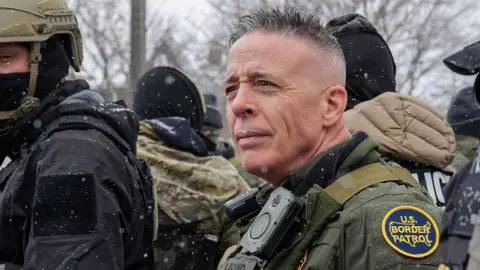
Unlike Homan, Bovino has spent almost his entire law enforcement career in border cities, having first joined Border Patrol in 1996 and serving in a variety of US domestic postings as well as overseas in Honduras and Africa.
The North Carolina native rose to prominence in Trump's second term, taking the lead during immigration crackdowns in Los Angeles, Chicago, New Orleans and Minneapolis.
Bovino had been serving as "commander-at-large" in Border Patrol - an informal role outside of the organisation's formal hierarchy. Border Patrol is one of several immigration-centred agencies that operates under the Department of Homeland Security (DHS).
He reportedly answers directly to DHS head Kristi Noem. In his informal role, he worked alongside officials like the chief of Border Patrol, a position held by Michael Banks, and the Customs and Border Protection commissioner, a position currently held by Rodney Scott.
Bovino's tactics have been controversial, particularly the aggressive "turn and burn" method of making swift arrests before protesters can arrive to an area.
"We're going to turn and burn to that next target and the next and the next and the next," he told the Associated Press. "We're not going to stop."
Bovino has also earned a reputation as an official willing to clash with lawmakers.
Toward the end of his tenure in Minneapolis, he publicly sparred with lawmakers from both parties who expressed concern about the operation.
Bovino had been set to return to his previous posting as chief patrol agent of the El Centro Sector in California, according to US media outlets.
Will leadership switch mean change in Minneapolis?
Homan's arrival in Minneapolis was seen by some political observers as recognition from the White House that an urgent change was needed amid growing public concern.
In practice, however, that change is ultimately unlikely to alter the administration's approach to immigration enforcement nationwide, observers say.
"Homan has more years at ICE and doing interior enforcement," former DHS immigration official Lora Ries told the BBC, referring to Homan's work in many American cities that are not near the border. "This isn't a surprise to me."
Ries, now head of the border security and immigration centre at the conservative-leaning Heritage Foundation in Washington, added that while Homan has said he's sought to focus "on the worst, first", all deportable undocumented migrants will continue to be "on the table".
At a news conference announcing the withdrawal of agents from Minneapolis, Homan said immigration teams are carrying out targeted arrests but "if we find an illegal alien there, they're coming".
For immigration activists, Homan's career - that has included staunch defence of Trump's family separation policy, which led to children being separated from their parents who were in the country illegally - also means that they see little practical difference between him and Bovino.
"I'm not sure it means much. Homan is a career deportation advocate, and the architect of family separation," said Michael Lukens, the executive director of the Amica Center, an organisation which helps immigrants with legal access and services.
"I think the difference is that he is more polished than Bovino. He is better at speaking to the press, and stakeholders," he added. "He's better for what they need, someone to paint their actions as not what they are."
"This is much more about whether the White House sees this as a political issue, not a human one," Lukens added.
"But there is no world in which Homan is a moderate."