Drones hammer Sudan's gold and oil zone - the pivotal new front line

 Reuters
Intensified drone attacks on the new front line of Sudan's civil war have led to mass civilian casualties in recent weeks and are increasingly shaping the course of the conflict.
The epicentre of the fighting has shifted to the south-central Kordofan region since both sides consolidated their gains in the other main battlefields of this nearly three-year war.
The conflict between the Sudanese regular army and the paramilitary Rapid Support Forces (RSF) has become one of the deadliest in Africa for civilians and shows no sign of abating despite US-led peace efforts.
The near-daily drone strikes have hit targets including markets, health facilities, aid convoys and residential areas across the Kordofan region, prompting outrage from the UN and humanitarian officials.
"The continued attacks by all parties on civilian objects must stop," the UN human rights chief Volker Türk said last week.
"The parties must take urgent measures to protect civilians, including by refraining from the military use of civilian objects."
He was speaking after reports that more than 50 civilians had been killed over two days in separate drone strikes in North and West Kordofan.
 Getty Images
Those attacks were blamed on the Sudanese military by local reports and war monitors, but both sides are accused of deadly strikes on civilians and civilian infrastructure.
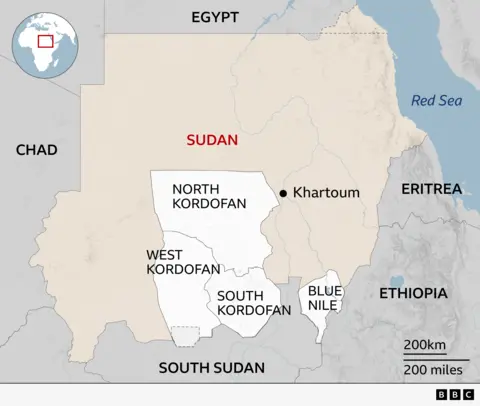
Greater Kordofan comprises three states and serves as a vital axis linking the western Darfur region, controlled by the RSF, to the capital, Khartoum, in the eastern Nile Valley, now in army hands.
The war erupted in April 2023, triggered by a power struggle between the leaders of the Sudanese Armed Forces (SAF) and the paramilitaries.
It began to intensify in Kordofan, a strategic area rich in gold and oil, once the SAF regained control of Khartoum last year.
The south-central region became the main battlefield after the RSF consolidated its hold of Darfur by capturing the city of el-Fasher in October.
Securing territorial control over the Kordofan states would put the RSF in a position to seize back Sudan's central corridor.
It would also help it anchor its rival administration in western Sudan, says Acled, an independent global conflict monitor.
The RSF set up a parallel government last year, hardening the de facto division of the country.
It did so in alliance with the rebel Sudan People's Liberation Movement-Army North (SPLM-N) which has its base in South Kordofan, securing access to experienced fighters, territory and border areas.
The SPLM-N has been fighting against the central government and armed forces for decades, seeking to end the political and economic marginalisation of Sudan's Nuba and Blue Nile regions.
But in recent weeks it is the SAF which has made strategic gains, breaking a blockade imposed on South Kordofan's two main cities by the RSF and its SPLM-N allies.
UN-backed food monitors said the two-year sieges of Kadugli and Dilling had created famine conditions.
Since the takeover of the cities, the SAF has escalated its bombardments of RSF positions, including on its aerial weapons.
The paramilitaries have been using drones from early in the war to overcome the army's air dominance.
They are widely reported to deploy Chinese long-range CH-95 drones that are supplied by the United Arab Emirates, which the UAE denies.
Sudan's military uses drones from Baykar, Turkey's largest defence contractor. Its supply is believed to have been buttressed over the last year by advanced Akinci combat models.
The Turkish government says it does not provide direct support to the SAF.
In early February, the Sudanese army said it had destroyed drones and anti-aircraft missiles belonging to the RSF in the Kordofan and Darfur regions.
It was "part of a strategy to dismantle the non-conventional aerial capabilities utilised by the RSF", its spokesperson Brig Gen Asim Awad said.
The BBC was not able to verify the footage published by Sudan's state news agency, but Turkish media outlets reported that an Akinci drone on 10 February destroyed a Chinese-made FK-2000 air defence system in Sudan.
"If the RSF's air defence infrastructure collapses, Sudan's liberation could be imminent," the Turkish defence expert Yusuf Akbaba posted on X.
Five days later the army again announced it had destroyed an RSF air defence system, in West Kordofan state.
 Anadolu via Getty Images
The army's advance appears to have been aided by a disruption in the RSF's supply lines from Libya into the Kordofan region, reportedly targeted by Turkish drones launched from an Egyptian airstrip near the Sudanese border.
Investigations by the New York Times and the Reuters news agency revealed that Egypt has become more involved in the war in the past six months, alarmed by RSF advances in Darfur.
Recent attacks led by the SPLM-N in Blue Nile State south-east of the Kordofans also threaten to widen Sudan's war into a regional conflict.
The state is a thin strip of land jutting between Ethiopia and South Sudan and the Sudanese army has accused both of allowing the RSF to launch attacks from their territory. The two countries have denied the accusations and the UAE has denied separate reports that it is funding an RSF training camp in Ethiopia.
Analysts believe the RSF and its SPLM-N allies are trying to open a new front in the Blue Nile region, partly to offset pressure in the Kordofans.
"Our brothers in the Blue Nile state are doing a good job," RSF leader Gen Mohamed Hamdan Dagalo said during a visit to Uganda last week.
"The distance there is short [referring to its proximity to army-held eastern regions]. It's not like Darfur."
Earlier this month the US envoy Massad Boulos said he was hopeful he might achieve a truce agreement by Ramadan, which began on 18 February.
Instead, a drone strike blamed on the Sudanese military hit families gathering at a water collection point in West Kordofan on the first day of the Muslim holy month. Young children were among the dead.
 Getty Images/BBC
Go to BBCAfrica.com for more news from the African continent.
Follow us on Twitter @BBCAfrica, on Facebook at BBC Africa or on Instagram at bbcafrica