Why are two fibreglass rhinos guarding a Scottish housing estate?

 BBC
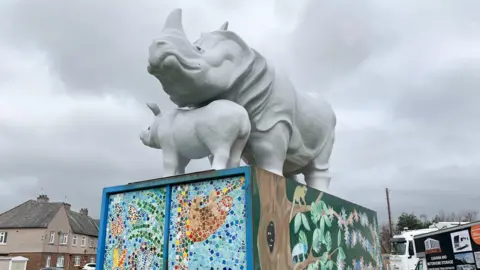
BBCFor decades two unusual figures have stood at the entrance to a housing estate in the south of Scotland.
Even the artist behind the Lincluden rhinos cannot remember the exact date the first one took up its position but it has become part of the landscape down the years.
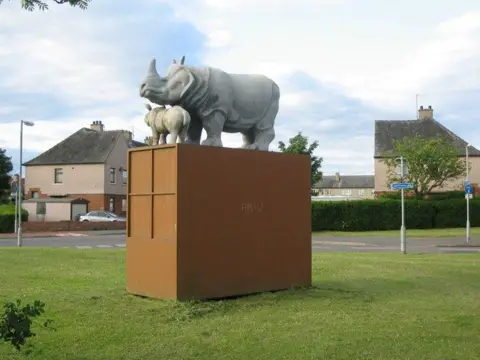
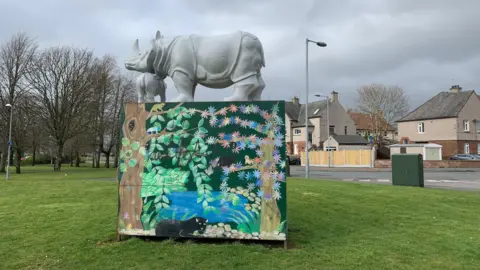
It has been moved, gone into storage, had a baby rhino added and seen further artworks adorn its base.
But how did a model of this far-from-native creature end up surveying the horizon in north-west Dumfries?
 Thomas Nugent
The man behind the fibreglass creation, Robbie Coleman, is now based near the village of Moniaive, a little more than 20 miles away.
He admits he cannot remember when it was first put up but knows it was a "long time ago".
He thinks it was some time around the late 1980s or early 1990s as part of a wider scheme which, he thinks, was linked to inventor Kirkpatrick Macmillan.
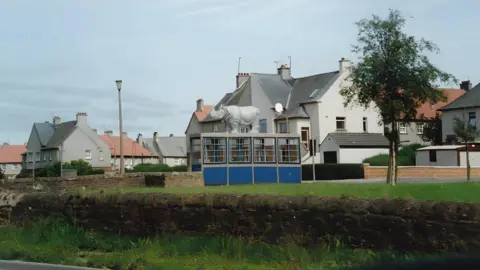
"The council asked me to look at renovating a couple of bus shelters in that area as an arts project," Robbie explained.
"I think it was to do with the celebration of the local inventor of the bicycle."
He worked with an after-school group of children and four students from the local art school.
 Phil Williams
Two of the bus shelters were "paint jobs" with murals but something more extravagant was created for the third.
"I was involved in making a load of fibreglass animals for a theme park at the time," said Robbie.
"I showed the kids a picture of some of the things I was making and they decided that it would be good if we had something on top, an animal or a fish or something like that.
"It was decided that a rhinoceros would be a good idea - we made the rhinoceros in my workshop and then that was it."
He said not everyone was convinced the project would last very long in its location.
A police car turned up while he was bolting it to the top of a bus shelter.
"These guys were just going - 'that ain't going to last the weekend'," he recalled.
"They said: 'A bus got hijacked here two weeks ago.'
"They were just telling me that it was going to be a disaster."
Local reaction, though, was good.
"Lots of the people who lived in the houses nearby were coming out and talking to us," said Robbie.
"The people thought it was pretty funny - it's not a big pretentious piece of artwork that no one understands."
Those predictions of disaster have also proved unfounded.
"I know a couple of people - drunk on a Saturday night - have been on top of it, but it has only ever been damaged once," said Robbie.
"Somebody had broken the horn off - I think it was an accident - but, anyway, I repaired that."
The statue was moved during road works for a nearby McDonald's, but after Robbie spotted it in storage it returned to Lincluden - on a plinth rather than the bus shelter.
 Creative Futures
That is where Kirsty Turpie, a creative industries lecturer at Dumfries and Galloway College, came into the story.
About eight years ago, she was working as the public art project worker for the Creative Futures initiative.
"We invited people to consider how they might revitalise the rhino statue," she said.
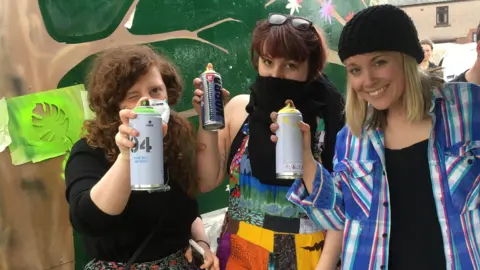
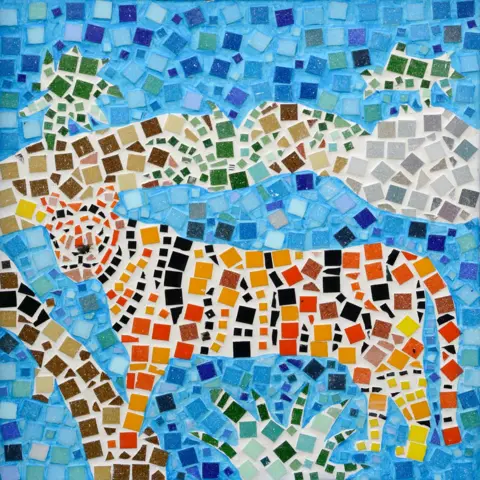
"So we decided that we were going to put mosaic panels into the windows and then do spray-painted designs around the rest of the base."
 Creative Futures
She was able to get residents from Lincluden and nearby Lochside involved in making something that belonged to them.
"It was really a project for the community to create something that added more colour and interest into their area," she said.
"And I think everybody that took part was really happy with what the outcome was."
 habiloid
Robbie also revealed that there was an unusual postscript to his involvement with the artwork when he was asked to produce another rhino hundreds of miles away.
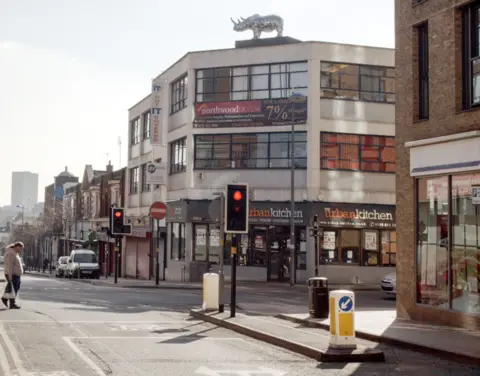
He was commissioned to work on a "gateway" project for the area of Birmingham known as the Gay Village.
"So there's a diamond-covered rhinoceros on the top of a building in Birmingham," he explained.
If it proves as durable as its Scottish cousin, it will be there for many years to come.