MPs would vote on using troops in Ukraine, Starmer says

 Getty Images
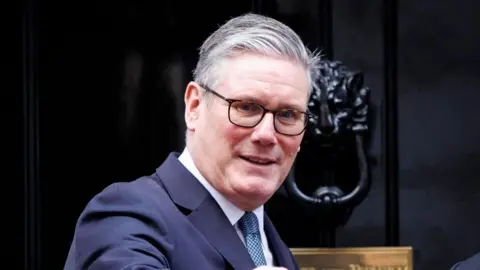
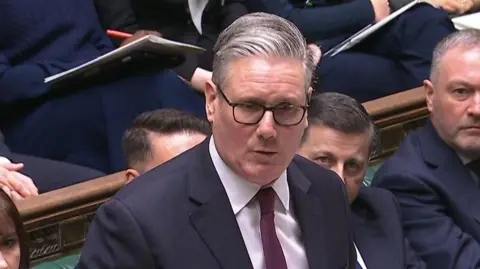
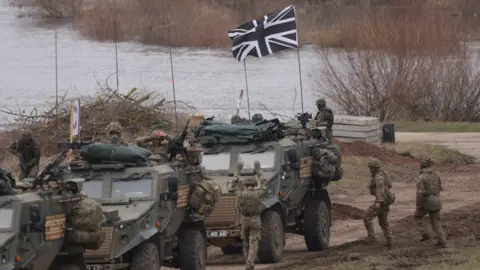
Sir Keir Starmer has pledged that MPs would get a vote on the deployment of British soldiers to police any agreement to end the conflict in Ukraine.
The prime minister said the move would be consistent with "recent practice" on approving military action in Parliament.
It comes after the UK and France reiterated their commitment to deploy troops to deter Russia from attacking Ukraine again if a deal to end the conflict is struck.
Sir Keir has not specified how many British troops could be committed, telling MPs it would be "in accordance with our military plans".
During Prime Minister's Questions, Sir Keir told MPs that in the event of a peace agreement, British personnel would conduct "deterrence operations" and protect new military "hubs" allies are planning in Ukraine.
The prime minister did not specify whether a vote would take place before troops are sent, but his press secretary later told reporters that Parliament would have a say ahead of any "long-term deployment" of UK forces.
However, the press secretary would not comment on whether the Commons vote would tie the government's hands should MPs reject the government's proposals.
Parliament does not have a legal role in approving military action, which is formally authorised by the prime minister on behalf of the monarch.
In recent decades a convention has developed that MPs should have the chance to debate deployments, although the principle has been applied inconsistently.
In 2013, MPs voted against possible UK military action against Syria to deter the use of chemical weapons, with David Cameron becoming the first British leader to lose a vote on military action since the late 18th Century.
They were also given a say on action against the Islamic State group (IS) in Iraq in 2014, and in Syria the following year.
However, Theresa May took action in Syria in 2018 without consulting MPs, whilst more recently Rishi Sunak and Sir Keir have authorised RAF air strikes against Houthi targets in Yemen without doing so.
Paris statement
On Tuesday, the UK and France signed a "declaration of intent" on deploying troops in Ukraine in the air, on land and at sea after a summit in Paris.
The statement added that Ukraine would authorise the UK, France and other allies to use "necessary means, including the use of force" within its territory.
Allies also proposed that the US would take the lead in monitoring a truce.
However, full security guarantees have not been agreed and the US, which has been leading efforts to end the war, reportedly did not sign such a pledge at the talks.
Chairman of the Commons Defence Committee, Tan Dhesi, welcomed the announcement but warned "it intensifies the very real challenges our armed forces are already facing".
"It also runs the risk of overstretching our armed forces and so calls into question the UK's ability to sustain pre-existing commitments to our allies," the Labour MP added.
During a Commons debate both the Conservatives and Liberal Democrats also welcomed the announcement but said it highlighted the need for an increase in defence spending.
However, Reform UK leader Nigel Farage said "under the current terms, with the current strength of the British Army" he would vote against the deployment of British soldiers to Ukraine.
"We neither have the manpower nor the equipment to go into an operation that clearly has no ending timeline," he told Times Radio.
Farage said he might consider supporting the move if more countries were involved but he added: "As it is, it will be us and the French completely exposed for an unlimited period of time."
It comes after nine months of planning talks by a group of countries, dubbed the Coalition of the Willing, over security guarantees to be offered to Ukraine in the event of a deal, alongside separate talks over ending the war itself.
Sir Keir said a deal to end the war "will not happen" without such guarantees in place, "backed by the United States".
Moscow has repeatedly warned that any foreign troops in Ukraine would be a "legitimate target".
Russian President Vladimir Putin launched a full-scale invasion of Ukraine in February 2022, and Moscow currently controls about 20% of Ukrainian territory.