'Bid to buy Rothbury Estate as divisive as Brexit'

 Duncan Hutt
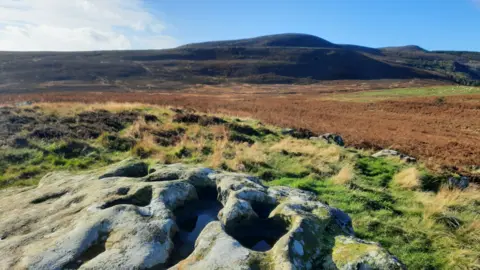
The Rothbury Estate is up for sale and potential buyers Northumberland Wildlife Trust and the Wildlife Trusts - a federation of 47 conservation charities - are more than a third of the way towards raising the £30m needed. The Wildlife Trusts says it plans to boost wildlife, restore bogs and promote nature-friendly farming on the site - but those plans are not popular with everyone.
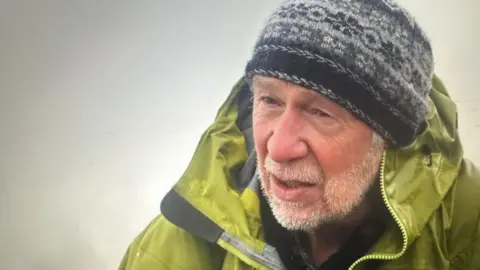
February's weather is doing its worst on the hills above Rothbury, with persistent rain and mist shrouding much of the scenery, but the man trudging towards me loves this landscape - even on a day like this.
Conrad Dickinson is the president of the Northumberland Wildlife Trust.
He is a polar explorer and crossed Greenland, Antarctica and reached the geographic North Pole on his own, but this area is special to him.
"I'm born and brought up in Northumberland and when it's in your bones - it's in your bones," he says.
"Yes, I've been fortunate enough to see some parts of the world but this is just fantastic, I know it's a bad day today weather-wise, but it's just amazing."
The Wildlife Trusts and Northumberland Wildlife Trust (NWT) are attempting to buy the Rothbury Estate, which was last sold in 1328, from the Duke of Northumberland's youngest son Lord Max Percy for £30m.
They are now more than a third of the way there, after two recent donations totalling £1.5m.
Dickinson says: "We've had over 18,000 people want to support this - from people who've given a million pounds, but at the other end of the spectrum we've got school kids giving their pocket money or their birthday money, and other people wanting a memory for their father who used to walk in these hills.
"I mean, the stories bring a tear to your eye to be honest."
He adds that it is "a once-in-thirty-years opportunity".
"If it slips away away, it'll be broken up."
'Wild corridor'
The project has some other high profile supporters. Last year, Sir David Attenborough made a public appeal, which brought in more than eight thousand donations from across the world.
The 15-sq-mile (38.8-sq-km) estate is the largest area of land to be put on sale in England in decades, and sits in the heart of what nature experts say could be a 40-mile (64km) "wild corridor", from the coast to Kielder and the Scottish border.
The Wildlife Trusts says it plans to boost wildlife, restore bogs and promote nature-friendly farming on the site.
The charity has already purchased one parcel of the land, the Simonside Hills, and has until September this year to raise the money needed to secure the entire estate.
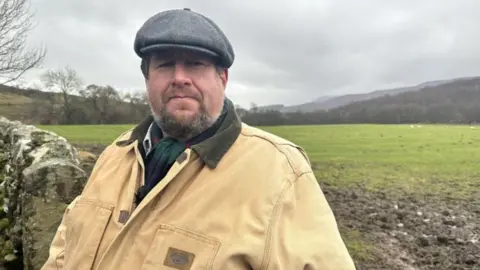
But the project has its critics. Chris Armstrong is a tenant farmer of 1,000 acres (405 hectares) close to the site.
"The most recent strapline seems to be - 'time is running out to save the Rothbury Estate'," he says.
"The Rothbury Estate doesn't need saving - saving from what?
"I mean, we are one of the most beautiful areas of the British Isles here - we're well supported by tourists all throughout the year.
"The stock will be the first thing to leave, the people will be the next thing to leave.
"And as has been proven up and down the country on various projects such as this, the wildlife leaves as well."
'Akin to Brexit vote'
Wildlife Trusts has said it wants to reduce the number of sheep on the estate by about two thirds from 1,500 to 500 and quadruple the number of cattle to 200.
But it also wants to introduce other species - the European bison has been extinct in the wild in Britain for more than 6,000 years but could be making a comeback.
Weighing up to 920kg (145 stone), it is one of the heaviest land animals in Europe and falls under the Dangerous Wild Animals Act.
The Wildlife Trusts' director of landscape recovery, Dr Rob Stoneman, says while it would be "extremely unlikely" bears and wolves could be reintroduced, European bison could be a long-term prospect on the Rothbury Estate should it take over.
"It would be immensely exciting to have bison in the hills above Rothbury," he says.
"We've introduced bison into Kent woodlands already really successfully, wouldn't it be fantastic to have them in Northumberland?
"Never in high numbers, of course, because they range over quite a big area."
However, he adds it has not yet been discussed with locals.
"If people didn't want it to happen, we wouldn't make it happen."
Back on his farm, Armstrong said despite the Wildlife Trusts' success so far in raising money to buy the estate, the community is split over the issue.
"I would put it very much akin to the Brexit vote, I would think it would be that finely split," he says.
"I think the majority of the farming community see this as a folly."
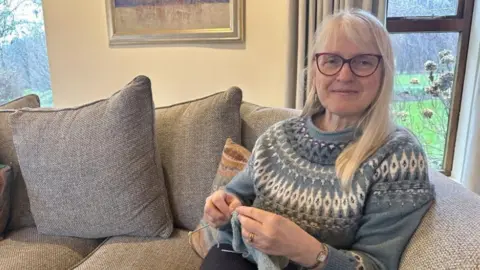
However, that is not an opinion shared widely in the Rothbury Women's Institute.
Secretary Katy Nicholls said members have raised £2,000 through fundraising towards the purchase of the estate.
"We have a walking group and we absolutely love walking in these hills, we don't want to have them covered with blanket forestry," she says.
"It would be heartbreaking to see it broken up.
"The Wildlife Trusts intend to open more footpaths so we're very keen to get the land, it's just an amazing opportunity to get a wildlife corridor about 40 miles long and to work with nature."
The Wildlife Trusts say while it would consider applying for government grants to help them get to their £30m target, so far they have not yet found any that will help with a land purchase as big as the Rothbury Estate.