'As a GP, I never thought cancer would happen to me'

 Jessica Bayley/ BBC
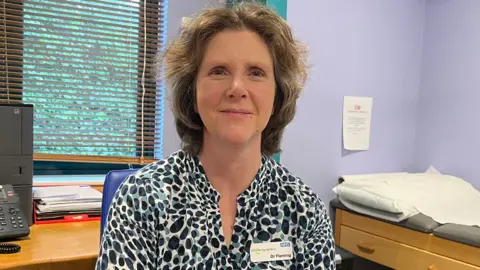
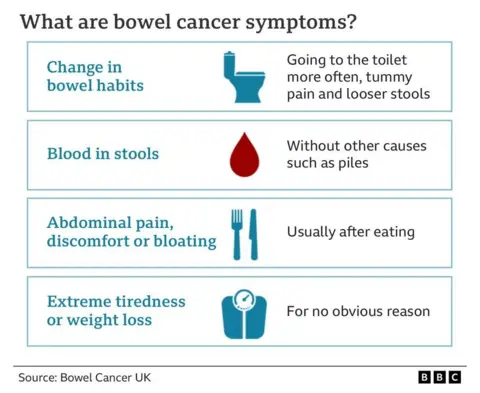
Over the course of her career Dr Fiona Fleming has told countless patients about the symptoms of bowel cancer to look out for - but that did not make it any less of a shock when she noticed them herself. After undergoing surgery she is now urging more patients to complete and return their screening test kits.
"That moment feels like the earth has sort of fallen out beneath your feet," the West Yorkshire GP said, recalling the moment she first noticed signs she may have a problem.
"You immediately think of all the worst-case scenarios that you have seen throughout your time.
"I can remember saying, 'it will be fine, I will drive there, I will drive back, it will all be absolutely fine.'
"And then, it was not."
Fleming was diagnosed with bowel cancer about 18 months ago, after undergoing a Faecal Immunochemical Test when she spotted blood in her poo.
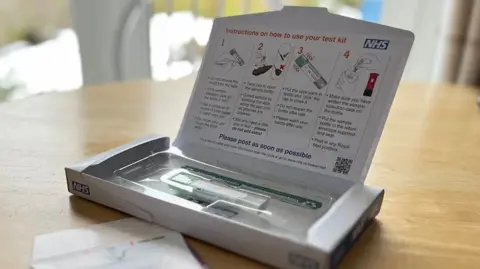
When she was diagnosed she was not in the correct age bracket to receive a routine bowel cancer testing kit.
But, last year, NHS England lowered the screening age for bowel cancer from 54 to 50, to help spot it before symptoms start.
"I was 53 at the time and in actual fact I received a bowel screening kit the day after I had my first chemotherapy so I just missed that," Fleming said.
All people aged between 50 and 74 in England will now receive a home-testing kit for bowel cancer every two years.
The screening kits are sent out by the NHS Bowel Cancer Screening Programme.
But not everyone sends them back.
'Screening saves lives'
Dr Stuart Griffiths, director of research, policy and impact at Yorkshire Cancer Research, said: "There is something deeply striking about Fiona's experience.
"It highlights why bowel screening is so important, and why it is concerning that around one in four people in Yorkshire do not complete their kit when invited.
"Screening saves lives by finding cancer at the earliest possible stage, and new ways of helping people complete their kits must be found so more people can benefit from this potentially life‑saving test."
Fleming said she had been trying to encourage uptake of the tests with her patients years before her own diagnosis.
"What I do not know is how much my letters and texts have made a difference," she said.
"I do not want to worry patients, [but] If you do not find out, you are never going to know and then we do not want people to be diagnosed too late."
Following her diagnosis she was enrolled in a clinical trial, funded by Yorkshire Cancer Research.
She had successful treatment after she joined the FOxTROT 3 trial, which investigates whether giving chemotherapy before and after surgery improves outcomes.
Urging others to make sure they take the test, she said: "I would absolutely encourage people to have the screening.
"I do not want people to always think, 'it will not be fine' but the whole point about reporting it to your GP or doing the test is to find out, is it not?"
Listen to highlights from West Yorkshire on BBC Sounds, catch up with the latest episode of Look North.