Former Iraqi PM Maliki denounces Trump threats to end support if he returns to power

 Reuters
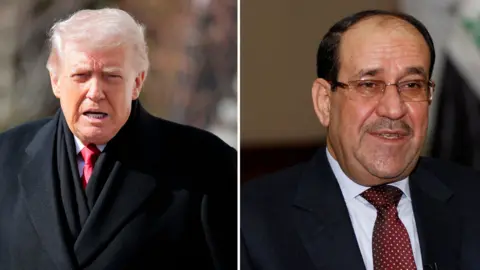
A former Iraqi prime minister has denounced threats made by US President Donald Trump to end US support for Iraq if he were to return to power.
Nouri Maliki, who has links to Iran, was selected at the weekend by the ruling coalition of Shia-led parties as its nominee for prime minister.
The US president wrote on Truth Social that Maliki would be a "very bad choice", adding: "Last time Maliki was in power, the Country descended into poverty and total chaos."
Maliki, whose time in office between 2006 and 2014 was marked by sectarian violence, stepped down after the Islamic State (IS) group seized large parts of the country.
In a post on X, Maliki rejected US interference in Iraq's internal affairs and said he considered the comments a "violation" of the country's sovereignty and its democratic order.
After being endorsed on Saturday by a Shia Co-ordination Framework, Maliki would then normally be nominated by the president, who holds a largely ceremonial role.
Iraq's parliament was set to elect a president on Tuesday but the vote was delayed after the presidential candidate could not be agreed on.
Influential Shia groups in Baghdad have varying links to neighbouring Islamic Republic, which is ruled by a Shia cleric.
Washington has voiced concerns about Iranian-linked groups deepening its influence in the region, including Iraq.
Trump said the country would have "zero" chance of success without US support after vowing to "no longer help" the country if Maliki was elected.
US Secretary of State Marco Rubio expressed concern about Maliki's links to Iran during a call with incumbent Prime Minister Mohammed Shia al-Sudani on Sunday, emphasising "that a government controlled by Iran cannot successfully put Iraq's own interest first".
Trump has frequently bucked precedent by intervening in other countries' elections, backing fellow right-wing candidates in elections in Poland, Romania and Honduras, where the US-backed winner was inaugurated on Tuesday.
Earlier this month, the American military seized then-Venezuelan president Nicolás Maduro in order for him to face trial in New York.
Maliki was a divisive figure during his two terms as prime minister.
He was Iraq's second prime minister after the US-led invasion in 2003, which led to the overthrow and eventual execution of Saddam Hussein, who had overseen a brutal repression of Shia Muslims and Kurds over three decades.
His sectarian approach and alienation of Sunnis and Kurds were blamed by many for precipitating the IS crisis.
In 2014, Iraqi security forces under his command collapsed as hundreds of IS fighters seized control of a large part of north-eastern Iraq, including the city of Mosul.
Three months later, Maliki was replaced as prime minister after losing the support of key militia and political leaders form his own Shia community and many outside powers, including Iran.