New ferry enters service as CalMac faces 'firestorm' of ship shortages

 CalMac
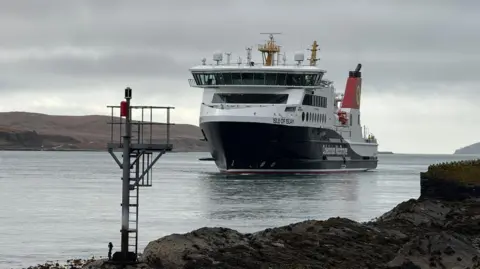
The first of four new CalMac ships built in Turkey has carried its first passengers, bringing some relief to the ferry operator as faces a "firestorm" of vessel shortages.
MV Isle of Islay sailed from Port Askaig on Islay, bound for Kennacraig on the Kintyre peninsula after its planned maiden voyage on Friday was delayed by a technical problem and "snagging" issues.
The state-owned ferry firm has been struggling to maintain services since last week, saying it is facing an "unprecedented" number of ships out of action.
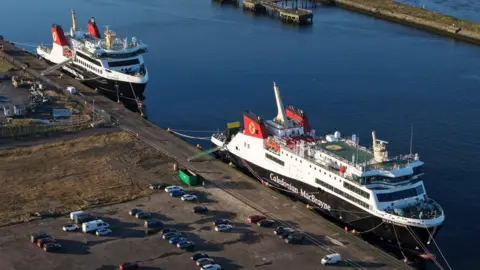
Five out of CalMac's 11 major vessels remain unavailable along with the chartered catamaran Alfred and two smaller ferries, either due to faults or scheduled maintenance.
MV Isle of Islay is 85m long and can carry 450 passengers and 100 cars or 14 HGVs.
It joins MV Finlaggan in serving the island, increasing the route's capacity by 40% when it is fully operational.
CalMac chief executive Duncan Mackison said MV Isle of Islay was a more powerful and capable vessel than many other ships in the current fleet.
He said: "MV Isle of Islay's first passenger sailing is a significant milestone for the people and businesses of Islay and Jura, who will now benefit from a significantly enhanced service thanks to a larger, more modern vessel on the route."
When asked about the ongoing disruption, he said the west coast ferry operator was in the middle of a "firestorm" and apologised for the impact on customers.
The service was making deployment decisions "almost on a daily basis" based on where the need was greatest, Mackison told BBC Scotland News.
"It's day by day, it's very difficult to run at the moment," he added.
"We have seven vessels out of service at the moment: I'm hoping we'll get the Glen Sannox back in by the end of this week.
"We have two other vessels that will come back into service from maintenance at the end of next week."
CalMac is trying to source parts in Europe for the other two ferries which are out for maintenance.
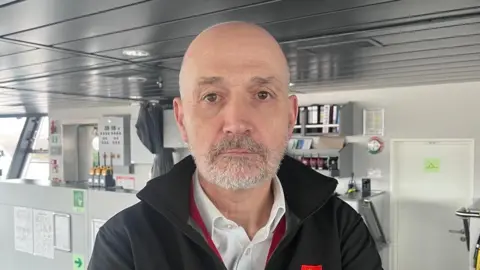
When asked why vessels had been taken out of service for maintenance during the breakdowns, he said the entire fleet needed to undergo servicing in a short amount of time during the winter months.
Mackison said a limited number of yards could be used for the process.
"We will look at that and we will look at lessons learned," he added.
"But we have to manage that process during that period of time and this is an unfortunate set of circumstances."
Services are expected to remain under intense pressure for the next week or so until more vessels are repaired or return from maintenance.
MV Isle of Islay was ordered from Turkey's Cemre shipyard four years ago and was originally due for delivery in late 2024, but a series of delays have been blamed on various factors including the war in Ukraine and the Turkish earthquake.
Three more of the "Islay-class" ships are due for delivery by the end of the year, with the fourth expected early in 2027.
 Christopher Brindle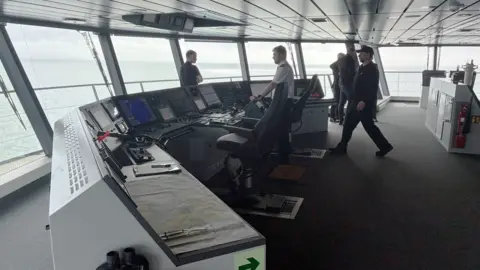
The new ships are smaller than CalMac's last new vessel, the dual-fuel Glen Sannox, and use a conventional diesel-electric propulsion system with some battery power available while manoeuvring.
But in other ways the new ships, ordered by ferries procurement agency CMAL, represent a significant departure in design terms.
The vessels have a deeper draught - the amount of hull below the waterline - than most CalMac ships, allowing for a sleeker, more fuel efficient shape. Dredging and other modifications have been required at some harbours.
They are also the first large CalMac ships fitted with Voith Schneider propulsor units - spinning blades that hang vertically from a drum - rather than traditional screw propellers.
Such systems, which do away with the need for a rudder, are already used on smaller CalMac ferries, making them highly manoeuvrable.
CMAL chief executive Kevin Hobbs said the ship's entry to service was a "clear demonstration of the progress being made to rejuvenate Scotland's ferry fleet".
CalMac ferries still out of action
Elsewhere, CalMac's west coast ferry network remains under pressure with some vessels now being switched to different routes to try to maintain services.
MV Isle of Mull has been redeployed to serve Coll, Tiree and Colonsay.
MV Clansman will operate a service from Uig on Skye to Barra, as well as Tarbert on Harris and Lochmaddy on North Uist.
Services from Lochboisdale on South Uist are suspended due to pressures on the network.
Passengers from Harris have been asked to travel via Stornoway to Ullapool where possible.
Four vessels under annual maintenance.
- MV Alfred (Due back 6 April)
- MV Loch Frisa (Due back 9 April)
- MV Hebrides (Due back 15 April)
- MV Isle of Lewis (Due back late May)
Four vessels with technical problems.
- MV Isle of Arran (Off since 25 March)
- MV Glen Sannox (Off since 26 March)
- MV Lord of the Isles (Off since 28 March)
- MV Isle of Cumbrae (Off since 30 March)