How seaweed is replacing single‑use plastics

 BBC
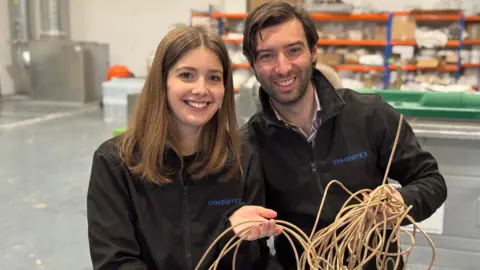
BBCIt was while working in a hospital that Olivia Simpson really noticed the blizzard of single-use plastics that surrounded her, all used once and then thrown away.
Either to be incinerated, damaging the climate, or to be buried in landfill and taking years to break down.
She said: "I thought to myself, why are we making devices to help our health, but which are actually detrimental to the environment and then form microplastics which impact us?"
Simpson was on a placement as part of her Medical Science course at the University of Wolverhampton, where she met Dr Mattia Parati and together they hatched a plan.
Their aim was to make a plastic from "a truly natural bio-based source". "One that has no impact or is even beneficial to the environment," she added.
They came up with the idea to use seaweed, sustainably farmed in South East Asia, as the basis for a completely compostable material capable of behaving like plastic but with none of the downsides.
An idea that is now a working business on an industrial estate in the Black Country.
It has not been easy, as Parati told me: "When you heat plastic up it flows, but for seaweed when you heat it up it burns, it doesn't melt."
Adding sugar helped to "plasticise" their seaweed material and was the breakthrough they were looking for.
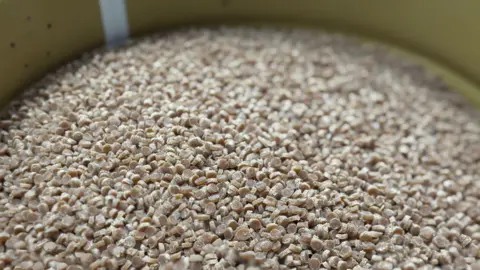
A powder containing the seaweed enters a machine where it is heated and extruded, turned into long spaghetti-like strands about the thickness of a pencil. These strands are then chopped into pellets.
What is really clever is, after 370 different attempts, these particular pellets can be dropped straight into the hopper of a standard injection moulding machine, producing any part you like, no longer made of plastic but compostable and biodegradable seaweed.
New formulations
Olivia showed my the office wormery, a plastic tub full of soil and worms where former coffee cups, golf tees and pregnancy tests are all breaking down in the earth.
"At the end of its life, our material can be home composted, it can go to landfill or incineration and we're not releasing that locked up carbon you have in fossil fuels," she said
Since seaweed is also used as a fertiliser, it could even help add nutrients to the soil as it breaks down.
The team are continually working on new formulations, introducing colours and even transparency to their seaweed based material.
In the offices of Symbiotex I saw all sorts of single-use plastic bits reimagined in the new material.
They included those weird triangles of plastic you get when unpacking flatpack furniture, and already a company is using this material for the casing of lateral flow tests.
Exactly the sort of single use-plastic Simpson saw in the hospital which inspired her in the first place.
Follow BBC Wolverhampton & Black Country on BBC Sounds, Facebook, X and Instagram.