Why was Andrew Mountbatten-Windsor arrested and what happens next?

 PA
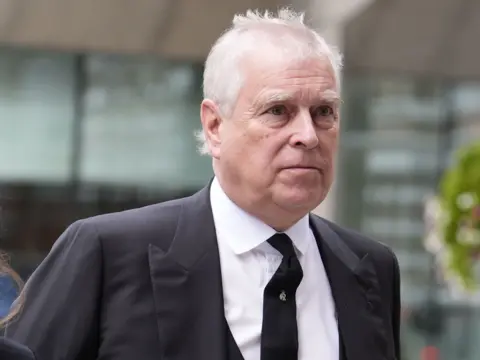
PAAndrew Mountbatten-Windsor was arrested on suspicion of misconduct in public office on 19 February.
The former prince was taken to a Norfolk police station for questioning, before being released under investigation.
Police are continuing to search his former Windsor home, Royal Lodge. A search of another of his properties in Norfolk has concluded.
The King's brother has consistently and strenuously denied any wrongdoing.
Why was Andrew Mountbatten-Windsor arrested?
Mountbatten-Windsor was arrested at about 08:00 GMT on 19 February on the King's Sandringham Estate in Norfolk, where he has been staying.
The arrest came after Thames Valley Police said it was assessing a complaint over the alleged sharing of confidential material by the former prince with late sex offender Jeffrey Epstein.
Officers arrested the King's brother on his 66th birthday. It was the first time the former prince, who has faced numerous allegations over his links to Epstein, had been arrested.
It is understood that neither the King nor Buckingham Palace was informed in advance.
We don't know the specifics of the allegations of misconduct in public office being investigated.
However, previously reported allegations include that he had shared reports from trade visits, forwarded a confidential briefing on investment in Afghanistan, and passed a Treasury briefing to a personal business contact.
It is possible the police investigation extends beyond the emails seen widely in Epstein-related documents published in the US.
Buckingham Palace has previously said it would support Thames Valley Police in their inquiries.
What does released under investigation mean?
 Reuters
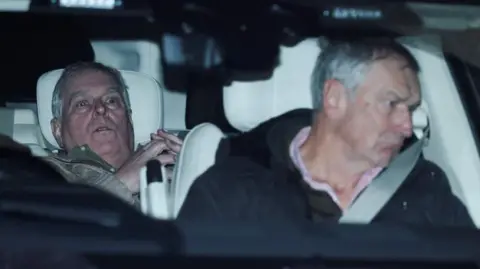
Thames Valley Police released Mountbatten-Windsor on the evening of 19 February. He was pictured slumped back in a vehicle as it left Aylsham police station.
Being released under investigation means he faces no restrictions and does not have to follow any conditions such as curfews or travel bans.
In keeping with normal procedures, he would have had his rights read to him on arrest. Upon his arrival at the police station, a custody sergeant would have been responsible for verifying his identity and ensuring he was in a fit state to be booked in.
Normal procedures may have been complicated by the fact Mountbatten-Windsor was probably accompanied by royal protection officers.
However, it is likely that police took his mugshot, fingerprints and a DNA sample, before taking him to his cell. These cells each have their own loo.
Andrew probably got two meals while he was in custody, given three meals are served in a 24-hour period. A recent inspection noted Aylsham Police Investigation Centre had more reading material than other stations.
It is not clear what legal advice he would have received while being held by police. Given his arrest came out of the blue, he would have had to decide whether to seek advice from the local duty solicitor while he waited for his preferred criminal lawyer to arrive, if he has one.
Typically with arrests relating to white collar crime, people are held for a few hours to allow for searches and initial questioning. Being released under investigation does not rule out further questioning at a later date.
At some point a decision will have to be made by the Crown Prosecution Service and Thames Valley Police about whether to charge the King's brother with misconduct in a public office.
It could be weeks before any substantial decision is made.
What is misconduct in public office?
Misconduct in public office is an allegation that someone knowingly did something seriously wrong while acting on behalf of the British public, writes BBC News home and legal correspondent Dominic Casciani.
There are four "elements" that police must establish to prove the crime has taken place.
First, police must show the person they're investigating was a "public officer" and the incident in question was plausibly part of those duties.
Secondly, police will investigate whether the suspect "wilfully" neglected to perform their duty or were wilfully misconducting themselves in some other way. That definition has long been a source of legal debate.
The next question is whether the action was "an abuse of the public's trust".
Lastly, police need to examine whether the person under investigation acted "without reasonable excuse or justification".
That final question is crucial. It's a fundamental principle of criminal justice that someone suspected of wrongdoing is given an opportunity to put forward their side of the story - and that starts when the police come and knock on their door.
Where have searches been carried out?
On the morning of 19 February, Thames Valley Police said that, in addition to the arrest, it was "carrying out searches at addresses in Berkshire and Norfolk".
Unmarked police vehicles were seen arriving at the Sandringham Estate in Norfolk before Andrew's arrest.
In an updated statement following Andrew's release, Thames Valley Police said its searches in Norfolk "have now concluded".
In recent weeks, Andrew has set up a temporary home on the estate while his permanent residence there, Marsh Farm, is being renovated.
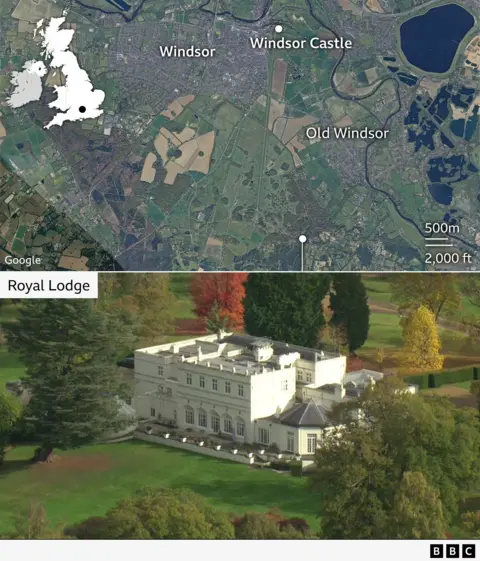
Meanwhile, police searches at Royal Lodge, in Windsor Great Park, are ongoing.
Until very recently, this sprawling property in Berkshire is where the former prince lived.
Dal Babu, a former Metropolitan Police chief superintendent, told BBC News that by arresting the King's brother, officers will be able to "to access computer equipment, files, photographs, any other evidence".
He said they will be able to "carry out searches of any premises he owns or occupies, or any other premises he controls, so there may well be searches in other areas as well".
Is Andrew Mountbatten-Windsor still in line to the throne?
The former prince is eighth in line to the throne.
However, there are so many other, younger royals in line ahead of him that it is near impossible he would ever become king.
Parliament would have to pass legislation in order to remove him from the line of succession.
This would require the support of all the Commonwealth countries that have King Charles as their head of state, as it would also affect their lines of succession.
Mountbatten-Windsor also technically remains a counsellor of state, who could stand in for a monarch who is ill or overseas.
In practice, only working royals are called upon to carry out those duties, but in theory he still holds that status.
On Monday, Australia's prime minister told Sir Keir Starmer that his government would "agree to any proposal to remove him from the line of royal succession".
In a letter, he added: "I agree with His Majesty that the law must now take its full course and there must be a full, fair and proper investigation.
"These are grave allegations and Australians take them seriously."
New Zealand would also back the change, according to a spokesperson for Prime Minister Christopher Luxon.
In a statement, the spokesperson said: "If the UK government proposes to remove Andrew Mountbatten-Windsor from the order of succession, New Zealand would support it."
What has the King said about the arrest?
The King said "the law must take its course", following the arrest of his brother.
In a statement the King said: "I have learned with the deepest concern the news about Andrew Mountbatten-Windsor and suspicion of misconduct in public office.
"What now follows is the full, fair and proper process by which this issue is investigated in the appropriate manner and by the appropriate authorities.
"In this, as I have said before, they have our full and wholehearted support and co-operation.
"Let me state clearly: the law must take its course.
"As this process continues, it would not be right for me to comment further on this matter.
"Meanwhile, my family and I will continue in our duty and service to you all. Charles R."
The BBC understands that the Prince and Princess of Wales support the King's statement.
Additional reporting by Ella Kipling