Republicans and Democrats reach funding package deal, US president says

 Getty Images
US President Donald Trump has said Republicans and Democrats in the Senate have reached an agreement to move forward with parts of a funding package.
Senate Democrats and Republicans agreed to a package of five spending bills on Thursday, but removed a sixth bill from the package related to funding for the Department of Homeland Security (DHS), the BBC's US partner CBS News reported.
Funding for DHS will continue at its current amount for two weeks while both sides work out a new deal to fund the agency, CBS News said.
US President Donald Trump endorsed the deal, and wrote in a post on social media: "Hopefully, both Republicans and Democrats will give a very much needed Bipartisan "YES" Vote."
The deal approves funding for the defence department, the health department, the treasury, the federal court system and other agencies until the end of the 2026 fiscal year on 30 September.
In his post Trump added: "Republicans and Democrats in Congress have come together to get the vast majority of the Government funded until September, while at the same time providing an extension to the Department of Homeland Security (including the very important Coast Guard, which we are expanding and rebuilding like never before)."
However, by Thursday evening, chances of the funding package's survival appeared to thin after Republican Senator Lindsay Graham called it "a bad deal".
His opposition was related to a provision that would repeal a law allowing senators to be compensated if they had their phone records seized in the 6 January Capitol riot investigations. That group includes Graham.
Another frustration in the package among Republicans - and a sticking point for Graham - is the absence of laws cracking down on sanctuary cities.
"I will not lift my hold on this bill until I get guaranteed a vote on my legislation that would criminalize the conduct going forward," he said on Friday afternoon, speaking to reporters on Capitol Hill.
Chances of the deal's survival before the midnight-Friday deadline also appeared to drop after it was announced that investigators from the FBI and DHS arrested former CNN host Don Lemon for his connection to a protest at a church in Minnesota.
"More reason for us to hold the line," Senator Chris Murphy, a Democrat, posted on X in reference to Democrats' frustrations with current DHS funding levels.
Democrats have been pushing to remove funding for the Department of Homeland Security (DHS) from a $1.2tn (£870bn) federal spending package since a federal agent killed a second US citizen in Minneapolis over the weekend.
The DHS is a sprawling department encompassing multiple agencies, including Immigration and Customs Enforcement (ICE), Customs and Border Protection (CBP), the Coast Guard and Secret Service.
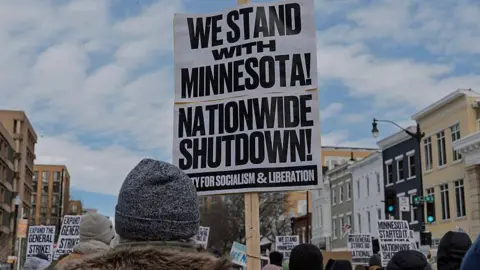
Thousands of federal agents from ICE and CBP have been deployed to Minnesota as part of the Trump administration's aggressive immigration crackdown in the state.
In Minneapolis, an ICE agent shot and killed 37-year-old Renee Good on 7 January, and a Border Patrol officer shot and killed 37-year-old Alex Pretti on 24 January. Both killings, and the ongoing immigration operation in the state, have sparked protests around the country. The second shooting led Democrats, and some Republicans, to push back on approving DHS funding.
Among the changes to DHS Democrats are seeking are requirements that federal agents obtain warrants before making arrests and clearer rules governing how they identify themselves.
On Wednesday, some Senate Democrats escalated their demands, expressly calling for DHS Secretary Kristi Noem's removal, and for structural changes to both ICE and CBP.
"This madness," Senate minority leader Chuck Schumer said. "This terror must stop."
Some Republicans pushed back, with John Cornyn of Texas saying that "any changes must not come at the expense of shutting down the government".
What happens next?
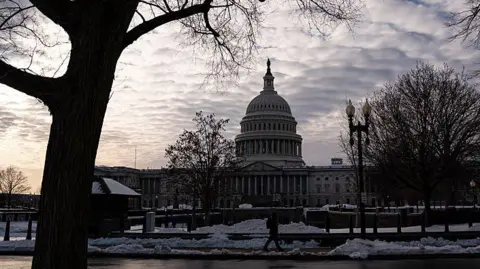
The spending bill had already passed in the House of Representatives, but in the Senate, it needs 60 votes to advance.
There are only 53 Republican senators in the 100-member body, meaning that passing the bill required support from at least some Democratic members.
Before the Senate reportedly agreed to remove the DHS bill from the package, a procedural vote to advance the budget failed in the Senate by 45-55 earlier on Thursday. All Democrats voted no, along with eight Republicans who said they were concerned about wasteful spending.
Earlier this week, Schumer said: "I will vote no on any legislation that funds ICE until it is reined in and overhauled, and Senate Democrats are overwhelmingly united on this issue."
Because the Senate removed the DHS bill from the six-bill package, the package now needs to be re-approved by the House, whose lawmakers are not due back until Monday.
That means funding for the departments included in the package could lapse over the weekend until the House convenes on Monday. The effects will be minimal though, as many government services do not operate over the weekend.
 Bloomberg via Getty Images
What is a 'partial shutdown'?
The entirety of the US federal government will not be hit by a shutdown if it does occur this weekend.
It would only be partial because legislation already was passed to fund dozens of agencies through the end of the 2026 fiscal year.
Other branches included in the same spending bill as DHS, are the defence department, the health department, the treasury and the federal court system.
The reported agreement between the Republicans and the Democrats would strip out the DHS from the funding bill, allowing Congress to pass the overall package of bills.
DHS funding would be extended for two weeks, giving negotiators time to reach an agreement on immigration tactics, according to the reported deal.
The DHS is a sprawling department encompassing multiple agencies, including ICE, CBP, the Coast Guard and Secret Service.
During a partial shutdown employees that are "essential" to the functioning of impacted agencies continue to work, but will not be paid until funding is restored - unless the government finds other sources - as Trump did with military personnel last year.
How long was the last shutdown?
The most recent shutdown lasted 43 days, between 1 October and 12 November last year, making it the longest in US history.
Democrats initially refused to support the funding bill, demanding that Republicans agree to extend health insurance subsidies for low-income Americans that were set to expire at the end of the year.
Eventually, enough Democrats crossed the aisle to help pass the bill.
That shutdown left around 1.4 million federal employees on unpaid leave or working without pay. Food aid was also left in limbo, and air travel was severely disrupted across the US.
There have been a total of 16 government shutdowns since 1981, although some only lasted days.