Robots trebled one warehouse's efficiency - what did it mean for jobs?

 Ben Schofield/BBC
Staff at Decathlon's Northampton warehouse used to walk more than six miles (10km) a day, picking items to send to stores or customers.
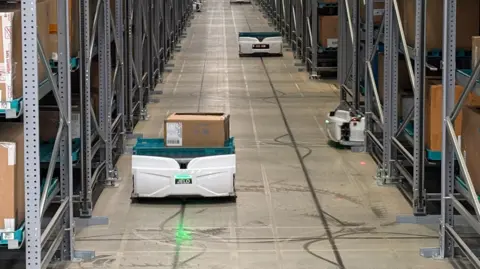
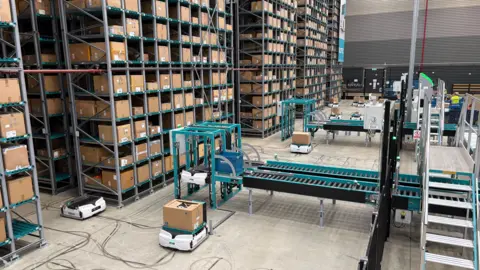
Now a fleet of 100 robots zips around, climbing shelves more than 12m (39ft) high and delivering stock.
The sports retailer says the set-up is more than three times as efficient – but that no-one lost their job due to the robots arriving.
Unions representing warehouse workers are more sceptical, with one representative saying the "ultimate aim of automation" was "to replace human workers".
 DJ McLaren/BBC
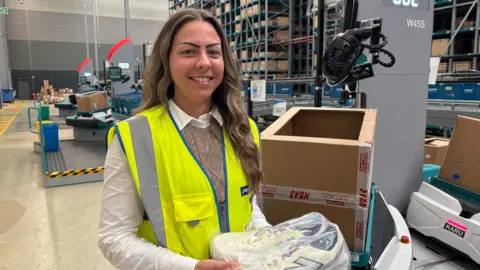
Standing at her "picking station" waiting for a robot to arrive, Diana Kovacs says "you can't help but grow fond of them over time".
On the rare occasions the system breaks down, Kovacs, 26, has "a little laugh about it – as if it's in a mood".
Kovacs has worked for Decathlon for about three years, arriving just before the warehouse was largely automated in 2023.
Now, about 75% of items going through the facility are handled by robots.
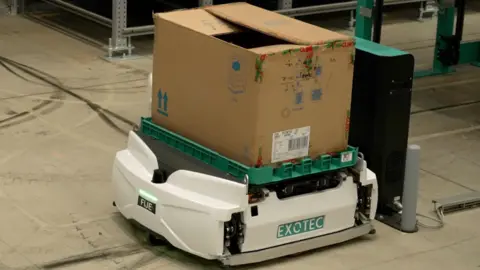
A stream of them brings Kovacs boxes of stock – maybe trainers, socks or sports equipment – and a screen tells her how many to put into each of four other boxes, heading to some of the company's 40 shops.
When she has handed out the right amount of stock, the robot leaves and another arrives.
Likewise, when the other boxes are correctly filled, they are taken away, ready to be put on a pallet, into a lorry and on to the road.
 DJ McLaren/BBC
The current system has a greater focus on "health and safety", she says.
Kovacs describes how workers would previously be on their feet all day, climbing ladders to collect boxes from high shelves, but that was "all taken away" by the robots.
The smaller motorised robots can reach speeds of nine metres (30ft) per second and climb the warehouse's shelves to retrieve stock. A separate robotic arm uses a suction pad to lift boxes up to 25kg (55lbs).
"It makes a massive difference to our backs – it's not that pain; you're not on your feet all day," Kovacs adds.
Automating the warehouse was "not necessarily about reducing [staff] numbers", she continues, but freeing up time for staff to "gain more skills" and become "more versatile".
 Alastair Bell
But the system has meant fewer people are needed on the warehouse floor.
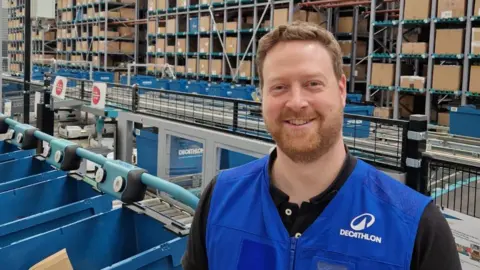
Alastair Bell, Decathlon's UK director of logistics, says the warehouse is "three times more efficient" since the robots arrived.
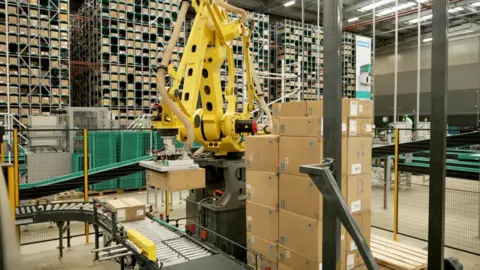
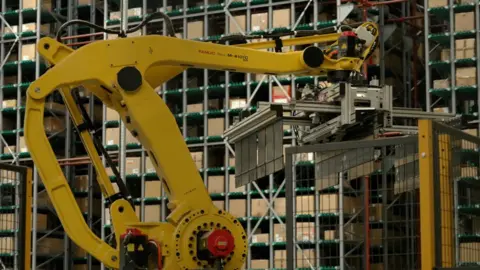
A robotic arm takes boxes off pallets and "injects" stock into the warehouse.
Bell, 39, says 12 to 24 people used to do this task, but now there are five or six.
 DJ McLaren/BBC
Another robotic arm lifts completed boxes on to pallets ready to head on to the road.
The system knows the layout of the company's shops and packs pallets so they can be efficiently unloaded.
The outbound team used to consist of six people per day; now it is one or two.
 Ben Schofield/BBC
The robots, guided by sophisticated sensors and GPS, know what stock is held at about 70,000 locations in a huge 3D grid of shelves.
Previously 50 to 60 people a day would be needed to pick 50,000 items, Bell says.
"Today, it's now 12."
But aren't the robots "job killers"?
Bell says while the company uses fewer staff in these roles, it has allowed those staff to be "upskilled" into other areas, such as retail, customer services and workshop repairs.
"And in reality, yes, it's a job," he says.
"Is it an engaging job? Is it a thrilling job? It's really about how we can enhance and enrich our teammates and the environment around them."
Bell says a "circular economy hub" used to employ five people but now has 12.
They work on prolonging the life of products, such as buying back bikes and reconditioning them for resale.
 Ben Schofield/BBC
Steve Garelick, who specialises in artificial intelligence and automation for the GMB union, says he finds claims about no job losses from automation "fanciful".
"When you have a warehouse that is primarily automated, you're stripping out the workers," he says.
While he says the consequences of automation have so far been "very limited", he fears "we are sleepwalking into a situation where many, many individuals are going to be losing their jobs".
 Ben Schofield/BBC
That could have a big effect on places like Northamptonshire, which mostly falls within the logistics "golden triangle", defined as being within a four-hour drive of 90% of the UK population.
Tony Bellot, a senior lecturer in logistics at the University of Northampton, says just over 10% of all jobs in Northamptonshire revolve around logistics.
Logistics UK says the industry is worth £170bn and employs 8% of the nation's workers.
Bellot remains optimistic about the impact of automation on jobs.
While there has been a significant shift away from manual tasks, he says, businesses are looking for staff with "analytical skills" and a "digital understanding".
Artificial intelligence, he adds, would allow companies to plan more accurately and "drive out waste".
 Ben Schofield/BBC
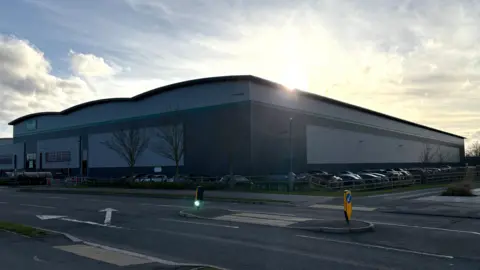
About 20 miles (32km) north of Northampton, just off junction 18 of the M1, Daventry International Rail Freight Terminal (DIRFT) is home to six million sq ft (560,000 sq m) of warehouses and 10,000 logistics jobs.
The site recently held a ground-breaking ceremony for a new Arla Foods warehouse.
Fran Ball, Arla's senior vice president of supply chain, says it chose DIRFT because it is "in the centre of gravity of where our customers are" and would make "distribution more sustainable".
The fully automated warehouse will be run by logistics company XPO.
About 400 jobs will be created at DIRFT but it is unclear what will happen to those at an XPO-run warehouse in Hatfield, Hertfordshire – which supplies Arla – and another Arla facility in Stourton, Leeds.
 Ben Schofield/BBC
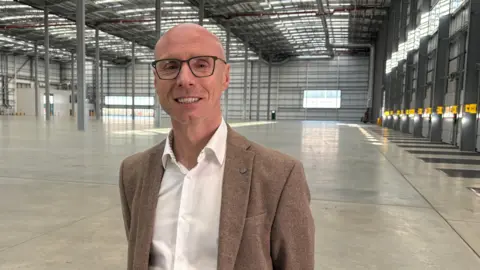
XPO's UK managing director Dan Myers says it will have "next generation automation", including robot-like "shuttles".
Jobs in logistics are becoming "more and more technical", he says.
"The skill required, the level of education required, are becoming much, much higher," he adds, but says he is "absolutely confident" XPO will "continue to grow employment" and that entry-level positions will still exist.
Phil Oakley, senior vice president of DIRFT owner Prologis, says he does not think the number of workers on the site will reduce.
"We see the number staying the same, maybe increasing – but automation will help with getting these buildings more efficient," he says.
 DJ McLaren/BBC
But what is the biggest challenge of relying on robots in a warehouse?
According to Bell from Decathlon, it's their fixed capacity.
If the site sees a "huge spike" in demand, for instance, he can't expect them to respond.
"I can't ask them to work overtime – I can't ask them to do me a favour," he says.
Follow Northamptonshire news on BBC Sounds, Facebook, Instagram and X.