New adverts urge boys not to share sexist content online

 Scottish government
The Scottish government has launched a new advertising campaign urging boys and young men not to share misogynistic content online.
The adverts warn boys that sexist content is "never harmless" and has the potential to hurt girls, including people they know.
They will run for five weeks from Monday across Instagram, Snapchat, Twitch and YouTube, as well as on outdoor advertising.
First Minister John Swinney said the rise of online misogyny was "deeply concerning" and that ministers would do "everything we can" to eradicate violence against women and girls.
The campaign was developed with the charity White Ribbon Scotland - which attempts to engage men and boys in preventing violence against women and girls.
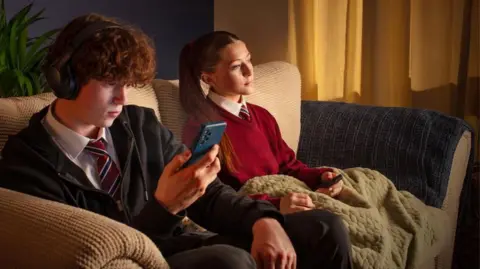
One of the video clips shows a boy sitting on a couch, watching a video on his phone of a character speaking into a podcaster-style microphone.
A voiceover says "sexist content is never harmless, it hurts girls in real life - including the ones you know" as the emojis on the boy's phone all change to become the face of an upset girl, resembling the person sitting next to him on the couch.
Rebekah MacLeod, a project lead for White Ribbon Scotland, said the campaign was not about punishing men but educating them on the impact of sharing sexist content.
MacLeod told the BBC's Radio Scotland Breakfast programme: "It really is about urging men and boys, especially boys aged between 11 and 18 to avoid sharing misogynistic content.
"A huge part of that is the belief that our online behaviour doesn't always reflect real life.
"The campaign is about tying up that disconnect and showing that there are real life consequences for your actions."
She explained that a lot of boys and young teenagers do not understand the content they are viewing online, but feel pressure from peers to get involved.
"It's not about blaming men and boys for violence against women and girls, especially on the whole spectrum," she said.
"What we are trying to say is they hold so much power in their words and actions. By confronting their peers or telling their peers this kind of content is not suitable and that it can contribute to violence against women and girls.
"They listen to their friends, and are a captive audience, so this is really important."
'Dangerous' manosphere content
MacLeod said the charity had noticed that boys were being easily drawn into looking at 'manosphere' content - websites, blogs and forums which promote potentially harmful ideas about masculinity - even without searching for it.
She said: "You just have to look at some of the content that comes out of the manosphere to see how damaging the content they are viewing is.
"A huge part to blame for that is the algorithms and social media. By engaging with it, it ends up on more boys' social media.
"What we are seeing at the moment is they can start looking at something quite innocent - for example, 'how to get a girlfriend' or 'how to get fitter' - that becomes something really misogynistic through this manosphere content which is really dangerous."
The campaign also includes information aimed at parents about the scale and impact of misogynistic content.
It is hoped this will support parents to have conversations with young people who may become caught up in it.
John Swinney said: "By choosing not to like, share or comment on sexist content online, boys and men can help stop it spreading.
"Ensuring equality for women and girls, and protecting them from harm, is central to building a fairer Scotland.
"Violence against women and girls in all forms – including online – is completely unacceptable, and the Scottish government will continue to do everything we can to eradicate it."
The Scottish government had promised to bring forward legislation to criminalise misogyny before the next Holyrood election, but this was dropped last year.
A bill had long been promised to improve protections for women and girls, but ministers said there was not enough time to draw up a law which reflected last year's Supreme Court judgement on the definition of a woman.