Sombr stopped a show over safety - but are concerts in the UK really that risky?

 Getty Images
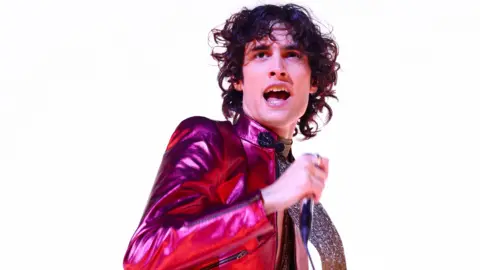
"Alright, stop the show, guys, there's someone passed out over here," said the US pop star Sombr, bringing his sold-out show at the Brixton Academy to an abrupt halt last week.
But after flagging the fan to security staff, the singer became impatient at what he saw as a lack of urgency.
"This is the most poorly managed venue I've ever played at in my life," Sombr said. "It's insane. Safety comes first."
Luckily, no-one was hurt.
According to the venue, CCTV footage showed that staff, including a medic, reached the fan less than a minute after they had passed out. By that stage, they were already back on their feet and responsive.
But the episode made headlines around the world - especially because Brixton Academy was the scene of a fatal crush in 2022, when a large crowd gathered outside the venue and tried to force their way in, resulting in two deaths.
Lambeth Council, which suspended the venue's licence after those fatalities, told BBC News it was aware of Sombr's comments and was "liaising with the Metropolitan Police... to determine what action is needed".
Any safety breaches would be taken "seriously", a spokesperson added.
The Academy Group, which runs the Brixton venue, said an internal review of Sombr's three night residency found there had been "no serious incidents".
But the singer's intervention is part of a growing trend.
In 2022, Billie Eilish stopped a headline show at London's O2 Arena to demand that security guards passed water to fans.
The same year, Harry Styles paused during a performance in Colombia because fans in the front row were telling him: "We can't breathe."
Taylor Swift, Chappell Roan, Adele, Stray Kids, Busted, A$AP Rocky, Lady Gaga and Playboy Carti have all taken similar action.
Industry experts say artists have had a heightened focus on safety since the 2021 Astroworld festival in Houston, where overcrowding led to the deaths of 10 people.
The rapper Travis Scott, who headlined the event, received particular criticism for failing to stop the show - although he claimed he was unaware of the unfolding tragedy.
Since then, there has been a measurable increase in "artists voluntarily choosing to interrupt their own performances," according to the 2023 European Festival Report.
A problem occurs, however, when musicians criticise the very people who are there to help fans in distress.
 Getty Images
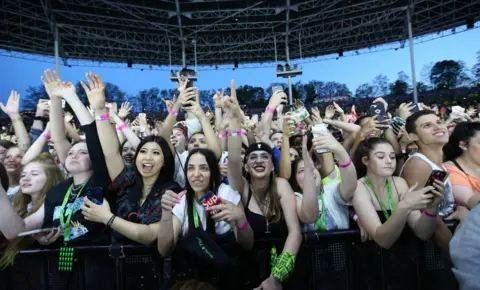
"A fundamental principle is that, to ensure a safe event, the safety staff and the audience have to see themselves as part of the same community," says Prof John Drury, a psychologist specialising in crowd behaviour at the University of Sussex.
"If audience members are told that staff are not acting in their interests, then they're not only going to stop listening, but they might be actively hostile and confrontational towards those staff.
"That's not conducive towards safety."
'Disruptive' audiences
Complicating things further is a change in fans' behaviour since the Covid-19 pandemic.
Audiences have become increasingly disruptive, and less co-operative, says Drury.
Professionals have observed "more volatility, impatience, and sometimes a loss of the unspoken 'crowd rhythm' developed through shared experience," agrees Anne Marie Chebib, chair of the UK Crowd Management Association (UKCMA).
"Whether those shifts persist is still unclear, but crowd behaviour will keep evolving."
 Getty Images
Thankfully, attending a gig in the UK is relatively risk free.
A study of medical interventions at the 2022 Glastonbury Festival showed that the most common injuries were joint injuries like sprained ankles, followed by blisters and gastrointestinal conditions (intoxication, surprisingly, came fourth).
The scenario every concert safety manager fears is a crowd collapse - where people surge forward and fans get trampled underfoot.
Such incidents are rare, but they're devastating.
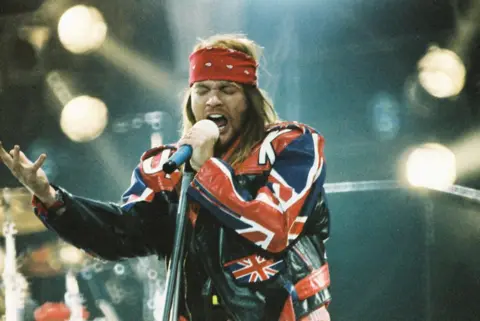
In 1974, a stampede at a David Cassidy concert in London was so traumatic that one medic said the scale of the injuries reminded him of the Blitz. Five hundred were injured, and a 14-year-old girl, Bernadette Whelan, tragically died in hospital four days later.
A crowd collapse involving 50 people also claimed two lives at the 1988 Monsters of Rock Festival at Castle Donington.
Those deaths led directly to the creation of new safety guidelines - known as The Purple Guide - that covers everything from site design and barrier systems to the care of lost pets.
Constantly revised and updated, the guide has made "the UK one of the leading countries in the world on safety", says Steve Allen, founder of the event management consultancy Crowd Safety.
 Getty Images
With more than 35 years' experience, Allen has been head of security for artists including Oasis, Eminem, Shakira, Red Hot Chili Peppers and Led Zeppelin.
In the 1990s, he developed what is known as the "show-stop procedure" - a rapid, co-ordinated response to crowd surges that can bring a concert to an immediate halt.
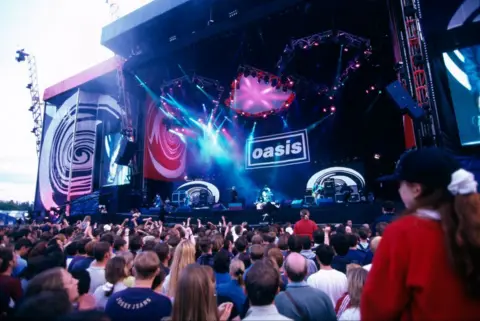
The system was designed during Oasis's 1997 Be Here Now tour.
"I was well versed with dynamic crowds but Oasis was a completely different beast," Allen recalls.
"Their crowd profile was off the Richter scale, and it was very apparent to me that we need to have something in place."
The procedure seems obvious now, but it established a chain of command that had previously varied from venue to venue.
For the entire tour Allen stood at the safety barriers, maintaining radio contact with his team and never leaving the band's line of sight.
"I told Noel and Liam: 'If I give the sign, there's a reason to stop the show. It means this is life-critical - I'm not doing it to spoil your night'," he later recalled.
It proved crucial at Manchester City Stadium in 2005.
As Oasis played the opening bars of Lyla, the crowd rushed forward and a safety barrier cracked.
Footage of the concert shows people being lifted off their feet and carried along in a wave of bodies that hits the barrier then reverberates back through the audience.
"In the control tower, they had CCTV and everything, but they couldn't see what we could see [on the ground]," says Allen.
Thanks to the show-stop system, "we had safety spotters who were able to radio the tower, and we stopped the show", he says.
Immediately, the stage lights went off, a floodlight illuminated the audience and all audio was cut, except for Noel Gallagher's microphone, allowing him to calmly explain the situation before the band left the stage.
Some 25 minutes later, after the barrier was repaired, Allen gave the go-ahead for a restart.
"The band had full trust in my decision. Everything was safe, no injuries, no deaths. Everyone went home safely, reputations intact."
 Getty Images
Allen has only used the procedure 32 times - "rest assured, we will not stop the show for a bee sting" - but it is now becoming the industry standard.
That's thanks to the Pink Bows Foundation, which was created in memory of 23-year-old Astroworld victim Madison Dubiski.
Her family decided to take action after a police investigation showed that the lack of an established communication chain had contributed to the tragedy.
"Astroworld highlighted the need for clear, rehearsed procedures that empower teams to pause or stop a performance when safety is compromised," says UKCMA chair Chebib.
"In the UK, we've had our own sobering reminders of how critical planning and co-ordination are. The [2017] Manchester Arena bombing revealed gaps in multi-agency preparedness. The Brixton Academy fatalities raised hard questions about access control and venue management.
"Across all of these events, the consistent themes are failures in communication, in situational awareness, and in understanding what crowds actually do under pressure."
As a result, Pink Bows has incorporated the show-stop procedure into a comprehensive training programme for live event organisers, with the aim of creating an international standard for crowd safety.
At venues where the plan has been implemented, the "incident response time has been reduced from minutes to seconds", says Allen.
In the UK, event organisers will also have to plan for and mitigate the risk of terror attacks, under Martyn's Law - named after Manchester Arena victim Martyn Hett - which takes effect in April 2027.
But, as Sombr realised, artists are often the best positioned to spot emerging dangers.
Allen says that can only be a good thing.
"I think it's very important that artists take the safety of their fans seriously," he says.
"Because let's face it, if I walk on stage, push the artist out the way and stop the show, I'm going to get bottles of yellow liquid thrown at me."