Is better training the answer to dog attacks?

 Getty Images
Dog bites are on the rise, according to police statistics, so what can be done to curb the problem? A victim of an attack, a trainer of aggressive dogs, an animal rescue charity and a researcher from the University of Lincoln offer their views on the way forward.
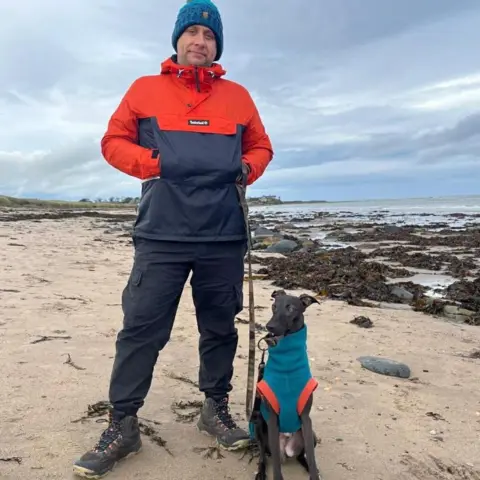
When a dog "clamped on" to his leg and would not let go, Corey Nobbs says he had "never felt pain like it" in his life.
The keen rugby player from Goole, East Yorkshire, was walking his whippet when a bull-type dog, which was on the loose, set on him.
"I genuinely thought at that point, if he rags me down to the floor, I don't know what's going to happen," he recalls. "I think the screaming and the shouting is what scared it off."
The 32-year-old was left black and blue, with bite marks and severe bruising to his thigh.
 Corey Nobbs
And while he was given treatment and antibiotics at Goole Hospital, he says the experience is likely to stay with him for the rest of his life.
"There's the mental side, thinking if I take my dog out today is it going to happen again?
"An hour or so later and you've got the school down the road. If that dog had have got hold of a child, I wouldn't like to think about what could have happened. It could have been horrific."
Nobbs adds: "It gives you that thought about should dogs be licensed, should people have a licence to have a dog? Maybe there should be vetting checks in the future.
"It does make you think, if you're not fit to have a dog like that, you shouldn't be having a dog in the first place."
 Corey Nobbs
Humberside Police said a bull dog cross and an Akita-type dog had been seized in connection with the incident on 26 January. Officers were investigating reports that another dog had also been seriously injured.
There were 31,920 dog attacks on people recorded in England and Wales in 2024 - a 2% increase on 2023, according to Freedom of Information figures obtained from police forces.
In Lincolnshire, there have been 2,550 attacks over the past five years.
Statistics provided by Lincolnshire Police also show incidents rose in 2025, to 749 from 637 the year before.
Trainer Pamela Dempsey, who is based near Grimsby and deals with aggressive dogs, believes too many owners are failing to set proper boundaries for their pets.
"When there's no discipline, no boundaries, that's when we get problems," she says.

She believes a move towards force-free or "positive reinforcement" training has led to more issues with dog aggression.
"When they do anything wrong, owners are told not to correct them or to bring any consequences, and that's not bringing up a balanced dog.
"Dogs don't just need love and affection and cheese, they actually need boundaries and discipline and exercise, more than they need the love."
The Dogs Trust argues a range of issues need to be addressed to reduce incidents of biting, including irresponsible breeding and a lack of education.
The charity, along with the RSPCA, advocates "positive reinforcement" training, which involves rewarding dogs for good behaviour with treats or praise and doesn't involve punishment or "aversive" methods.
Kris Glover, the head of clinical behaviour support and development at the Dogs Trust said: "The problem is that when we're punishing behaviour that we don't like, we're not understanding why they're doing it in the first place.
"In a lot of situations, we haven't taught the dog the behaviour that we want from them.
"When telling a dog off for jumping up, have we actually taught them not to jump up and what we could be rewarding them for instead?
"With positive reinforcement, it encourages dogs to make the right choices."
She adds: "As soon as we start using punishment-based methods, like shouting or physical correction, it doesn't build that understanding and can actually increase stress, fear or long-term behavioural problems in dogs."
'Look at the owner'
Academics at the University of Lincoln and Bishop Burton College, near Beverley, have been carrying out research into the causes of dog aggression and developing a tool to help professionals identify dangerous dogs.
Ann Baslington-Davies, who works for both institutions, has spent five years assessing why some dogs behave aggressively.
"Aggression in any species is multi-faceted. Trying to pin down one single thing that's going to cause an aggressive response is futile," she says.
"At the moment, when we think about aggression in dogs, we tend to place all the blame on the dog.
"You have to look at the owner, you have to look at the circumstances that the dog is living in, what experiences has that dog had."
When it comes to training dogs, Baslington-Davies says consistency is important.
"One of the risk factors we identified through our research was a lack of consistency.
"So if sometimes your dog is encouraged to get on the sofa, and then other times you tell him off for getting on the sofa, that's confusing.
"That leads to frustration, and frustration can be a cause for aggression."
She adds: "In terms of being gentle with your dogs, I don't think that's an issue.
"I don't think punishment, in terms of things that the dog will find fearful, or intimidating, or painful, has any place.
"The research suggests that those sorts of approaches are likely – not absolutely certain, but likely – to potentially increase an aggressive response."
Listen to highlights from Hull and East YorkshireorLincolnshireon BBC Sounds, watch thelatest episode of Look Northor tell us about a story you think we should be covering here.
Download the BBC News app from the App Storefor iPhone and iPad orGoogle Play for Android devices