'Me and my guide dog have to walk in the road because of selfish parking'

 Jessica Bayley/ BBC
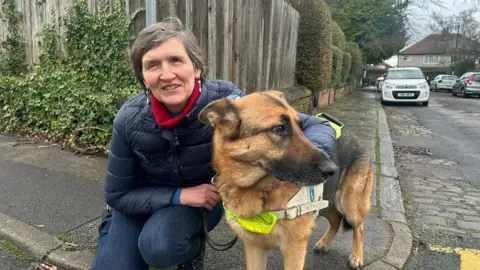
"Luckily I have not been hit by a car but it is very stressful", says Anna Lawson, a guide dog owner living in Leeds.
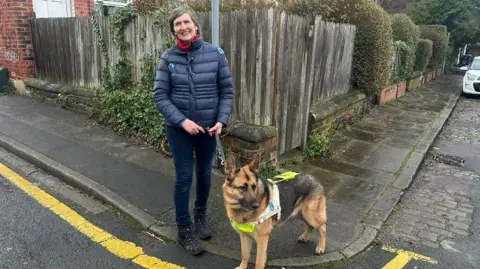
For Lawson, who is blind, this is the reality of a walk to the shops with her companion Finn, an errand made more dangerous by parked cars blocking the pavements.
Lawson is often forced to walk in the road to get around them, which she feels is unsafe.
"On a windy day or a noisy day you cannot really hear if there is traffic coming, so you are stuck in the road and have the dog, which I feel is less visible than me so I am worried about him as well.
"So it is really quite stressful having to go out into the road to get around them."
But that could be about to change, with councils across England due to be given more extensive powers to fine motorists who cause disruption by parking on the pavement.
"It will make a big difference to me just to be able to say to somebody 'this is a problem, please do what you can about it', rather than having no right to do anything about it."
Inconsiderate parking also presents obstacles for wheelchair users or those with children in prams and pushchairs.
"When you are being guided by a dog you are not quite sure how far away you are from the edge of the cars that are parked, or how far into the middle of the road," adds Lawson.
Pavement parking is currently banned outright in London and Scotland but councils elsewhere in England will soon be able to introduce restrictions for specific streets.
The aim is that wider enforcement powers will make it easier for local authorities to tackle the worst examples of disruptive parking.
'Revolutionary'
Adam Marsh, regional policy and campaigns manager at the charity Guide Dogs UK, wants this change to be a step towards the end of pavement parking.
"If we can consign pavement parking to the history books, it will be revolutionary for people with sight loss.
"Being able to walk out of your door and know that you are going to be able to navigate your local area or get to work without obstacles, it is a lot of the things that a lot of us take for granted."
Anna is a professor of law at the University of Leeds, and hopes her future walks to work will be less stressful.
"It does affect where I go, I will not go on certain routes now because I think it is too risky, so it definitely has an impact."
 Jessica Bayley/BBC
According to research from Guide Dogs UK, one in five people with sight loss has been injured as a result of a vehicle parked on the pavement.
That figure includes Lawson, whose cane once become stuck under a car's tailgate, causing her to fall and cut her knee.
"If you have been injured once, the physical recovery is one thing, the emotional recovery is quite a different thing and you can really lose your confidence."
Marsh says that pavement parking is more than just an inconvenience for people with sight loss.
"We've heard examples of people coming missing appointments, being late to work because of having to take longer routes, not to discount the actual danger of potentially having an incident whilst navigating around pavement parked cars."
The new powers are due to take effect later this year, alongside guidance on how the rules can be enforced in a "proportionate" way.
Listen to highlights from West Yorkshire on BBC Sounds, catch up with the latest episode of Look North.