'Doncaster was a 90s party town until its HIV crisis,' says playwright

 Marc Brenner
In 1997, Doncaster was one of the night-life capitals of Britain. The Clubland classic Children of the Night was a smash hit, belting from the sound systems of Visage in Silver Street and Karisma in Duke Street, week in, week out.
But not long afterwards, the city was hit by the UK's first heterosexual AIDS cluster – when 10 people were infected with the disease.
The local health authority issued a press release warning about a rise in cases of HIV and pointing the finger at the local nightclub scene.
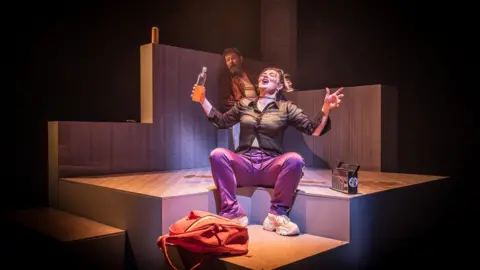
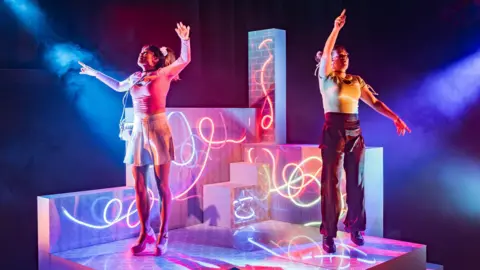
Nearly two decades later, writer and actor Danielle Phillips has created a theatre show inspired by the testimony of 30 people from Doncaster.
Stage play Children of the Night follows Lindsay Jenkins, a young woman in the city who loves the local rave scene.
Phillips says the popularity of club culture in the city was about "escapism" and a "hedonistic need".
"People really wanted to go out and forget everything and be whoever they wanted to be on the dance floor and there was real freedom I think in that," she says.
"When people look back on it there's this sort of rose-tintedness and there's always going to be a dark side and there's always going to be a danger and responsibility and I think there was such a sexual freedom and liberty that was both, you know, enjoyed and then also exploited. And so it was a complex time."
Not long after the public health warning, The Doncaster Star broke the story that a man named Steve Robson, a nightclub bouncer, had supposedly infected several women.
Reportedly, Robson got HIV a decade earlier while living in Amsterdam. Apparently he did not know he was infected until a routine blood test in 1996 revealed the virus and the infected women had been partners prior to 1996.
 Marc Brenner
Phillips says it caused "a lot of fear" for women who frequented the city's pubs and clubs.
"It was just really, really scary, I think, to be a young woman in that time where you were suddenly watching the telly and Spice Girls were wearing what they wanted, and there was this sort of feeling of, hey, we can wear what we want and go out and dance how we want.
"And then this thing happened that sort of jeopardised a lot of that initial freedom. So it was a really complex and scary time for Doncaster."
The health authority set up a helpline, staffed by 120 workers, for concerned women and local nightclubs, which received more than 2,000 calls, she says.
While writing the play, Phillips spoke to many people who remembered the club culture, but they were reluctant to speak about the outbreak.
"My personal politics are that silence kills and that if we don't talk about HIV, then we're never going to continue to combat it long term. But there's a sort of feeling that was better left unsaid," she says.
Jane Whitham was working as a journalist on The Doncaster Star in its office on Duke Street when the story broke.
Ten cases of HIV had been identified, twice the national average at the time. She was 26 and also going out clubbing.
When Robson's involvement became public knowledge, national newspaper journalists swarmed to the town she says – and "it was hysteria".
"HIV was still a big deal, now people take PREP (pre-exposure prophylaxis) but back then it was like if you get this then you're going to die," she says.
Whitham tried to get Robson to speak, putting letters through the door at his ex-council house, and trying to talk to him through the curtains.
In the end, he sold his story to the Daily Mail.
"He started bragging about it, he said he had slept with 1,000 women," she says.
"Doncaster was a party town. It was nuts. There was one pub after another, after another. It did affect the night-time economy. It was a stain on Doncaster's character."
A decade later, the story came back to Whitham in an unexpected way.
"I moved to Penistone," she said.
"The woman who lived next door was a former director of public health at Doncaster and we were on either side of it. When we talked about it, she said 'you were my nemesis'."
Children of the Night is on a national tour across England, with performances at venues including CAST, Doncaster and Hull Truck theatres.
Listen to highlights from South Yorkshire on BBC Sounds, catch up with the latest episode of Look North