Mum who gave up job to care for disabled daughter 'can't afford to eat breakfast'

 BBC
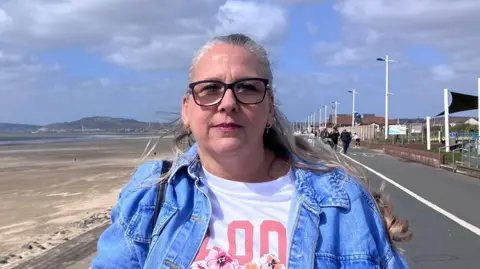
BBCA mum who gave up work to care for her disabled daughter who needs constant supervision says unpaid carers feel "used" and have to "fight for everything".
Michelle Rees, 45, from Crynant, Neath Port Talbot, said the carer's allowance she received left her unable to afford to eat breakfast.
A Senedd health and social care committee report found more than 300,000 people in Wales provided unpaid care, but there had been "little improvement" for them since 2019.
The Welsh government said it "highly valued" the role unpaid carers played and "recognised the pressures many experience". The UK government, which provides the allowance, has been asked to comment.
An unpaid carer is anyone who cares for a friend or relative who could not cope without their support, but does not receive a professional salary.
The Senedd committee's report found 310,000 people in Wales – or one in 11 - provided unpaid care as of March 2024, but only 4,924 had a support plan in place.
Some carers waited months for an assessment with no services available at the end of the process, the report added.
It made 35 recommendations to the incoming Welsh government, including making it easier for doctors, health and social workers to identify unpaid carers and providing more support for young people.
"Unpaid carers have shouldered heavy burdens for too long and the evidence is clear - Wales must do far better by those at the heart of our care system," said committee chair Peter Fox MS.
'I've had to fight for everything'
Michelle cares for her 23-year-old daughter Alicia, who has a learning disability and a rare form of epilepsy.
Alicia can have thousands of seizures every day and the condition means she needs constant supervision.
She also cares for her parents who are in their 70s, as well as her sister and her nephew.
"People say they appreciate unpaid carers, but we don't feel appreciated, we feel used," said Michelle.
"Our love is used against us, because we love the people we care for, we give them our time.
"I gave up work to care for my daughter but every system I've come across, I've had to fight for everything she's entitled to and everything she needs and everything I need to keep her alive and safe in the home."
Michelle said she spent more than 90 hours a week caring - the carer's allowance is £83.30 which is available to anyone who provides at least 35 hours of care a week.
"I don't have breakfast because I can't afford breakfast. I have one meal a day," said Michelle.
"With the cost of living, the price of food, petrol, gas and electric. It's dire. There's no money left."
The report said carers' physical and mental health was deteriorating - some report isolation, burnout, and suicidal thoughts. It found that respite care was "non existent" in parts of Wales.
Michelle said the Welsh government needed to put pressure on the UK government, which makes decisions on the carer's allowance, to help support people in Wales.
"Don't say you appreciate - recognise us," she said.
'Many young carers don't know they are one'
 Albie Sutton
The committee report also found that younger carers were missing out on education, struggling with anxiety, and losing opportunities for work and a social life.
Albie Sutton, 17, lives in Denbighshire and has been caring for his mother Helen since he was 11 years old.
He helps with physical care for his mum, as well as supporting his dad with things such as cooking dinner and cleaning the home.
"As a young carer, it's not something you're taught to do and then you do it," he said.
"You're just sort of thrown into the deep end or you start off small and then it gets sort of more and more demanding."
He said he was "very busy" trying to balance caring with studying his A-levels, as he hopes to become a nuclear physicist, as well as supporting other young carers.
He chairs the Young Carers Advisory Board for Wales, which contributed to the report.
"There are thousands of young carers that are in my position that don't have access to a break or don't have much access to support, whether that's financially or emotionally or even just having a break from your caring role," he said.
He said the Welsh government should implement a "uniform approach" in schools so young carers, no matter where they are, were supported.
His mother Helen said: "I feel really bad because he's only 17 and he's been doing this since he was 11.
"He's not a child but he shouldn't have to have this on his shoulders."
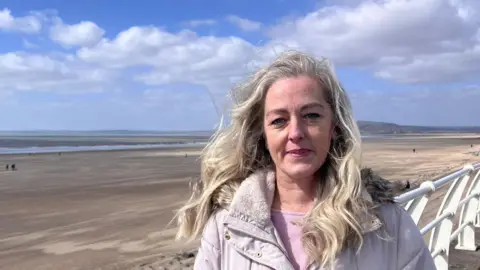
Jo Phillips, from Swansea, cares for her 22-year-old son who has debilitating OCD and autism.
She also supports other carers trying to negotiate the health and benefits system.
"We're exhausted," she said.
"We're not exhausted from our caring roles, the exhaustion comes from dealing with professionals, or social care, health, education. Parent carers I think have got it the hardest."
She said local authorities should be held accountable for carer assessments.
"The whole system would collapse [without us]," she added.
"I've got to keep going because without me, what happens to my son? There is no choice."
Fox described the report as a "call to action" and urged the next Welsh government to accept all 35 of its recommendations.
"We're hoping that this report with its strong recommendations will turn the dial and make the changes that are needed so that they feel recognised and supported," he said.
"They do a fantastic job for our health system, they are the unsung heroes, the backbone of our social care system and our health system, and they need our support."
A spokesperson for the Welsh government said: "Local authorities have their core funding to provide support for carers.
"We are driving a programme of national improvement work and have provided a further £13m this year to provide additional advice and wellbeing services for carers, short breaks and emergency financial assistance.
"We have also been consulting on a draft national strategy to improve support for unpaid carers."
A Reform UK Wales spokesperson said: "Our carers are playing a key role in keeping our entire healthcare system working. We applaud them and will continue to engage with them."
A Plaid Cymru spokesperson said unpaid carers deserved "respect and greater support" and added: "A Plaid Cymru government will be serious about supporting those carers who give so much to our society, ensuring a system where carers have access to the necessary respite they need."
A Welsh Conservative spokesperson said: "We fully recognise that carers often feel unheard and struggle to access the support they need, which is why we are introducing a right to respite and providing free bus travel for young carers, alongside wider measures to ensure they are properly valued and supported."
A Welsh Labour spokesperson said: "We deeply value the work that carers do. If re-elected Welsh Labour would increase support for unpaid carers and provide 16,000 short breaks for unpaid carers each year."
The Green Party and the Lib Dems have been approached for comment.