Reform leader defends criticism of police chief

 BBC
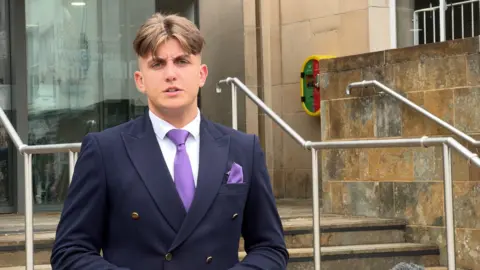
BBCA Reform UK council leader has defended his actions in criticising the county's chief constable in an open exchange of letters over the handling of a case involving the rape of a 12-year-old girl.
Warwickshire County Council's George Finch, who is facing a no-confidence vote in his leadership, accused the force and the Home Office of covering up the fact that the two men arrested and then charged with the attack were asylum seekers from Afghanistan, living in Nuneaton.
"I wanted to make sure there was transparency," Finch said.
An independent investigation has ruled that he breached the council's code of conduct by publishing information that "could have jeopardised" the trial.
Last month Ahmad Mulakhil was found guilty of abducting and raping the girl, while his co-defendant, Mohammad Kabir, was cleared of strangulation, attempted child abduction and attempting to commit a sexual offence.
The case prompted changes to guidance on reporting the nationality and immigration status of people arrested and charged.
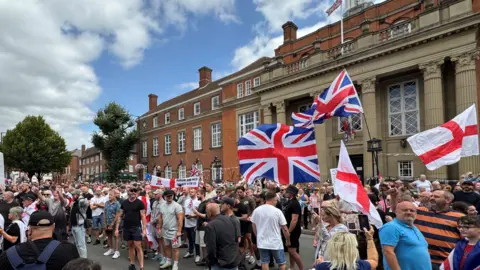
It also sparked anti-immigration protests, with hundreds gathering in the Warwickshire town.
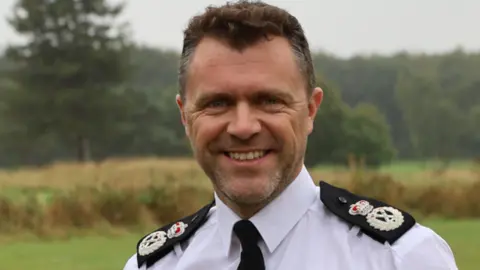
Following the arrests of the Afghan nationals, Finch published a letter on his social media accounts addressed to the Home Secretary at the time, Yvette Cooper, the Chief Constable of Warwickshire Police, Alex Franklin-Smith, and the chief executive of his council, Monica Fogarty.
He said Ms Fogarty had told him that Kabir was an asylum seeker living in a house of multiple occupancy.
Residents had "very easily been able to join the dots together" and conclude that the men were asylum seekers, he said, and that people in the town had "not been told the full story".
Exchange of letters
The chief constable responded saying officers "did not and will not cover up such criminality".
He added that the force had simply followed the official guidance given to officers at the time which did not include sharing the ethnicity or immigration status of suspects.
In an interview for BBC Politics Midlands, Finch said he had acted appropriately and his actions "held the police to account".
"I believe that what was happening at the time in Nuneaton with the rape of that poor girl is that I stood strong with the community," he added.
After the trial of the two Afghan nationals Finch again wrote a letter calling into question the integrity of the chief constable, accusing him of not having written his own response to his questions and asking if he had been on holiday at crucial points.
Responding in his own letter to those accusations, published on the force's website, Franklin-Smith said he wrote his response in August which he stood by and added that he flew home early from a family holiday due to the protests in Warwickshire over the issue.
The leader said he stood by his actions.
"I've said that from day one I wanted clarification, the people wanted clarification, so I asked for those points, there's nothing wrong with doing that, and he responded back," said Finch.
 Police and Crime Commissioner Warwickshire
Finch was accused of breaching four separate elements of the council's code of conduct which sparked an independent investigation by solicitor Claire Ward.
While he was cleared of three, he was found to have breached confidentiality by publishing details that he had been privy to as leader of the authority.
The investigation report detailed how Finch had argued the information had already been inferred by local and national media, that highlighting it was a matter of public interest and relied on his right to free speech under Article 10 of the European Convention on Human Rights.
Responding, the investigator accepted that raising issues with the home secretary privately would have passed the public interest test and that publicising that he had written to her would have been fair - but the publication of the correspondence itself, given the detail it contained, was a breach of confidence.
She also found that the leader's rights under Article 10 were superseded by the need to maintain confidentiality due to the sensitivity of the matter.
"Publicly releasing such details could have jeopardised the ongoing prosecution, caused undue distress to the victim and undermined community cohesion," she said in the report.
"While transparency remains vital for public confidence, in this instance a more measured and confidential approach was required."
Later in the report, Ward added: "The information shared by councillor Finch was not trivial. It concerned matters that could have a direct impact on the effectiveness of a police investigation and the stability of the community."
Recommendations following the report are yet to be made, with the council adding it would not comment on individual complaints against councillors.
Councillors will decide the fate of the leader in the no-confidence vote at a meeting on Tuesday, after the Green Party accused Finch of bringing the authority "into disrepute".
It is a vote the Reform leader says he can survive, adding he was "doing a good job".
If the Liberal Democrats, Greens, Labour and two Restore Britain councillors - who have recently defected from Reform - support the motion of no confidence, Finch's future will be in the hands of the Conservative group on the council.
The Tories on the issue have described calls for him to go as leader as "premature" and asked the Greens to withdraw their confidence motion until the complaints process concluded.
"If the Green group will not withdraw the motion, the Conservative group will vote against the motion in order to maintain stability, keep out a left-wing coalition of chaos and allow Warwickshire County Council to focus on delivering for residents," the group said in a statement.
"The Conservative Party will continue to hold Reform to account in Warwickshire and ensure they deliver for residents."
Additional reporting by the Local Democracy Reporting Service.
Follow BBC Coventry & Warwickshire on BBC Sounds, Facebook, X and Instagram.