Airport seeking night exemption for quieter planes

 Danny Lawson/PA Wire
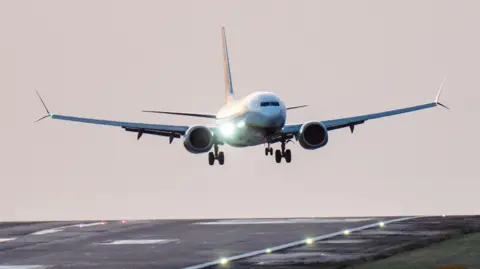
Leeds Bradford Airport has defended its decision to apply for immunity from prosecution when it flies certain types of aircraft overnight.
The airport is currently limited to 2,920 aircraft movements between 23:00 and 07:00 BST annually.
But the Group for Action on Leeds Bradford Airport (GALBA) claimed the limit has been breached for four successive years between 2022 and 2025, with more than 500 additional flights each summer season.
GALBA's data is disputed by Leeds Bradford Airport, with chief executive Vincent Hodder suggesting that new aircraft that have a noise level of 87 dB or less shouldn't be included in the summertime night cap figures.
The airport's legal submission to Leeds City Council argued that aircraft below 87 dB operated continuously between 2010 and 2019 without enforcement and should, therefore, remain exempt now and in the future.
The airport is applying to the council for a certificate of lawful existing use or development (CLEUD) that would allow the quieter aircraft to remain outside the night quota.
Hodder said: "UK planning law lays out that if a breach of planning has existed continuously for a long period of time and that everybody has adjusted to the way restrictions on the airport apply, then those things become immune from enforcement.
"Our argument is for 10 years the airport continuously operated quieter aircraft during the night period that were in breach of the planning conditions in place at that time - we would argue that because that has happened it should be allowed to continue."
 Reuters
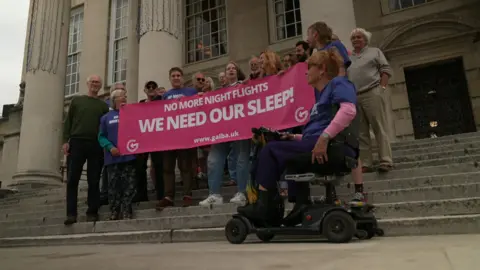
GALBA described the airport's application as "irresponsible and cowardly".
Ian Coatman, from the group, said: "LBA's argument is like a burglar being able to say, 'I've been stealing for 10 years and I haven't been caught, so now I can steal as often as I like forever and there's nothing anyone can do to stop me'."
He added: "To be clear, no one is saying people should never take holidays abroad, but frequent night noise is harmful to the many thousands of people who live under the flight path."
Horsforth resident Susan Ditchfield lives close the runway and moved into her home before night flying had been permitted.
"It's relentless, one after another after another, just in a short space of time during the night, then there's a lull and then it starts again, it's just dreadful and such a nuisance," she said.
The airport said in the longer term it wanted to fly more than the summer night limit and hoped to change the regulations to a noise-based system, rather than one that counts individual aircraft movements.
Hodder added: "What we want to do is to change the rules around the way that the night flights are counted to provide a foundation for monitoring and controlling the level of noise which is produced by the airport and which causes discomfort for people who live around the airport."
Leeds City Council is asking for third parties to submit relevant factual evidence, such as flight data, flight times, flight frequency and size of aircraft – relating to the specific operations at Leeds Bradford so that they can be considered as part of the CLEUD application.
A council spokesperson said: "A call for evidence from third parties is currently ongoing in relation to the flying of certain types of aircraft during the nighttime period at Leeds Bradford Airport between 1 January 2010 to 31 December 2019.
"This began earlier this month and ends on 26 March, so it would be inappropriate to comment further until this process has been concluded and the evidence provided has been assessed."
Listen to highlights from West Yorkshire on BBC Sounds, catch up with the latest episode of Look North.