First aid for pets: Not just a walk in the park?

 BBC
BBCWould you know what to do if someone had a seizure, or how to administer CPR?
Thankfully, basic first aid skills are taught to children and adults across the country - but what if it was your pet that required help?
One veterinary surgery in Oxford wants to make sure everyone knows what to do if they find their pet in a medical emergency - and are running public pet first aid drop-in sessions.
The BBC went down to Beaumont Vets on the Botley Road to find out more about the sessions, as well as some top first aid tips for pet owners.
Head vet Hannah Gardiner explained: "A big part of it is finding out when to contact the vets, so common emergencies and things you might not realise actually make us quite worried."
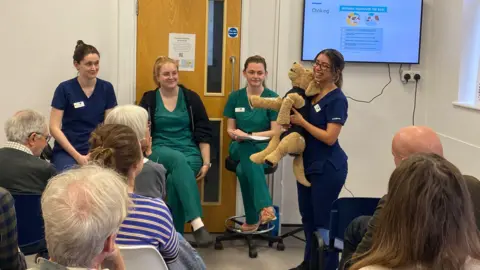
Just under two dozen people - mostly cat and dog owners - attended the session, which covered a variety of topics.
Toxins
It is already common knowledge that certain things we as humans love to eat and drink are in fact poisonous to our pets.
Flicking through a slideshow of examples of these substances, Hannah listed four particular toxins and explained their impact.
The first was chocolate, which she said "most people" knew was toxic to dogs, but explained it was in fact "more toxic to cats".
"Chocolate is a dose-dependent toxicity - so that means that it might be that your dog has a chocolate digestive and it's a labrador and it's absolutely fine, whereas if they eat a box of 100% dark chocolate, that's a different story," she said.
"That's something you can ring us and we have calculators that will tell us whether you need to come to the vet or not."
Next was grapes and raisins, which Hannah said were "a more difficult one".
"It could be a dog eats a punnet of grapes and is absolutely fine, but it could also be that they eat two grapes and goes into kidney failure - it's not well understood," she said.
Alongside those, she also listed mouldy food and sugar-free products containing the substance Xylitol as things we should keep our pets away from.
CPR
Katie Vokes, head nurse at Beaumont, said she had previously worked in an intensive care unit where she would perform CPR on animals daily.
"It can be very confusing - it's only something that I've learnt through time."
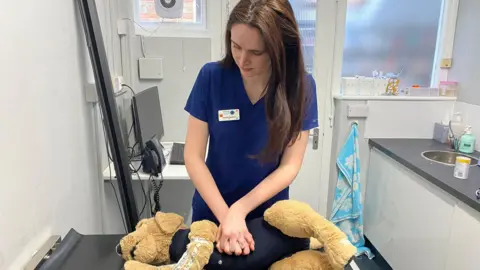
She explained you wanted the animal's body on its side and "as close to your legs as you can".
"Depending on the breed of the dog, you're either going to go over the widest section of the ribs if it were a bigger sized dog, or if we've got a cat or a small dog we're going to do one hand over where the heart would be - which is around where their elbow is," she said.
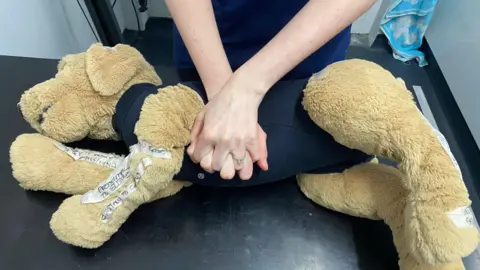
Katie said the process of administering CPR "to humans is the same for dogs".
"One hand on top of the other, you can either interlink your fingers or you can leave them straight, whatever you feel more comfortable with and your elbows need to be locked," she explained.
"If they were a two-day-old kitten, you'd probably only use two fingers, but for any aged pet they should all be big enough for the calf, thumb, and palm."
She added that you could also do breaths by wrapping your mouth around their nose and exhaling twice, but that chest compressions for two minutes were "more effective".
You can follow BBC Oxfordshire on Facebook, X, or Instagram.