White-tailed eagle spotted 'exploring' coast

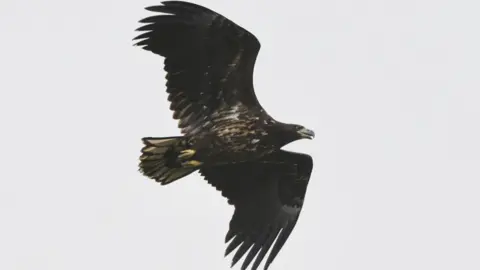 Jo Richardson
One of the largest birds of prey in the UK has been spotted far from its usual breeding ground, delighting nature lovers.
The white-tailed eagle was seen by bird watchers at locations including Druridge Bay, Sunderland and Hartlepool over the weekend.
Jo Richardson was enjoying a walk around Holywell Pond in Whitley Bay when she was told the bird of prey had landed in trees at the back of the pond.
She said despite spotting white-tailed eagles on Mull in Scotland several times, "it was very special" seeing one so close to home.
"I was at Holywell Pond looking at the ducks and a gentleman told me the eagle had landed in the trees at the back of the pond," Richardson said.
"A short while later it flew away south, very high up, then it circled back flying right over our heads, it looked huge."
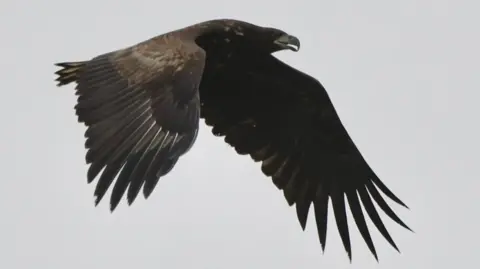 Jo Richardson
An ornithologist for the Roy Dennis Wildlife Foundation, Tim Mackrill, said it was not one of the eagles the organisation was tracking from the Isle of Wight.
He said: "I suspect it is a juvenile from Scotland.
"There are now around 200 pairs of white-tailed eagles in Scotland and we know that young birds can be highly nomadic in their early years."
Having seen pictures of the bird, Mackrill believes it fledged last summer and it was be exploring for the first time.
Chief executive of the Northumberland Wildlife Trust Mike Pratt said he was "delighted" to hear the eagle was in the area.
He said: "What a treat for members of the public and bird watchers alike.
"I'm delighted that such a wonderful bird chose to touch down at a number of our reserves along Druridge Bay and our Holywell Pond reserve near Whitley Bay."
White-tailed sea eagles
- Brown body with a noticeably pale head and neck, which can become almost white in older birds
- Enormous, broad wings – much broader than a golden eagle's – with fingered ends
- Huge, chunky yellow beak (dark in juveniles) and yellow feet
- Adults have white tail feathers, as their name suggests
- Soars with wings held flat, rather than in a 'V' shape like golden eagles
Source: RSPB