Cost and freedom fears over new driver plans

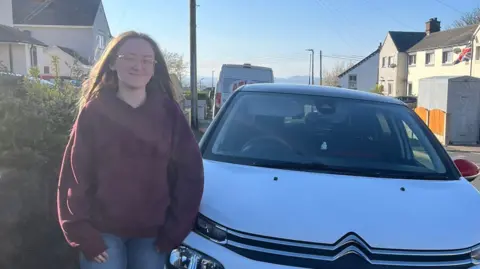 Tilly Kay
For young people living in rural areas, learning to drive can equal independence. But government proposals to introduce stricter rules for new drivers have sparked fears over affordability and impact on their day-to-day lives.
The government is consulting on plans to introduce a minimum learning period for learner drivers in the UK as part of a new road safety strategy announced in January, which it says will reduce deaths and serious injuries on the roads.
For Tilly Kay, 20, who lives near Frizington, in west Cumbria, learning to drive was a priority.
"I live in the middle of nowhere, there's no buses that go to my road and you have to walk 20 minutes to the nearest bus stop," she says.
The Department for Transport (DfT) says it wants to tackle "the root causes of collisions", with consultations also looking at other issues such as drink and drug driving.
Kay is now a trainee supervisor at a gastropub, but when she was a teenager, she was picking up shifts there in between her school duties.
As a 17-year-old, learning to drive was a big but necessary expense and she spent about £60 for each two-hour lesson with an instructor.
'Ridiculous costs'
Kay passed her driving test within four months of starting to learn, but she says a minimum learning period may have priced her out of learning.
"Minimum wage is so low and you do not earn enough to live off and pay for lessons for six months, that's ridiculous," she says.
Aside from routine maintenance costs and rising fuel prices, insuring her car also costs about £1,500 a year, adding to an already high bill.
The discussions fall within wider conversations over whether to introduce graduated driver licensing (GDL), a series of extra requirements for new drivers.
Northern Ireland is the first UK country set to introduce GDLs in October, with a requirement for learners to wait at least six months from getting their provisional licence before taking a test.
The chief executive at the Driving Instructors Association (DIA), Carly Brookfield, says longer learning periods should not equate to higher costs for learners "if designed well".
She says: "It could be that you are logging private practice, out in the car with mum and dad or an accompanied driver versus just formal lessons."
She adds research shows drivers with more experience are proven to be safer on the roads.
Lexie Mower, from Egremont, is 18 and passed her test in September.
She agrees the price of learning to drive is very high and she had to rely on help from her parents to help with costs.
 Lexie Mower
But she believes learning to drive over a nine-month period helped her to feel confident on the road.
"I just think it was a bit better for me to take my time with it really," she says.
"It gave me a bit more experience, because [you practise in] different weathers."
Discussions around GDL proposals include limiting the number of young people new drivers can carry and a ban on late night driving.
Mower, who works in a pub in her rural area, says she has been able to pick up more shifts since she does not need to rely on her parents for lifts.
She also often gives lifts to friends and colleagues to school and work and any limits on passengers and driving times would mean she would not be able to give lifts or drive herself home from work, with her shifts often finishing at about 23:00.
"[What's being proposed] is just not right," she says.
"I feel like it doesn't matter how many people you've got in the car, as long as you're focusing on the road."
'It's about safety'
For County Durham dad John Rowlands, reforms on road safety are about avoiding young people paying the ultimate price.
His son Andrew was 18 when he died in a crash on the A692 at Tanfield in a car driven by a 16-year-old without a licence.
"Andrew left that day to nip out somewhere and then the next time we saw Andrew was in the intensive care unit at Newcastle RVI to say our final goodbyes," says Rowlands.
He backs calls for GDLs and said while driving instructors could teach driving skills, they could not give new drivers "real life experience".
 Family handout
"A graduated driving licence is not there to put a shackle round your ankle," he says.
"What it's there to do is to say you've got to stage one, you've got yourself on the road, but for the next six to twelve months can you just make it so instead of having a car full of your friends, where there's lots of distraction, basically [you can just have] your close family members - I don't think that's unreasonable."
Stewart Lochrie, chairman at the Approved Driving Instructors National Joint Council (ADINJC), says the industry has been "crying out" for a new safety reforms.
He says while hours on the road do matter, what drivers learn is far more important.
 Family handout
"People crash, people die, and people cause other people to die because of personality traits and beliefs and behavioural factors - and this is what is missing in this country and in our profession," he says.
He believes driving lessons and tests are too skill-focused and outdated instructor training means it does not take into account new evidence from research done in recent years.
Government data shows drivers aged between 17 and 24 are one of the highest fatality risk groups, especially males, both as car drivers and passengers.
Lochrie says: "I don't quite understand why we're not teaching people or making the general public more aware that if a young person is in a car with two friends of roughly the same age, they are four times more likely to be involved in a crash."
He adds new drivers should be taught how to be more self-aware, how to reflect on their decision making and increased risks that come when a young person is surrounded by other young people in a car.
"In terms of knowledge, these are personal critical thinking skills that can be coached," he says.
 ADINJC
As part of its response to the government's consultation, the DIA says it will tell the government a focus on modular learning would be more efficient than setting an amount of time drivers have to learn for.
Brookfield says: "If every instructor and every pupil consistently was exposed to learning in key risk areas, we genuinely believe that there would be more risk reduction in things like distraction, speed, driving under the influence."
The DfT says it is consulting on a range of issues to tackle the causes of crashes.
A spokesperson said: "We want to keep young people safe while supporting vital access to work, education and social opportunities that drive up living standards."
The government consultation on a minimum driving period closes on 11 May.