I re-visited one of England's most spectacular hikes after a £5.5m upgrade

 Getty Images
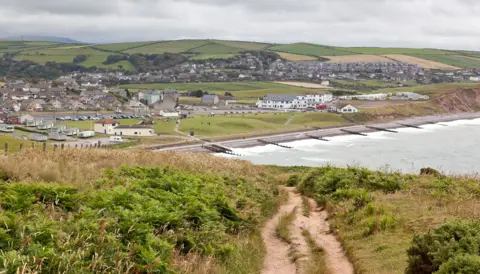
The tradition at the start of the Coast to Coast walk is to dip your boots in the sea near the village of St Bees.
Just don't get them too wet.
This spot, on the Irish Sea coast in West Cumbria, is the starting point for a very long stroll, all the way to the North Sea.
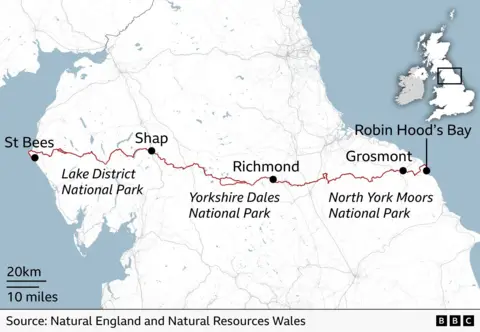
It's a tough 190 mile (305km) trail through three National Parks, from England's west coast to its east.
"It's got culture, it's got historical interest and it's got challenge, but it isn't too challenging," says Doug Sim, chair of St Bees Parish Council. "And by having a definitive start and finish at the beaches, it feels very complete."
The route has now been designated England's newest National Trail following a £5.5m upgrade - overseen by Natural England and partners - improving surfacing, signage and accessibility.
It was first devised and walked by the legendary fell-walker Alfred Wainwright more than 50 years ago.
He felt the Pennine Way - the famous 268 mile (429 km) trail from the Peak District to the Scottish Borders - was too long for most people, taking three weeks. He believed a challenging yet beautiful two-week trek was needed.
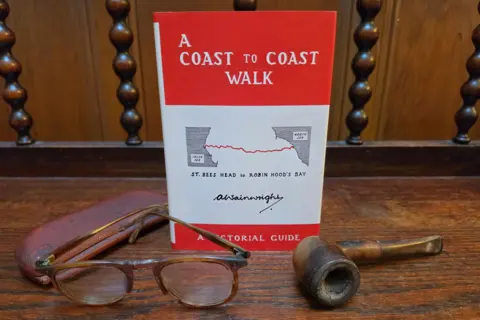
A guidebook to the Coast to Coast was published by him in the early 1970s in his own handwriting and sketches. It is a work of art.
 Chris Butterfield
I walked it back in 1991, book in hand. The weather was glorious. I was lucky.
The first few days of the trail across the Lake District are the hardest yards. Up and down, over numerous mountain ridges and along remote valleys.
Make it to the village of Shap and you've done the toughest bit.
The issue up until now is that some of the route was on permissive paths through private land, which could be closed for some of the year.
Over the last few years a lot of legal work has been done by local authorities and the National Parks to make the path an official right of way.
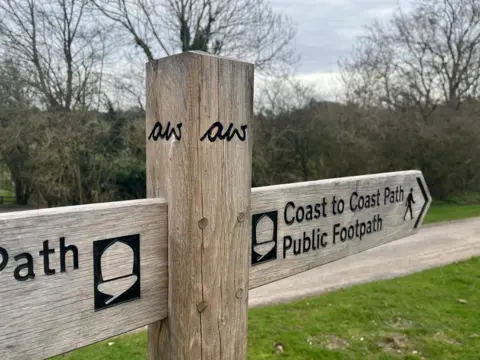
It is now better signposted too, with the letters "aw" inscribed on each way-marker as a nod to the man who thought of it first. In many ways it is his National Trail.
Day two of the journey for most is the eastward march up Ennerdale in the Lake District. This is just one place where a lot of improvement work has been done. There are new gates and bridges to make it accessible for all.
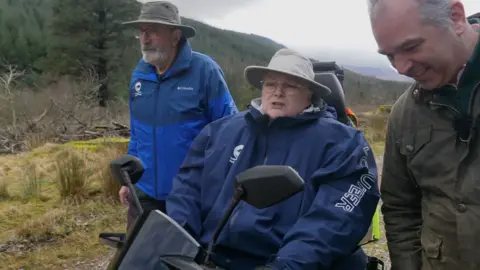
It is impossible for a wheelchair user to follow the whole trail but chunky sections are now doable. This is a joy for Annie Wallen, who lives in the area and can travel 15 miles (24km) in her motorised wheelchair.
She says Wainwright "might have walked in boots but I roll on rubber. I love it." Even being able to do a portion of this trail is "really special" to her.
Above the valley the path stretches away over high ground, parts of which have now been laid with giant flagstones. This will tackle the erosion caused by years of boots from all over the world.
Jo Willmott, a project ranger for the trail's upgrade, says you often meet people from the US, Canada and other countries. "It's showing the best of the UK," she says.
After the Lakes comes the Yorkshire Dales National Park.
The route goes from Kirkby Stephen, over the hills to Swaledale, past long-forgotten lead mine ruins - as recently seen in Wuthering Heights - and on through vibrant green pastures to Reeth and Richmond.
This is Mark Reid's favourite stretch. He should know, he has walked the Coast to Coast nine times. He guides groups of walkers along the trail from end to end.
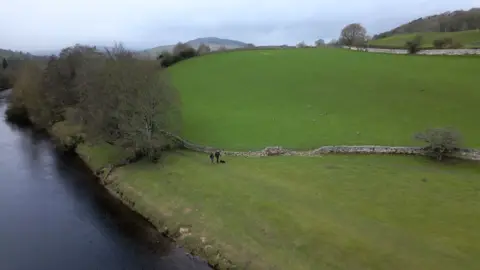
I meet him on the village green in Reeth and we walk down to the banks of the River Swale.
He says "you've got a group of friends" after two weeks of walking, and visitors often return again and again. "You reach the North Sea and it's really emotional, there are people in tears. It's really quite a fantastic experience."
The fact that people often come back is part of the reason the £5.5m upgrade went ahead. It is seen as an investment with a demonstrable future return from visitor spending.
From the Dales, the Coast to Coast goes across to the North York Moors National Park.
Clad in flowering purple heather in late summer, the moorland path goes via the famous Lion Inn pub at Blakey Ridge, through wooded gorges, past steam trains at Grosmont and onto journey's end at Robin Hood's Bay.
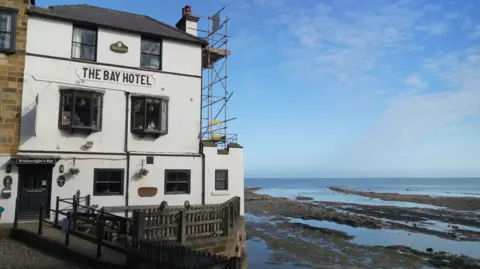
It's a picture-postcard finish. A quiet, steep lane leads down through fishermen's cottages with their orange pantile roofs to a waterside hotel and the sea. Or rock-pools if the tide is out.
This is where you can dip your boots in the water for the final time and reflect on memories of a life well walked.