Kinder Scout peatland restoration nears end

 National Trust
Work to restore peatland on the highest point in Derbyshire is nearing an end and conservationists have said it has already started to pay dividends.
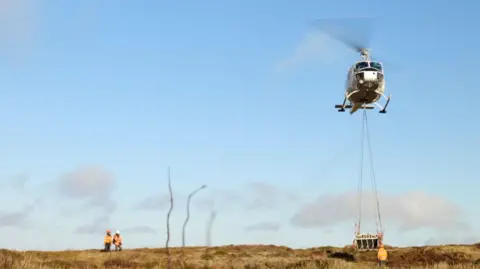
The National Trust planted Kinder Scout with sphagnum moss, with thousands of the plants and other supplies being ferried to the remote site by helicopter.
Peatland restoration project manager Phil Owen said the mosses' surface roughness meant the plants held up to 20 times their weight in water and helped to draw carbon from the atmosphere.
The charity has been building natural dams made from stone and coir, which it claimed had already slowed the run-off of water, reducing the risk of flooding downstream.
Repairing peatlands high up in the hills reduces both the risk of flooding and its severity, according to the Peak District National Authority, by holding up rainwater that would instead swiftly join the rivers below.
It said restoring and re-wetting peatlands also significantly reduced the risk of wildfires.
Placing small dams into Kinder Scout's natural gulleys and planting moss to soak up rainwater should achieve this goal.
The impact of this work will be felt in nearby towns and villages including Glossop, Whaley Bridge and Edale.

But Kinder Scout is one of the hardest parts of the Peak District to reach.
The sites being restored are typically at least half a mile from a road, so conservationists have been using a helicopter to airdrop moss plants, brash and fertiliser.
Mr Owen said treating areas of bare peat was a priority.
He said: "The main reason for the lack of vegetation is pollution from the Industrial Revolution onwards which changed the acidity level of the soil and killed off quite a lot of the vegetation.
"We start by spreading lime fertiliser and lots of cut heather brash to create vegetation cover.
"Once that's done, we re-wet the area by creating thousands and thousands of really small dams by hand to block up the gully systems to hold the water back."
 National Trust
The National Trust said while restoring peatland could take a very long time, there were already early indications that the restoration was working as the drain-off of rainwater was starting to slow.
Mr Owen said: "A healthy active blanket bog adds about a millimetre of peat each year, so these bogs took thousands of years to establish.
"But in the shorter term we can treat the bare peat and stop the active erosion.
"The more water we can hold up on the moor, the slower that flow of water down into the rivers and further downstream".
The current phase of works is expected to be completed by March 2026.
Follow BBC Derby on Facebook, on X, or on Instagram. Send your story ideas to eastmidsnews@bbc.co.uk or via WhatsApp on 0808 100 2210.