Who is running Venezuela after US forces seized Maduro?

 Reuters
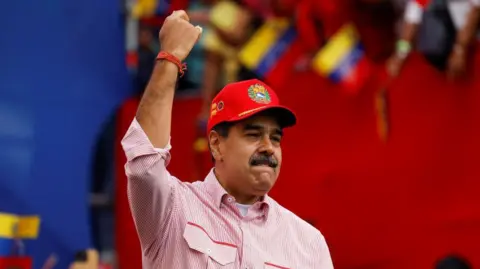
Venezuela's former leader Nicolás Maduro and his wife, Cilia Flores, are due back in court in New York later on Thursday, where they face charges of "narco-terrorism".
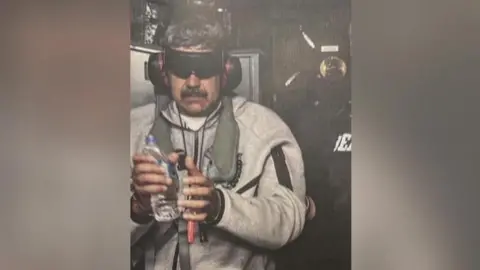
The couple was seized on 3 January in an audacious raid by US special forces authorised by President Donald Trump.
In the hours after the raid, Trump said his administration would run Venezuela until a "safe, proper and judicious transition" could take place, adding that the US would indefinitely control the sale of the country's oil.
Who is Nicolás Maduro and what charges does he face?
 @realDonaldTrump
Nicolás Maduro and former First Lady Cilia Flores were indicted in the Southern District of New York in January and are being held in a jail in Brooklyn. They face four charges:
- engaging in a narco-conspiracy with designated terrorist groups
- conspiring to traffic cocaine into the US
- possessing and using illegal weapons - primarily machine guns - to carry out the alleged conspiracy
- conspiring to possess machine guns and other destructive devices.
Both Maduro and Flores pleaded not guilty in their first court appearance in January. Maduro insisted he was a "decent man" and his wife said she was "completely innocent".
Their trial expected to last many months, if not years.
Nicolás Maduro, a former bus driver and trade unionist, rose to prominence under the leadership of the previous left-wing Venezuelan President Hugo Chávez, serving as his foreign minister.
Maduro was elected president after Chávez's death in 2013. Under his rule, the party founded by Chávez, the United Socialist Party of Venezuela (PSUV), further tightened its control over key institutions in Venezuela, including the National Assembly, much of the judiciary, and the electoral council.
In the most recent presidential election in July 2024, the electoral council declared Maduro the winner, even though voting tallies collected by the opposition suggested that its candidate, Edmundo González, had won by a landslide.
Pressure on Maduro increased after the start of Trump's second term in January 2025. Trump called him a "bad guy" who is "no friend of the US", insisting that it would be "smart" for him to step down.
Trump blamed Maduro for the arrival of hundreds of thousands of Venezuelan migrants in the US. Without providing any evidence to back up his claims, he accused him of "emptying his prisons and insane asylums" and "forcing" inmates to migrate to the US.
Trump also said that under Maduro, huge quantities of cocaine and fentanyl had reached the US from Venezuela.
Who is running Venezuela now?
 MIRAFLORES PALACE HANDOUT/EPA/Shutterstock
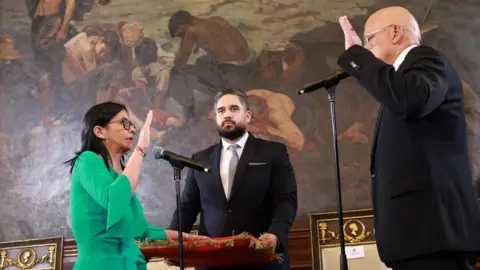
Despite Trump saying that the US would "run" Venezuela, Maduro loyalist Delcy Rodríguez - who served as vice-president before the US raid - is in charge on the ground.
Venezuela's National Assembly - which is dominated by lawmakers from the PSUV - swore her in as interim president after Maduro was taken.
The constitution says the vice-president can remain in post for up to 180 days, but that if the president's absence is deemed "permanent", elections must be called within 30 days.
So far, Rodríguez appears to have the backing of the US.
After their first phone conversation, Trump described her as a "terrific person" who was working well with his administration. He had previously warned Rodríguez that if she did not comply with US demands, she would "pay a very big price, probably bigger than Maduro".
Trump also held a face-to-face meeting at the White House with Venezuelan opposition leader María Corina Machado. She presented him with her Nobel Peace Prize medal, in recognition of his commitment to her country's freedom.
The US president said meeting Machado was a "great honour", calling her a "wonderful woman who has been through so much".
But he did not endorse her as Venezuela's new leader, even though voting tallies gathered by her opposition coalition suggested the candidate who stood in for her after she was banned from running had won by a landslide.
What has changed in Venezuela since the US raid?
 EPA
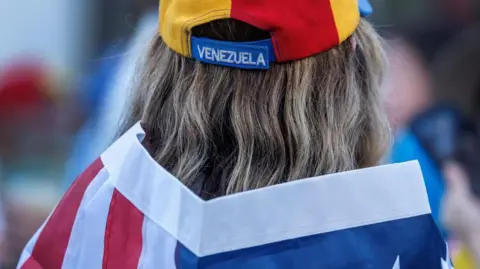
EPARodríguez is taking a two-pronged approach: using defiant rhetoric when addressing her supporters while largely complying with US demands.
She described Maduro's seizure as a "kidnapping", and organised public rallies calling for his and Flores's release.
But her government also swiftly changed the law to allow foreign investment in the country's oil industry.
She had a two-hour meeting with CIA director John Ratcliffe and met US envoy Laura Dogu. The US embassy in Caracas reopened after a seven-year hiatus, during which there had been no diplomatic relations between the two countries.
Under US pressure, hundreds of political prisoners have been released and an amnesty law has been passed, but prisoners' rights group Foro Penal warns that hundreds of political prisoners remain behind bars.
Rodríguez has also replaced some ministers and senior officials with people from her inner circle, but they too are Maduro loyalists.
What are Trump's plans for Venezuela's oil?
 AFP via Getty Images
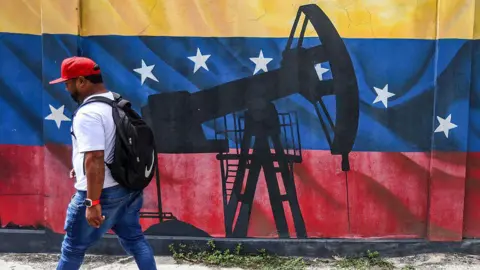
Trump promised to "unleash" Venezuela's oil, while indefinitely controlling its sale.
"One of the things the United States gets out of this will be even lower energy prices," he said after the US raid.
Venezuela has the largest proven oil reserves in the world - an estimated 303 billion barrels.
However, production has plummeted from its peak in the late 1990s.
Trump has asked US oil firms to invest at least $100bn (£75bn) to restore the oil industry to its former glory.
He claimed the rights to Venezuela's oil after alleging that the country had in the past "unilaterally seized and sold American oil, American assets and American platforms, costing us billions and billions of dollars".
Venezuela's oil industry was nationalised in 1976, and in 2006 state control over production was further tightened, prompting many foreign firms to leave.
Unlike other foreign oil firms such as Chevron and BP, US oil giants ExxonMobil and ConocoPhillips refused to sell their controlling stakes to Venezuela's state-run oil company PDVSA, as demanded by the 2006 changes.
They were ordered to leave the country and had their assets seized.
The two companies were later awarded billions of dollars in compensation, which Venezuela has not paid, blaming US sanctions for its failure to settle the debts.
Legal experts point out that based on the UN principle of permanent sovereignty over natural resources, Venezuela's oil belongs to its people.
US Secretary of State Marco Rubio said the Trump administration would allow Venezuela to sell its oil but that "the funds from that will be deposited into an account that we will have oversight over".
He added that the US would ensure that Venezuela would spend the proceeds "for the benefit" of its people.
What happened during the US attack on Venezuela?
The US military stormed Fuerte Tiuna, the military base where Maduro and his wife were staying, at 02:01 local time (06:01 GMT) on 3 January 2026.
According to Trump, more than 150 aircraft got the extraction team into the capital Caracas, and US officials indicated that air strikes around the city provided cover to get them out.
Trump said Maduro made it to a steel-fortified safe room but was unable to close the door.
Venezuela Interior Minister Diosdado Cabello said that 100 people died during the operation, including civilians and 32 Cubans who served as Maduro's bodyguards.
Maduro and his wife were taken on board the USS Iwo Jima before being flown to New York.
The strikes were condemned by Venezuela's long-term allies. Russia accused the US of "an act of armed aggression", while China's foreign ministry called on the US to release Maduro and his wife "at once".
Many Latin American countries also criticised the operation, including Venezuela's neighbours Colombia and Brazil.
UN Secretary General Antonio Guterres' spokesman said he was "deeply concerned that the rules of international law have not been respected".