'Closing pilot sickle cell unit could be fatal'

 EPA
EPAEnding an emergency care pilot for sickle cell patients in London could have "fatal" consequences, an MP has warned.
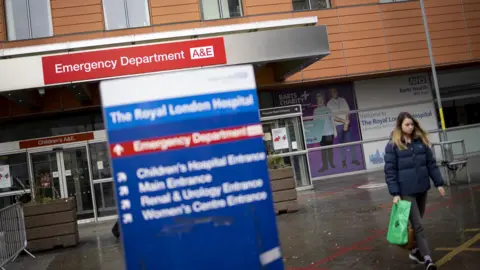
The Same Day Emergency Care (SDEC) unit at the Royal London Hospital in Whitechapel provided an alternative to A&E admissions for sickle cell patients between September 2025 and January.
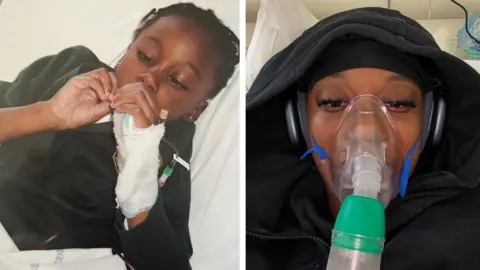
Abi Osei-Mensah, a sickle cell campaigner, visited the unit multiple times during the pilot. She said she was disappointed that something "so effective" had been "snatched away".
Barts Health NHS Trust said it recognised "the strength of feeling and support" for the pilot scheme and said patients would "continue to receive specialist-led care" at the hospital's Haematology Day Unit.
The trust said it trialled the emergency care scheme in order to "evaluate its impact and plan more robustly for future services."
Sickle cell disease is the most common and fastest growing genetic condition in the UK. It is particularly common in people of Black African or Caribbean descent and London has the highest number of people living with sickle cell in the UK, according to the Haemoglobinopathy Registry.
The blood disorder requires lifelong management of extremely painful episodes called sickle cell crises, which often require hospital admission and powerful painkillers.
 Abi Osei-Mensah
Labour MP Bell Ribeiro-Addy told the BBC that ending the emergency care pilot "could ultimately be fatal" and urged the government to develop a national strategy for specialised sickle cell care.
A petition against the pilot closure said the unit "allowed patients experiencing acute pain crises – often dismissed or mismanaged in standard A&E settings – to receive treatment quickly and compassionately from clinicians with specialist expertise."
Barts Trust told the BBC that sickle cell patients would have to use its A&E department for emergency care.
"Patients with sickle cell disease will continue to receive specialist-led care at our hospital," it said in a statement.
"There is no change to the way we manage patients with sickle cell disease, and our Haematology Day Unit remains open for all our elective transfusion therapies.
"We are committed to improving pathways for the management of pain in patients with sickle cell disease, both acute and chronic, and will continue to welcome input into service design."
'Excruciating pain'
Osei-Mensah said that following the end of the pilot, she had actively avoided A&E due to "unbearable" previous experiences.
"Just being in A&E can make the crisis worse," she said.
The 21-year-old added that she had previously waited up to 28 hours in an emergency department for medical care and had to repeatedly advocate for herself while in "excruciating pain".
Guidelines from the National Institute for Health and Care Excellence (NICE) advise that a sickle cell crisis should be treated as "an acute medical emergency" and patients should receive pain relief within 30 minutes of presenting at hospital.
Osei-Mensah said she had waited longer than 30 minutes just to be triaged at A&E.
She said the emergency unit pilot meant she received pain relief much faster, but said there had been problems in how the scheme was communicated to patients.
"I know for a fact that there's a lot of sickle cell patients that didn't know about the unit," Osei-Mensah said.
She said she was told about the unit through a group chat, not from the hospital directly, and only discovered that it was a trial when it was mentioned by a nurse during one of her visits.
"If there had been more [patients], they might have thought to have kept it," she added.
Barts Trust did not respond to questions about how and when patients were informed about the pilot scheme.

Delo Biye regularly travelled more than 10 miles (16km) to the emergency unit. He launched an online campaign against its closure and described it as a "haven" and "a place of safety through the pain".
When he was a child, doctors told his parents that he would not live beyond 30. He is now 48, but managing crises is a regular part of his life.
He said the pilot's five-month duration effectively told the sickle cell community: "Now you know what you're missing."
After it ended, he said he spent 24 hours in A&E in a sickle cell crisis, before ultimately giving up hope of admission and returning home.
His campaign caught the attention of Ribeiro-Addy, MP for Clapham and Brixton Hill, who said the trial closure was "typical of the wider trends in sickle cell".
"The level of support that people need is just not given," she said.
 PA
PARibeiro-Addy called for the scheme to be reinstated, for more emergency units to be rolled out across London and for the government to commit to a national strategy.
"The shutting down of units like this, adding to people's waiting time, adding to people's journey time, are the types of things that could definitely leave someone with sickle cell in a lot of pain, and in some cases could ultimately be fatal," she said.
She said that a blueprint for better treatment of sickle cell disease already existed in the recommendations of the No One's Listening report.
Published in 2021 by the All Party Parliamentary Group for Sickle Cell and Thalassaemia and the Sickle Cell Society, the report found that sickle cell patients faced "sub-standard care, stigmatisation and lack of prioritisation".
Labour MP Apsana Begum, whose constituents in Poplar and Limehouse used the emergency unit, supported Riberio-Addy's motion in parliament.
She said the decision to end the pilot "doesn't send the right signal" and added sickle cell care was both a local and national issue.
Barts Trust said the pilot was commissioned by the North East London Integrated Care Board and ended in January 2026, when agreed funding expired.
The Department of Health and Social Care did not respond to a request for comment.
Listen to the best of BBC Radio London on Sounds and follow BBC London on Facebook, X and Instagram. Send your story ideas to hello.bbclondon@bbc.co.uk