'You never know what you're going to see down there'

 BBC
BBCIn the waters of Strangford Lough, the only constant is change.
As waves churn its surface, beneath the water a changing climate and warmer seas bring new species of fish and other marine life, while some native species struggle to adapt.
There are some bright spots – members of the Dolphins Sub-Aqua Club can still be found in these waters more than 50 years after the club was founded in Belfast.
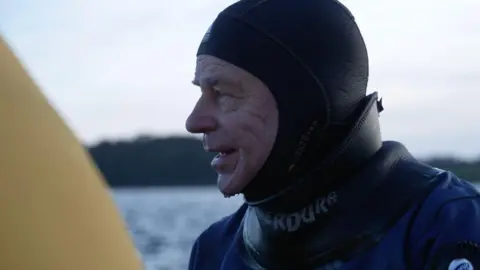
Bernard Picton, the club's diving officer and a marine biologist, is one of its longest serving members. Even he wasn't always sure that this milestone would be reached.
"It got very dodgy over Covid, but it's starting this year to pick up again," he said.
"I'm quite excited about the prospects really."
As to what keeps him coming back to these dives more than 55 years after his first, the answer is simple.
"Curiosity, I think. You never know what you're going to see down there.
"Most people have no idea of any of the things that are down there, really - except what you see at the fishmonger."
BBC News NI joined the club on a dive in Strangford Lough – bitterly cold even on a clear, dry day.
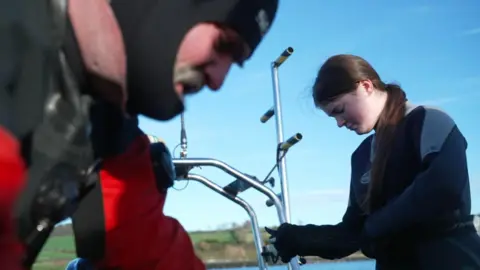
One of the club's newest members, Edie McClelland, is already well acquainted with the wide variety of species our seas have to offer.
"When I started diving I didn't know you could see all this stuff in Northern Ireland," she said.
"Loads of coral, fish. I've seen a really big lobster, a conger eel and a dog fish - that was pretty cool.
"I like going out to do a hobby with my dad and just experiencing a new world."
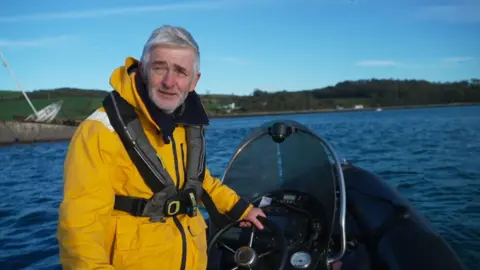
Another Dolphin, Colin Fitzpatrick, remained above the water to act as the day's skipper. But it was quickly clear that he would rather be suited up below the waves.
"You've got that sensation of weightlessness. You can just float around which is absolutely spectacular.
"The marine life around Ireland is amazing. Amazing fish life, lots of sponges."
Some of this marine life has found a home in a shipwreck which lies in the lough.
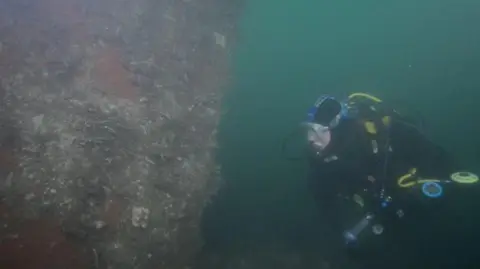
"The underside of it is covered in sea anemones and there's amazing fish life around it because they gather round the wreck," Colin said.
"The wreck itself has amazing history around it."
It's been in the lough as long as the Dolphins, arriving on a route less travelled.
From Somalia to Strangford Lough, via the D Day landings, the ship is now known as Lee's Wreck, lying mostly submerged near Portaferry Harbour.
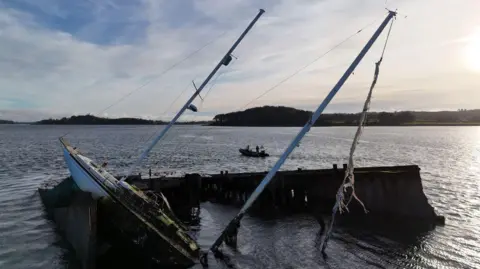
It began life as an Italian trade ship, the SS Carso of Trieste. In 1941 the ship was sunk off Somalia by Italian forces in an unsuccessful attempt to prevent it falling into the hands of the British Navy, its wartime enemy.
Refloated and rechristened, the new Empire Tana was brought to the D Day landings, only to be sunk and used as a breakwater off Sword Beach.
Again refloated, the ship was towed as far as Strangford Lough before it finally decided enough was enough.
En route to a breakers' yard, it wrecked after striking a reef when a tow line snapped. This third sinking stuck and the ship has lain there ever since.
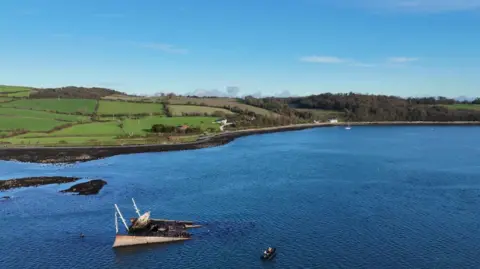
The well-travelled ship, now a destination in its own right, is popular with scuba clubs for its accessibility and abundant marine life.
Even here, change is inevitable.
As well as hosting a population of conger eels, scores of fish and corals, the wreck recently became the resting place of another ship – a yacht blown loose from the harbour in recent storms.