Skipper releases seahorse caught on fishing pot

 Chris Puncher
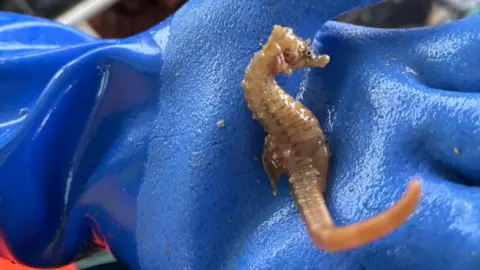
A trawler skipper released a seahorse back into the sea after it was caught on the side of his fishing pot.
Chris Puncher, skipper and owner of Salcombe Fish and Shellfish Ltd in Devon, said the male seahorse, which was about 6cm (2.4in) with its tail curled up, "strongly" swam away after it was caught.
The Seahorse Trust, a Devon based charity, confirmed it was an "immature" adult male short-snouted seahorse, meaning it was not pregnant.
Puncher, who is the skipper of Mayhem 2, a boat that fishes for crab and lobster, said it was the first time in his 20 years of fishing he had seen a seahorse at sea.
 Chris Puncher
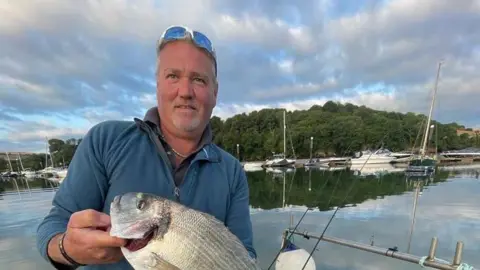
He caught the seahorse off Prawl Point on Sunday in what he called a "first-time-ever for us".
He said: "I've seen seahorses inside the estuary when I've been snorkelling years ago in the seagrass, but never out at sea.
"We hauled up the pot, and my crewman saw this seahorse clinging to the pot, so we took a couple of pictures and sent it on its way and off it swam."
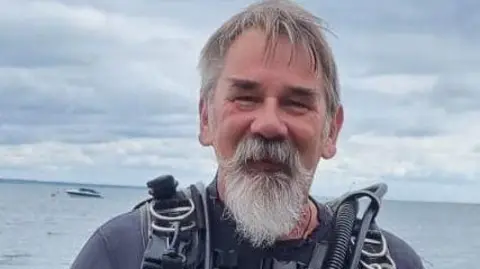
The executive director and founder of the Seahorse Trust, Nick Garrick-Maidment, said the species could be up to 16cm (6.2in) in length from the top of its head to the end of its tail.
 The Seahorse Trust
Garrick-Maidment said: "It's a great find and makes sense as they tend to be in deeper water at this time of year to avoid the storms in shallow water.
"It's adaptable and very good at occupying manmade structures, which is quite exciting because it gives us a chance to understand them more."
The trust said the species had a voracious appetite and ate a wide variety of crustacea such as small shrimp and crabs. It also said they could also change colour like a chameleon.
Garrick-Maidment said it was important to report sightings to learn more about marine animals.
"We are finding a lot more sightings are being recorded and sent to us, particularly here in the South West because there's a lot more people in the sea."
He said the trust had also been studying the migration of seahorses based on its database which was set up in 1994.
"In a month or so, they will start to migrate inshore, depending on the weather, and come into the shallows for the summer," he said.
Garrick-Maidment encouraged people who find a seahorse to take a "quick picture" without putting the welfare of the animal at risk, otherwise to put it straight back in the water.
He said, if the seahorse was dead, people should send to send the remains to the trust to better understand the species.
"The reason for that is so we can help protect them," he said.
 Chris Puncher
Puncher said fishing had been "hard" in recent storms and high winds since the August bank holiday.
He said his vessel was only managing to get out a couple of days a week, adding take-ins and catches were down.
"It's been pretty full-on," he said.
"Because there's so many storms, the pots get damaged and bundled up and we have to sort them; and then the next one comes in, so we seem to be constantly sorting gear out."
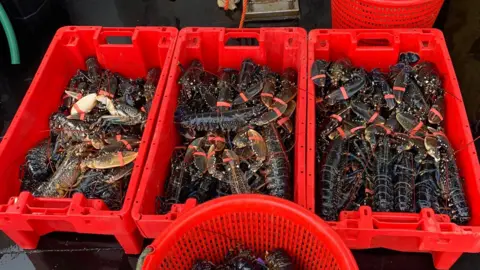
He said that, if sea conditions were rough, lobsters dug themselves a hole or hid under a rock or in a crevice.
"They don't move around and feed, and hunker down and ride the storm out," Puncher added.
"We've also had a massive plague of octopus which has devastated the stocks of crab and lobster, so it's just been a double whammy really."
Follow BBC Devon on X, Facebook and Instagram. Send your story ideas to spotlight@bbc.co.uk.