'Astonishing' rise in average waits for NHS 24 calls, report says

 BBC
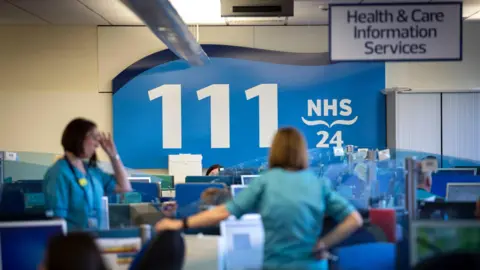
BBCThe average wait for an NHS 24 call in Scotland has seen an "astonishing" increase, according to the author of a report on the country's health service.
The review was carried out by Mike McKirdy, the former president of the Royal College of Physicians and Surgeons of Glasgow, and commissioned by Scottish Labour.
His report said the average wait for NHS 24 had risen from nine seconds to more than 22 minutes since 2014.
But NHS 24 said it did not recognise those figures and that the system had operated under "a completely different clinical model" in 2014.
Mr McKirdy said the health service was "failing to deliver" for Scots - but First Minister John Swinney insisted the health service had "turned a corner".
The statistic Mr McKirdy identified for NHS 24 calls was the median waiting time - which is the middle figure in a range of values.
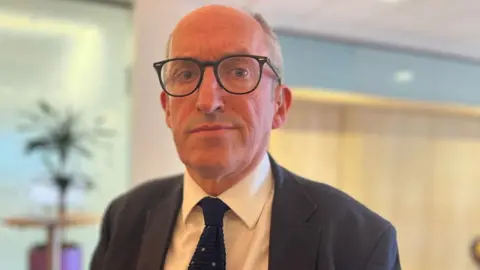
His report said this had risen from nine seconds in 2014 to more than five minutes in 2020, before jumping to 22.5 minutes this year.
However, NHS 24 said it would be seeking clarification from Mr McKirdy on the source of the statistics.
"In 2014/15, we did not report median time to answer and operated under a completely different clinical model – with patients receiving a call back from a clinician. Today, patient calls are concluded at first contact," it said.
"Comparisons with current performance are therefore misleading and do not reflect the scale and complexity of NHS 24's current service."
Mr McKirdy told BBC Radio Scotland Breakfast that he had identified a "central puzzle" in the health service.
He said: "We have more staff then ever before, there is more funding, there are more policy initiatives than ever before, demand is actually fairly static … but our activity is less than it was in 2018."
Mr McKirdy, a retired consultant surgeon, said that the issue could not all be blamed on the Covid-19 pandemic, telling the BBC: "We're really failing to deliver for people."
He said that NHS staff had become "demoralised", evidenced by higher rates of absences and younger workers leaving the health service.
Mr McKirdy said that the Scottish government needed to have a "relentless focus on delivery", calling for more spending on GPs, community care, planning and workforce training.
He also said there should be a better use of technology, highlighting that the full roll-out of the NHS Scotland app has been delayed until 2030.
Mr McKirdy's other findings included:
- One in five Scots take anti-depressants and nearly half self-report living with at least one long-term condition
- A rise in wait times in areas such as radiology, which was 88% higher than in 2017 and endoscopy, which was 36% higher
- In 2013 almost all inpatients were treated within 12 weeks of the decision to treat, but by since September 2022 about 57% have met that target, on average
- A "structural paradox" in NHS Scotland, which "has more staff, more funding, and more policy initiatives than ever before, yet patient outcomes and experiences are stagnating or even declining"
- Since 2007, more than 130 major health strategies have been published - the equivalent of one every seven weeks
- Challenges in the NHS "were not caused" by the pandemic, which "exposed and enhanced" existing weaknesses
- Pressures on the NHS are having a substantial impact on health staff, who are around 50% more likely than the general population to experience chronic stress
- Workers are "at risk of burnout" and at times dealing with "problematic cultures that actively discourage the raising of issues or shut down concerns even when regarding patient safety"
- "Small tweaks" have been made to delivery of care, such as NHS111 and Pharmacy First, but changes have been "bolted on", meaning capacity has been "failed to relieve pressure elsewhere"
Plan to 'fix the NHS'
Scottish Labour deputy leader Jackie Baillie said: "We cannot allow the people of Scotland and those who work in our NHS to continue to pay the price of SNP failure.
"This is why the analysis provided by this vital report will play a major role in informing the policy and direction of Scottish Labour's plan to fix our NHS."
The Scottish Conservatives, meanwhile, launched plans to tackle delays in people leaving hospital.
Under the party's proposals, patients in eligible areas with care home capacity would be placed temporarily in a care home within 48 hours of being declared fit for discharge.
Tory MSP Craig Hoy told BBC Radio Scotland Breakfast: "The problem that many people experience at the front door of a hospital, trying to get into A&E for example or trying to get in for an operation, is due to delayed discharge, which the government said would be a priority to reduce but they're simply not doing that."
Swinney acknowledged that the NHS was still recovering from pandemic – but that action on long waits was "bearing fruit".
He told BBC Scotland News: "Real progress is being made, we've turned a corner in the NHS and I'm absolutely focused on making sure that we deliver on the expectations of the public."
This Labour commissioned report contains many familiar themes. Targets not being met, burnt-out staff and growing dissatisfaction with the service patients are getting.
Just as the public spending watchdog outlined last week, the conclusions here are despite record investment and staff, the NHS cannot go on as it is.
Mike McKirdy points to the complex structure of the health service as a barrier to reform and improvement. He says governance is fragmented and under tight central government controls which he says makes accountability and transparency easier to avoid.
This is something that we may hear more of from Labour as we get closer to the Holyrood election in May. They have already proposed reducing the number of health boards to cut bureaucracy.
The NHS in Scotland faces the same issues as the NHS in England where Labour is in charge. Key targets are being missed, there are high vacancy rates and there is disruption due to strikes by resident doctors.
Politicians know the NHS is a key issue for voters. Every party will want to show what they are doing or what they plan to do to turn things around.