When satnavs go wrong: Why drivers end up following GPS into danger
Headlines were made around the world earlier this week when an Amazon delivery driver followed his GPS and ended up stuck in the mud on what has been described as Britain's deadliest footpath.
The coastguard was called and a local farmer eventually extracted the stranded van from the mudflat on The Broomway.
The six mile-long (9.7km) public right of way used to be the only route on to Foulness Island, on the Essex coast near Southend-on-Sea, before a bridge was built in 1922.
The Amazon driver certainly hasn't been the first person to fall foul of faithfully following a satnav - but why do we sometimes ignore what's going on around us in the pursuit of a robotic voice announcing "You have arrived at your destination"?
GPS gaffes from years gone by

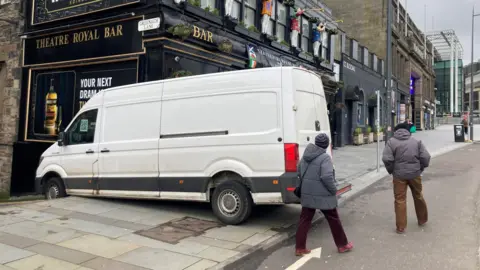
In 2024, Edinburgh city officials had to find a solution to drivers being repeatedly sent down a set of steps by their satnavs.
There had been changes to the road layout the year before.
A barricade was eventually installed at the top of Greenside Lane, near the city's Theatre Royal bar, and the council asked Google and Apple to update their systems.
In 2023, a Nissan Juke was left jammed in a narrow footpath in Tenby, Pembrokeshire, for a week.
A protected Victorian heritage wall perched on the cliff was a complicating factor in getting the car out of the narrow path.
The mechanic who helped remove it said the two American tourists blamed the satnav for sending them down the tiny path to St Catherine's Island, which is at the foot of the nearby beach.
They eventually abandoned the car to catch a train to their hotel.
Similarly in 2011, in Somerset, a lorry driver blamed his satnav for sending him down a 7ft (2m) wide alley off Bruton High Street, before badly damaging a 300-year-old house.
 Tony Fisher/BBC
Sometimes there can be more serious consequences.
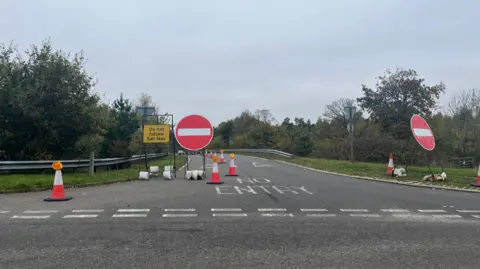
In 2024, a coroner in Buckinghamshire asked tech companies like Google, Apple and TomTom to make changes to their audio prompts after a driver went the wrong way - seemingly because of instructions from her satnav.
Tracey Haybittle, 58, and Amal Mohamed Ahmed, 38, both died in the head-on collision on a slip road to the A5 near Milton Keynes.
The coroner noted police attending the crash saw three other vehicles "perform exactly the same manoeuvre as Ahmed and attempt to travel down the slip road in the wrong direction".
National Highways put up no-entry signs and the tech firms all said they'd made improvements to clear up potential confusion.
In Essex, in 2019, police said a driver caught going the wrong way round the M25 had blamed his satnav.
There are regularly stories of drivers who end up going through floods, fords and teetering on the edge of canals after following their GPS systems, prompting warnings about the dangers of slavishly following the route.
'You're not working your brain out'
 Reuters
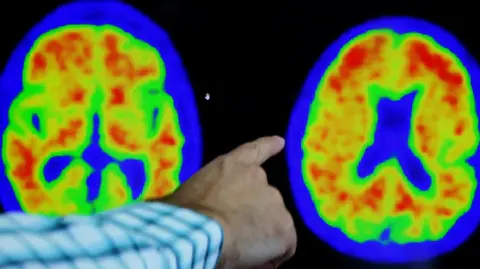
Prof Hugo Spiers, from the Faculty of Brain Sciences at University College London, conducted research into what our brains do when we drive using GPS to navigate.
The 2017 study involved 24 volunteers navigating a simulation of Soho in central London while undergoing brain scans.
"There's all sorts of things your brain is busy tracking when you're driving from memory, your brain's very active," Spiers said.
"All that just disappears when the GPS is in use.
"When you enter into a really busy roundabout, the particular bit of the brain for navigation is very active when you're trying to solve the problem.
"Whereas if you're going to a roundabout with GPS, your brain is not actively engaged in that at all."
The study had found the areas of the brain that switch off during GPS use were the areas associated with Alzheimer's disease.
"The hippocampus and the entorhinal cortex are two key brain areas that really early on get disrupted.
"It's good to keep your brain active navigating and not just offload everything to GPS."
A force for good?
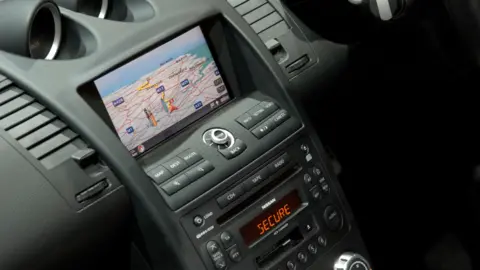
The advice from motoring organisations is to use satellite navigation systems when you need to - but not to be over-reliant on them.
"If you're going to a location you've never been to before, our advice is to plan ahead so you have a general sense of where you're going and the alternative routes available," said Nicholas Lyes, policy and standards director at IAM RoadSmart, a road safety charity.
He said in-built satnavs tended to be lower down the dashboard in the centre of the car, so people "might take their eyes off the road and look downwards" which could be "highly distracting".
"The best guide from getting from A to B is to use the Highway Code and road signs," Lyes added.
"Satnavs are a force for good, but they should be used to support your journey rather than something you completely rely on."
The AA recommends that drivers "understand the limitations of a satnav system so that you can get the best out of it without getting into trouble."
And if all else fails?
"It's a good idea to carry a road atlas for back-up, too."
Follow Essex news on BBC Sounds, Facebook, Instagram and X.