Stock markets and oil prices still volatile over fears Iran war may drag on

 Getty Images
UK and US stock markets rose but Asian indexes tumbled on Wednesday as oil and gas prices remained volatile over fears the US-Israel war with Iran may drag on.
The FTSE 100 index of the largest firms listed in London as well the big US and European indexes all rose on Wednesday following two days of sliding share prices, while several Asian indexes plummeted for a third day.
Oil and gas prices dipped on Wednesday but were still much higher than when the conflict started, after shipping traffic was virtually halted from travelling through a vital waterway near Iran.
Experts have warned that if oil and gas prices remain elevated it could make goods and services more expensive.
David Miles, committee member at the Office for Budget Responsibility, the government's independent forecaster, said the rate of inflation will increase in the UK if oil and gas prices stay high for a sustained period of time.
However, he said it was important to note the increases in both were "nowhere near as large" as those seen after Russia launched its full-scale invasion of Ukraine four years ago.
"If prices stayed where they were at the moment, probably we're talking about an impact on the level of prices in the UK maybe of 1% or so," Miles told the BBC's Today programme.
Brent crude prices have jumped by 12% since Israel and the US began bombing Iran on Saturday and Tehran responded by attacking neighbouring Arab countries.
On Wednesday, Saudi Arabia's defence ministry reported an attempted drone attack on its Ras Tanura oil refinery, the second time this week it has been targeted.
At the same time, one of the biggest producers in the world state-run QatarEnergy suspended production of Liquified Natural Gas (LNG).
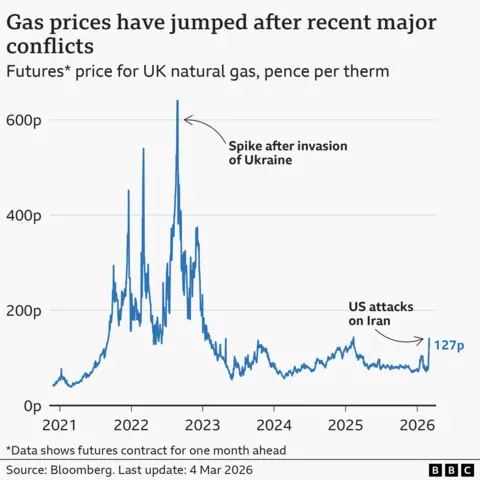
The benchmark UK gas price has surged to over 60% since the conflict began. It closed at 128p per therm by the end of trading on Wednesday, below Tuesday's high of 170p.
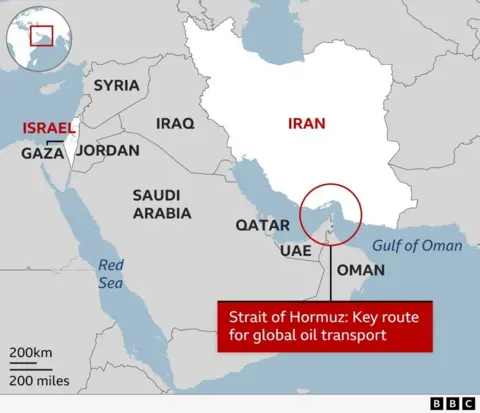
Around a fifth of the world's oil and gas usually flows through the Strait of Hormuz, a narrow waterway between Iran and the United Arab Emirates (UAE).
But traffic through the Strait of Hormuz has almost entirely halted following Iran's threats to "set fire" to ships.
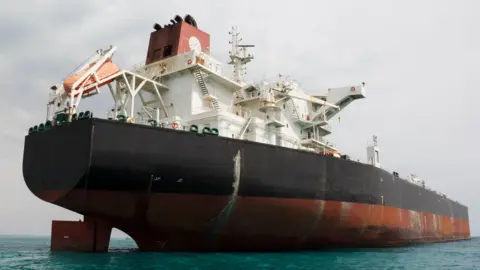
According to Lloyd's List Intelligence, about 200 tankers have been effectively stranded, while insurance premiums – particularly on vessels considered American, British or Israeli – have risen significantly.
On Tuesday, President Donald Trump said the US would provide risk insurance "at a very reasonable price" and use the Navy to protect oil tankers "if necessary".
However, experts warned his assurances might not be enough to ease companies' concerns, and the president did not detail how an escort through the strait would work.
Lindsay James, investment strategist at wealth management firm Quilter, told the BBC she believed markets had taken an "optimistic view" of the situation, because in reality Iran was well equipped to repel any ships using the strait.
"Shipping companies, insurers, crew members, potentially, are probably going to be reluctant to do this… It's not really feasible to think that that is going to be the solution to reopening energy supplies," she said.
"The solution is going to be a peace agreement, and it feels like we're some way away from that."
US Treasury Secretary Scott Bessent said on Wednesday that crude oil markets "are very well supplied".
Stock markets have fallen sharply since the US and Israel attacked Iran over the weekend, and many Asian stock markets have been hit particularly hard as the region imports large amounts of energy from the Middle East.
South Korea and Thailand stock markets were forced to temporarily halt trading after plunging by more than 8% and triggering so-called circuit breakers, which aim to avoid panic-selling.
James Hosie, oil and gas equity analyst at Shore Capital said roughly 80% of Qatar's LNG goes to Asian markets.
"Those consumers will now be bidding up the price of LNG cargoes to secure alternative supplies, as is now being seen with the spike in Asian LNG prices," he said.
"There obviously is a knock-on effect to the price of gas elsewhere, including the UK, where LNG helps balance demand with supply."
Risk to UK inflation and interest rates
In the UK, Chancellor Rachel Reeves is set to meet with North Sea energy bosses on Wednesday afternoon to discuss the implications of the Middle East conflict "and work with them to manage this uncertain period".
Quilter's James told the BBC that investors are forecasting higher inflation in the UK "and that could take one of the interest cuts that was pencilled in off the table".
Markets had projected that the Bank of England could cut interest rate twice this year as inflation eased.
The National Institute of Economic and Social Research, an economic think tank, said if higher energy prices persist, it could force the Bank of England to push interest rates back up, above 4%.
The Bank of England will announce its latest interest rate decision on 19 March.