'Black men overlooked in prostate cancer testing'

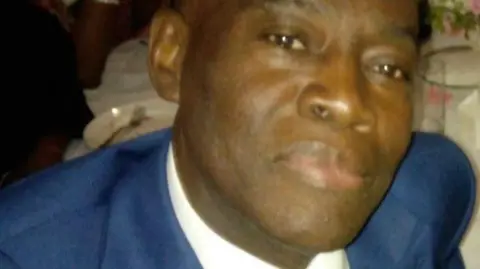 Guy Griffiths
Offering prostate cancer tests only to men with a confirmed genetic marker for it leaves black men at greater risk, a man diagnosed with the disease said.
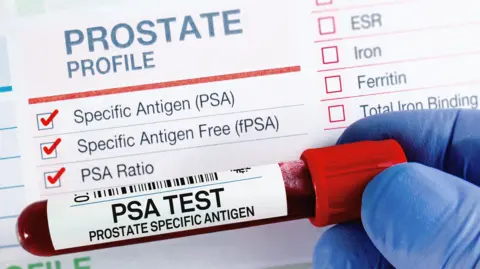
Guy Griffiths, 76, from Coventry, was diagnosed after he requested a prostate specific antigen (PSA) test from his GP in 2024.
He said black men were vulnerable and overlooked and must demand they get tested, regardless of the existing recommendations from the UK National Screening Committee.
The committee has said only men with specific genetic mutations that lead to more aggressive tumours should be eligible for testing, but this can rule out black men who have double the risk and men who have the disease running through their families.
Testing all men is not justified because the PSA test is not accurate enough, although a review is under way, the committee said.
Cancer Research UK has said it supported the committee's expert advice.
Prostate cancer is the most prevalent form of the disease in all men, with 56,000 cases diagnosed every year.
The charity Prostate Cancer UK suggests one in eight men will develop the disease during their lifetime, while that rate rises to one in four for black men.
Keith Morgan, associate director of black health equity at Prostate Cancer UK, said there was not any evidence to suggest racism was involved.
He said: "What I would say is that it's inconsistency. So sometimes men like Guy who are very proactive, they are able to detect prostate cancer early, which means that they're more likely to receive treatment that could cure prostate cancer.
"But then that's relying on people like Guy who are more informed maybe, have a better understanding of their risk. What about men that don't have that understanding?
"That's why we invest so much in our risk awareness campaign to try and get men, particularly men with the highest risk of prostate cancer, to understand that level of risk so that they can speak to their GP."
Morgan said GP guidelines need to be changed when speaking to asymptomatic men.
 Getty Images
Griffiths' PSA results meant he had an MRI scan and a biopsy in December, which showed he had the most aggressive form of the disease.
He is undergoing a trial treatment, under which he will receive five sessions of radiotherapy over a two week period. He added his latest PSA reading was 0 indicating he has a good chance of beating the disease.
Griffiths said he had asked for testing during health checks at his surgery, being aware of the risks and because the test was not routinely offered.
It led to test results in 2023 coming back with a high reading. However, he said he should then have been sent for further tests, but was not and had lodged a complaint with his surgery.
'Compromised view of black people'
He said this was not just about his journey, it was because he believed the NHS treats black men and women differently to other groups.
"Me and my type as black, who are vulnerable, are overlooked," he said.
"I don't believe I'm jumping on the bandwagon just because I'm black. I honestly believe there is a compromised view of black people in the health service."
Griffiths said black men must demand they are tested, regardless of the existing recommendations from the screening committee, because of the risk posed to their health by prostate cancer.
In a statement, the Secretary of State for Health and Social care, Wes Streeting, said: "We're expanding access to life-extending treatments, cutting waiting times, and ensuring that black men, who face twice the risk of dying from prostate cancer, are at the heart of our research efforts."
Follow BBC Coventry & Warwickshire on BBC Sounds, Facebook, X and Instagram.