Peregrine falcon lays five eggs in town's tower

 Getty Images
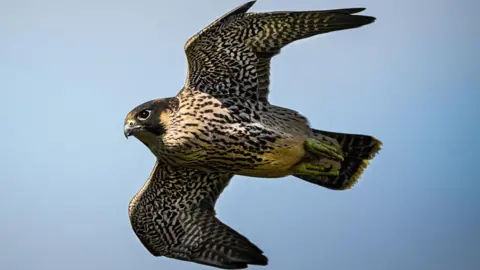
A pair of peregrine falcons have successfully nested in a Surrey landmark for another year, a charity has said.
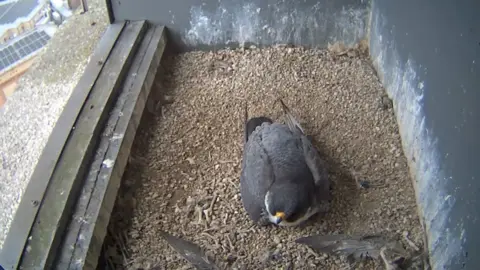
A nest box was installed at the top of Export House in 2016 by The Woking Peregrine Project.
Penny Williams, from Surrey Bird Club, said that one of peregrine falcons had laid a total of five eggs.
"Usually, peregrine falcons lay between three to four eggs, so to have five eggs is absolutely amazing," she told BBC Radio Surrey.
 Woking Peregrine Project
Williams said the pair, who had never laid five eggs before, had been nesting at Export House since 2022.
'Wonderful'
Williams said the first egg was laid on 21 March, with the chicks expected to hatch in one month's time.
"If you stand in Jubilee Square, you can just make out the nest box, which kind of looks like an upside down 'L' from where you stand," she said.
Williams added that the falcon chicks were ringed so their movements could be tracked.
"They do travel quite a distance. Some have been found in the south coast," she said.
Williams said that it was "wonderful" to see birds of prey, adding that they played a role in keeping down the population of feral pigeons.
Three eggs were laid by the falcons in 2025. The eggs typically hatch in late April or early May.
The birds' nest box is also fitted with a webcam, and visitors to the Woking Peregrine Project website can watch a live stream.
Peregrine falcon populations in the UK neared extinction in the 1960s due to human persecution and pesticides in their food chain. However, improved legislation and protection helped the birds.
Despite peregrines historically living on cliffs, tall buildings also make an ideal nesting place, and the population has expanded to urban areas including large office buildings and churches.
Follow BBC Surrey on Facebook, on X, and on Instagram. Send your story ideas to southeasttoday@bbc.co.uk or WhatsApp us on 08081 002250.