What revenue-raising options could be on the table for NI?

 Getty Images
Budget announcements done and dusted for another year and with public and political verdicts cast, yet again we are hearing the words "revenue raising" from the Secretary of State.
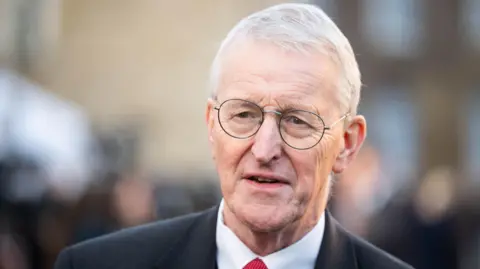
Hilary Benn is far from the first government minister in recent years to kick the financial football back into Stormont's court.
After power-sharing was restored in January 2020, the then NI Secretary Julian Smith tried to coax the executive into doing some form of raising money locally rather than relying as heavily on the exchequer.
Spoiler alert: It didn't work.
The rhetoric around the prospect of water charges was immediately shut down by the DUP and Sinn Féin, while a debate around raising tuition fees also failed to get off the ground.
Any notion of exploring other charges was quickly put on the back burner when the Covid pandemic hit.
The most recent collapse of devolution in 2022 - which lasted for two years - saw Smith's successor Chris Heaton-Harris threaten to impose revenue raising from London, in a bid to improve decaying public services.
But the parties chalked that up as an attempt to blackmail them back into government. So it didn't work either.
After the executive re-formed in early 2024 parties were again confronted with a backlog of issues stalled during Stormont's collapse, without the money needed to pay for them.
 PA Media
Since taking power last summer, Labour has followed the Conservatives' lead, insisting they've given Northern Ireland the level of funding it needs and that the levers to do more rest with the executive.
Throw in the potential of a £400m overspend by Stormont departments this year and Westminster sources say the argument for some form of revenue raising is a no-brainer.
Benn even went as far on BBC Radio Ulster's Good Morning Ulster to say that there are some people in Northern Ireland who "could perfectly well pay water charges".
"If you run out all of the means available and then say 'we're short of money', in the end you have to make a choice," he said.
As blunt a statement as it was, the Secretary of State knows there is no chance of our parties making that particular choice.
Northern Ireland is the only part of the UK where water is currently not subject to a separate tax for households.
The Fiscal Council estimates that water charges could raise several hundred million pounds, but it's almost unimaginable that parties would seek to impose a controversial measure, especially when the 2027 assembly election is on the horizon.
 Getty Images
What else could they do?
Smaller measures like reintroducing prescription charges in Northern Ireland could bring in £20m.
Increasing tuition fees is another option, but one that was recently ruled out by Economy Minister Caoimhe Archibald.
The five universities and university colleges in Northern Ireland had called for tuition fees to rise by more than £1,000 a year.
Stormont officials say raising Northern Ireland's student fees to the levels of those in Great Britain would generate about £98m.
Ending free bus and train passes for people aged 60 and over could generate about £30m, but those opposed to the idea say the societal costs of scrapping it would outweigh the immediate financial gain.
 Getty Images
What can Stormont currently do to raise money?
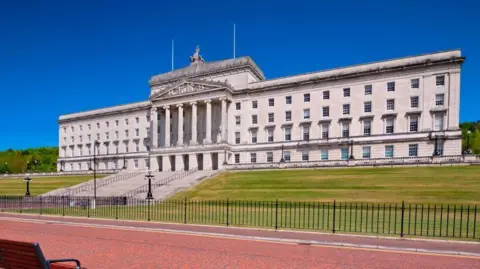
The only significant revenue raising undertaken by Stormont is regional rates - a property tax paid by households and businesses.
Income tax powers are not currently devolved to Stormont although in 2022 the Fiscal Commission recommended this should happen as a means of widening devolved tax and spending powers.
The SDLP, Stormont's official opposition, has also argued for the executive to be given more fiscal powers.
But in another sign of the growing tensions between the two parties jointly leading the executive, the DUP this week smacked down such a suggestion, saying Sinn Féin - which holds the finance ministry - had "consistently failed to demonstrate sound financial management".
John O'Dowd, the finance minister in question, in turn has argued he is being blocked by the DUP from taking forward rates reforms.
He has also in recent months warned executive colleagues of the need to live within their budgets or risk making a difficult financial landscape even worse next year.
The DUP Communities Minister Gordon Lyons told the BBC he has proposals for saving money within his own department, including a plan to tackle money lost through benefit fraud and error - something he claimed Sinn Féin is blocking.
Lyons also argued that his party would not support revenue raising that will place more costs onto families in Northern Ireland, in the context of a UK Government budget he said does "sod all" for workers.
The question of whether Stormont should commit to serious revenue raising has lingered off and on for most of the last three decades.
The answer still seems to be a resounding no, but without it there may be sod all chance of improving our public services.