Snake has virgin births - for second time

 City of Portsmouth College
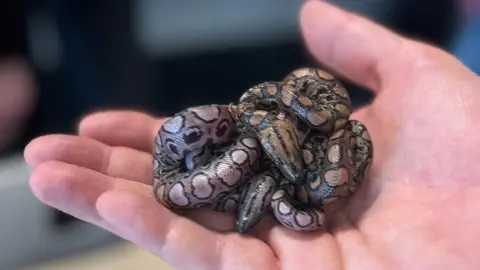
A snake which previously gave birth to 14 snakelets despite not having a mate has birthed more babies for a second time.
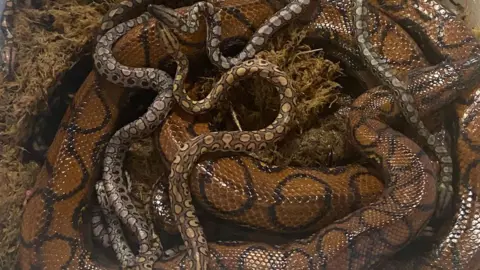
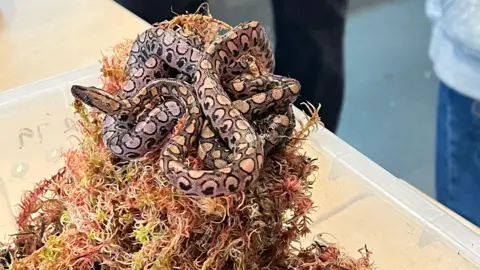
Ronaldo the snake, who was originally thought to be male, has given birth to a litter of 12 offspring without mating in a rare phenomenon.
The 14-year-old Brazilian rainbow boa constrictor gave birth at the City of Portsmouth College (COPC) on Monday, mirroring what happened two years ago.
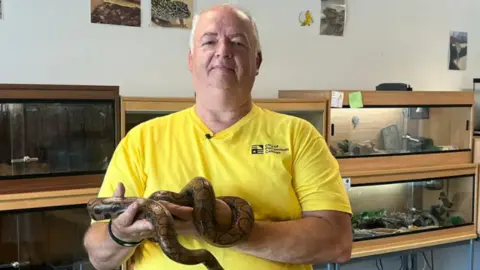
Pete Quinlan, animal care technician at the college. said the process of virgin births, known as parthenogenesis, has only ever happened three times to this particular species, but for the same reptile to give birth twice without a mate could be even rarer.
 City of Portsmouth College
"I've done as much research as I can and I can't find any record of it happening twice," he said.
"I had my suspicions for a couple of weeks and then suddenly she was showing all the signs."
The reptile showed other signs of pregnancy including nesting behaviours, excess skin shedding, and a loss of appetite.
Ronaldo was kept in a quiet vivarium where students could observe her behaviour and now learn about how to rear the baby snakes.
She first gave birth to her previous litter in June 2024.
Mr Quinlan rescued the boa constrictor from the RSPCA and started his animal care work at the college in 2022 where he took his collection of snakes with him.
"She was mine for nine years before she came here," said he said.
"And it's almost time for her to retire and come back to me. She's clearly had a great time at COPC – for parthenogenesis to happen, the conditions have to be perfect. Which I think is a great testament to the facilities we have here."
 City of Portsmouth College
Virgin births do occur in some animals, but it remains a novelty among vertebrate.
Many invertebrates, such as insects, can produce offspring asexually, without ever having mated.
They usually do this by cloning themselves, producing genetically identical offspring.
Exactly why this phenomenon occurs remains a mystery, with some scientists suggesting it is a "last ditch" attempt for females to pass their genetics onto offspring.