Fusion power plant plan is a 'calculated risk'

 BBC
BBC"You're talking once in multiple generations that a really new energy source comes into being."
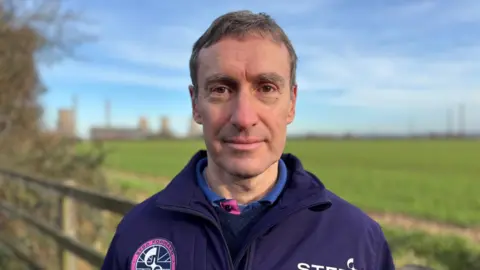
Speaking this week, UKIFS chief executive Paul Methven said a fusion power plant, set to be constructed in north Nottinghamshire, will have "global significance."
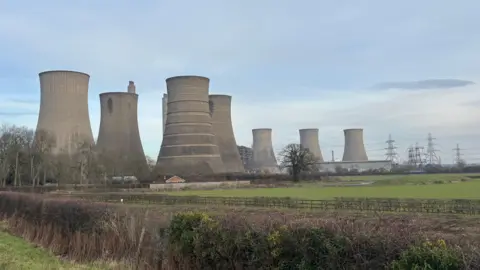
UKIFS is the company responsible for building the prototype, known as STEP (Spherical Tokamak for Energy Production), on the site of the soon-to-be-demolished West Burton A coal-fired power station near Retford.
The region's power-generating heritage was one of the chief reasons for it being chosen to pioneer the technology, which it is hoped could eventually provide humanity with near-limitless, clean energy.
Nuclear fusion is the process which powers the sun, and scientists have been trying to recreate it on Earth for decades.
It does not rely on fossil fuels or produce harmful greenhouse gases, and is the opposite of the nuclear fission used in existing nuclear power plants.
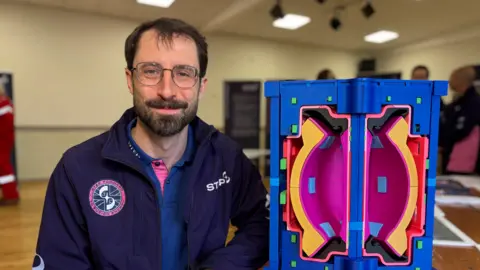
Speaking at one of the public consultation events which started this week, head of engineering for STEP's fuel cycle, Michael Lord, demonstrated the process with a model of a tokamak - the device at the fusion plant's heart.
"We're looking to replicate the conditions you would have in a star," he said.
"We're taking atoms, we're holding them together under high temperature and pressure, and when they fuse, they generate and release energy."
Fusion experiments usually consume more energy than they create, but there have been major breakthroughs in recent years.
Scaling the technology up to a point where it is commercially viable, however, is still a long way away.
"I don't expect the first device to be putting power on [the] grid in a way that will bring down energy bills, but all that learning will mean we have a futuristic power supply and power source for generations to come," Lord said.
With successive governments having invested billions of pounds in the sector, it can seem like a lot to stake on unproven technology.
"It's not a gamble, it's a calculated risk," Methven said.
"We're facing energy security challenges, climate challenges in the future, cost-of-energy challenges.
"If we don't take big strategic decisions and follow through on them over decades then those problems just get worse."
Overcoming the hurdles that still exist with fusion, he said, is "the job of the prototype".
"Solving every one of those problems is a business opportunity in itself," he said. "The spin-off technologies could be massive out of this."
He added he understands why people living nearby may be concerned about the project, but said the consultation is "not a tick-box".
Vikki Wallace attended one of the drop-in events, having moved to the area seven weeks ago.
"We've come for the quiet life, and now all this is happening," she said.
"They're going to need thousands of people coming to work here, they've all got to get here, they've got to live here somewhere."
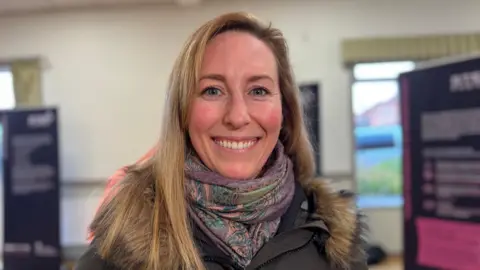
She added she was worried about traffic noise but was reassured after hearing about the project's transport strategy, which includes new rail infrastructure and using the River Trent for freight transport.
Godfrey Watmough has lived in the nearby village of Bole for almost 80 years.
"Anything that brings security in electricity and energy has got to be a good thing, if it works," he said.
"They seem to be spending a lot of money before they know it actually works, but it's going to be an experimental site so that's what you expect."
In-person consultation events are being held at various locations until February 17, and an online feedback portal is open until March 11.
Follow BBC Nottingham on Facebook, on X, or on Instagram. Send your story ideas to eastmidsnews@bbc.co.uk or via WhatsApp on 0808 100 2210.