Tech firms pledge to pay for AI data centre power costs. But will they?

 Reuters
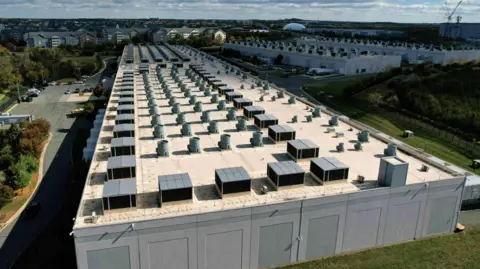
Technology firms including Google and Meta have said they will shoulder the costs to power artificial intelligence data centres, as the White House faces pressure to address rising electricity prices.
US President Donald Trump has embraced the AI sector. But the expansion of data centres has strained the electric grid, and utility bills are a top cost-of-living issue for voters ahead of November's midterm elections.
In a meeting at the White House, tech executives signed a "ratepayer protection pledge", which Trump unveiled last month. But it is unclear how Big Tech will be held to the pledge.
Analysts question how such an agreement can be enforced, and what relief it would offer US households.
The US and Israel's war with Iran could also undercut the president's push to lower electricity bills as supply chains are disrupted and global oil and natural gas prices spike.
Seven leading tech firms - Google, Microsoft, Meta, Oracle, xAI, OpenAI and Amazon - have signed on to the pledge, Trump administration officials said.
The companies have agreed to build, bring or buy new power generation capacity for data centres, officials said.
The firms said they would commit to paying for new power infrastructure upgrades, and would negotiate rate structures with utility companies at the state level, as well as hire workers local to where data centres are built.
The commitments "will help keep down utility bills very substantially", Trump said at Wednesday's meeting with tech executives, while cautioning it would "take a little bit of time to get there".
US Energy Secretary Chris Wright told reporters during a briefing that the administration is still committed to leading in the AI boom, but "we're going to do all of that without raising electricity prices for Americans".
At the same time, Trump acknowledged that tech companies "need some PR help" amid a backlash to data centres in local communities nationwide.
The tech pledge may be difficult to enforce, said John Quigley, a senior fellow at the Kleinman Center for Energy Policy at the University of Pennsylvania.
He cited the multiple layers of government, grid managers and electricity regulators involved in power projects.
"The burden of proof is on them," he said, referring to Trump administration officials, "to prove this is more than just a stunt".
On the campaign trail, Trump said he would cut energy bills in half during his first year back in the White House.
But residential prices rose 6% in 2025 on average, according to the US Energy Information Administration.
On top of strain from data centres, the price of natural gas - which is a crucial component for nearly half of electricity generation in the US - has jumped over the past year.
The natural gas industry is exporting more and more overseas to take advantage of high demand globally, which is contributing to higher domestic utility bills, analysts say.