New fungal research to support woodland creation

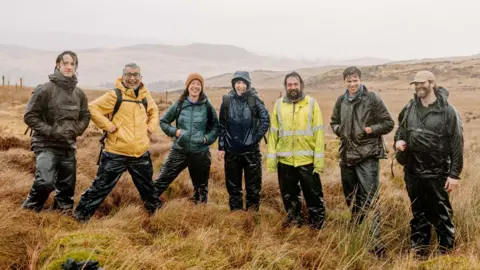 Spun/Seth Carnill
New research is being carried out to understand how underground fungal networks influence the creation of woodland.
As part of a commitment to create about 260,000 hectares of new woodland across England, the project taking place at Wild Haweswater in Cumbria aims to help establish resilient and ecologically rich trees in its upland landscapes.
Researchers will look at whether microscopic soil organisms could help tree survival consistently across sites.
Dr Mo Verhoeven, lead conservation scientist at the RSPB, said Cumbria was chosen because fungi which supported trees had transitioned to fungi found in grasslands that "have been grazed for hundreds of years".
The fungi, known as mycorrhizal, form partnerships with tree roots and act as underground support networks, helping trees access nutrients and water in exchange for carbon.
Samples will be taken from the site for analysis to identify the different kinds of mycorrhizal in the soil.
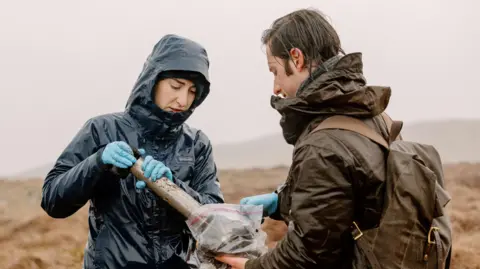 Spun/Seth Carnill
Knowing which fungi was present "could inform where and how we plant trees, and also which pieces of tree we plant", Verhoeven said.
He said without the right fungi, the trees would have "a much harder time" establishing which could result in the "death of the tree".
The landscape restoration programme is being led by Cumbria Connect in partnership with the RSPB, landowner United Utilities, and the Society for the Protection of Underground Networks (Spun).
Bethan Manley, lead Computational biologist at Spun, said the aim was to "improve confidence in woodland creation" by "working with natural processes".