England's adaptive cheerleading champions chasing gold in Florida

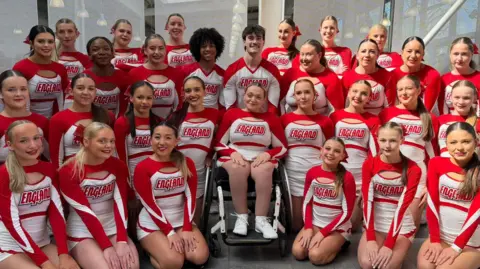 Team England AA Management
Every year, teams from across the globe head to Florida to compete in the ICU World Cheerleading Championships.
And one aiming for the "three-peat" - that's three back-to-back gold medals - is the Team England Adaptive Abilities Advanced team.
Adaptive Abilities, or AA, is a category where cheerleaders with and without disabilities compete side-by-side.
Routines are made up of familiar stunts, jumps, gymnastic tumbles and classic cheer chants, but modified to account for the needs of teammates.
Participation is growing.
All major UK competitions now offer contests for AA teams, and Wales and Scotland are also fielding teams at the world championships.
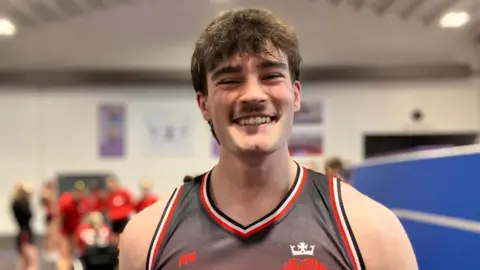
Harrison Phipps, 23, who has severe to profound hearing loss in both ears, is helped by an observer off the mat during routines.
They'll give counts via a microphone linked to his hearing aids, allowing him to keep time with the rest of the team.
"Quite a lot of the time I'm lost in training…" he tells BBC Newsbeat.
"And it's just because I haven't heard what the plan is. So I often find that my group's the one that isn't hitting that first time."
"I find a lot of teams will have disabled athletes on it, but not be in a disabled category. And so I feel like we kind of get hidden away," he says.
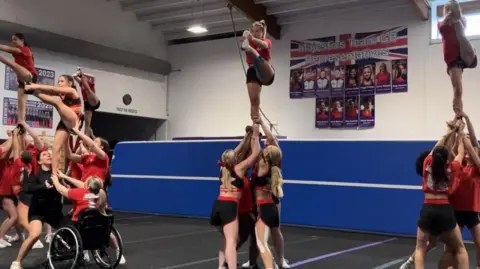
Tournament rules state that at least 25% of the athletes in each team must have a disability, but about half of Team England's squad do.
The youngest member is 11 years old, while the oldest is in her 50s.
One team member is in a wheelchair, while others have conditions such as ADHD.
Cheerleading was given Olympic recognition in 2021, and four years later it was officially recognised as a sport by Sport England.
SportCheer England celebrated the "monumental" decision at the time but confirmed that until they were formally recognised as the National Governing Body (NGB), the sport could not receive Sport England funding.
The adaptive category doesn't yet use the same classifications for disabilities as the Paralympics.
Joey Gamper Cuthbert, board chair of national governing body SportCheer England, says it means the make-up of the squad is "broad and varied".
"You might have somebody on a team who has a visual impairment and, on the same team, a wheelchair user," she says.
"An athlete with a limb difference on the same team and an athlete who's deaf."
She says the governing body, the International Cheer Union (ICU), has kept criteria broad "to encourage international participation" in the hope of developing an elite pathway for disabled athletes.
But there's still a lot of work to do in order to get more people involved in the sport, according to Gamper Cuthbert.
"There's a real confidence needed for coaches to feel that they are capable of working with disabled athletes," she says.
"There's a lot of fear. So coaches need to have good education to feel encouraged and supported."
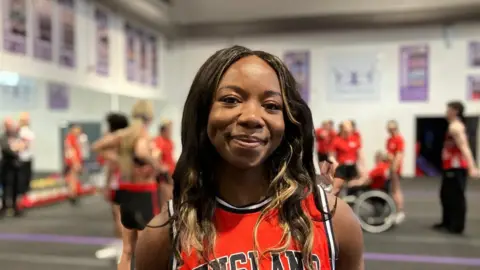
According to team member Tifé Adegun, 28, who has scoliosis, or curvature of the spine, having such a varied range of competitors is a way to inspire others to get involved.
"People might think: 'Oh, I can't do cheer for this reason or that reason'," she says.
"But I think that by us being there it makes people think: 'No, actually I can. Look at them, they're amazing'."
And, Tifé says, the feeling of performing is well worth all the effort and preparation that goes into training.
"I just feel so grateful that my body's allowed me to do this - it's really wonderful," she says.
"When I get up on that stage, it's like nothing else matters. I just want to do the best for my team."
Teammate Chloe Sheehan, 32, has a condition called non-epileptic attack disorder. It means she can faint or have seizures triggered by overexertion or anxiety.
"There is something really special about knowing that you can just be whoever you are and not have to worry that that's going to impact your value as an athlete," explains Sheehan.
If she's feeling "dangerously tired" a reserve will step in - an arrangement she says "makes it possible to train at such a high level".
For her, adaptive cheer is "probably the most important thing in the world".
"The ICU Worlds is broadcast on the Olympic channel, so it's basically kind of like the Olympics of cheerleading," she says.
"It's really exciting.
"It gives people like myself and many other athletes a chance to a dream."
