Fears cancers missed due to NHS dentist shortage

 PA Media
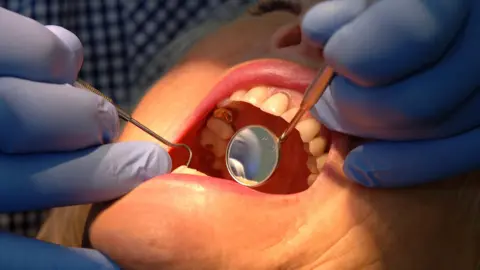
Some cancers could be diagnosed late because people cannot access an NHS dentist, a university professor has said.
Oral cancers are often picked up during routine dental appointments, but the University of Lancashire's dental school said it was seeing some people who had not been to a dentist for years.
Professor Kathryn Taylor, who heads post-graduate dental programmes at the university, said they had to send some patients to specialist centres as "almost certainly some of those have got head and neck cancer".
A Department of Health and Social Care spokesperson said efforts were underway to overhaul NHS dentistry to prioritise those with urgent needs and needing complex treatments.
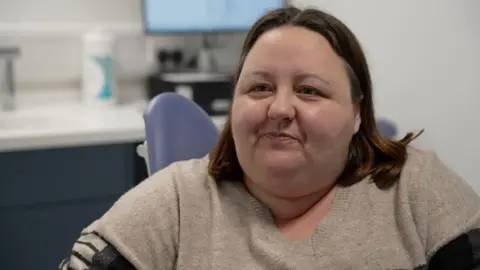
Student Victoria Lowe has spent years trying to find an NHS dentist.
"I phoned all around Lancashire pretty much as I drive so I can go anywhere but [it was] just no help at all," she said
Victoria, who's also a mum, cannot afford a private dentist and so has not been to see one for four years.
"My friends – they're in the same boat, a lot of them," she said.
Victoria has come to the University of Lancashire's Dental School in Preston because her jaw has become painful.
It is the biggest of five centres run by the university with others in Morecambe, Blackpool, Accrington and Carlisle offering services to the public.
The cost of treatment is either low or free, depending on the treatment and the experience of the student dentist.
"The whole premise of this school was to set up dental practices within areas of high need and where people were struggling to access NHS care," said the head of dentistry Dr Claudia Cunningham.
"The students can get the experience but also the patients can benefit from that service."
Many of the students are already qualified dentists undertaking further specialty training and the university is particularly keen to encourage patients who need more complex work.
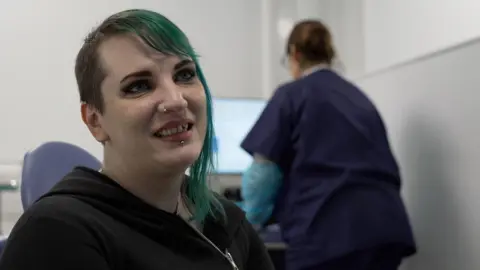
But others are just here for a check up. Sitting in the bay next to Victoria is Liz Whittaker.
"There just aren't any NHS dentists available in Preston," she said.
"I've been trying probably for about the past seven years to get one and have repeatedly had to go to private clinics and pay ridiculous amounts of money for things.
"By the time you get through to anywhere which says it's got availability for NHS patients they're always gone."
Last year the Association of Dental Groups which represents more than 2,000 practices in the UK told MPs that 4.5m patients were going untreated annually due to the 2,749 shortfall in the NHS dental workforce in England.
Prof Taylor said some people were coming in with signs of cancer which could have been picked up earlier.
"We've had certainly four or five patients over the past couple of weeks that have literally just walked in and we've sent them off to the specialist centres for diagnosis and treatment so almost certainly some of those have got head and neck cancer."
Oral cancers in particular are often picked up during routine dental checks before the patient has realised that anything significant is wrong.
Like all cancers, early diagnosis greatly increases the chance of successful treatment.
Prof Taylor said people often tried to get an NHS dentist for a check up "for a few weeks or months and at that stage the cancers are getting bigger all the time."
The Labour government's manifesto included a pledge to create 700,000 new urgent and emergency dental appointments – which have been rolling out since last year.
But that does not impact on the number of routine appointments available.
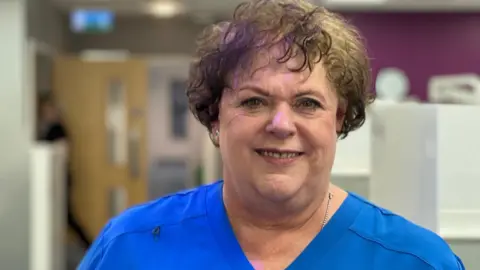
"There's drop-in centres for emergency treatment but it doesn't really fit into that so patients just don't know where to go really," said Prof Taylor, adding that by the time the cancer is big enough to prompt a GP visit it is often more advanced.
In the meantime, a steady stream of patients are filing to the treatment bays.
The student dentists are observed by one of the staff.
Saud Alharbi is here from Saudi Arabia where he has already worked as a dentist for three years, having initially studied for seven.
He is now doing specialised training.
"It helps us to get more exposure and better cases," he said, adding that the level of expertise in the UK is what brought him over.
Expertise is what also attracts some of the patients.
Louise Cookson already has an NHS dentist but said they had referred her to the centre for specialist treatment "it's a lot less waiting time than to go to the NHS".
"It's an excellent service. I don't think many people know about it."
The Department of Health and Social Care spokesperson said: This government inherited a broken NHS with people waiting far too long for urgent dental appointments and cancer diagnoses.
"We need to catch cancer earlier and faster because we know early diagnosis is key to cancer survival.
"That's why, through our National Cancer Plan, we are expanding screening and community testing, as well as investing in the latest tech and AI to spot cancers earlier."
Listen to the best of BBC Radio Lancashire on Sounds and follow BBC Lancashire on Facebook, X and Instagram. You can also send story ideas via Whatsapp to 0808 100 2230.