How one email helped reunite son and mum after 50 years

 BBC
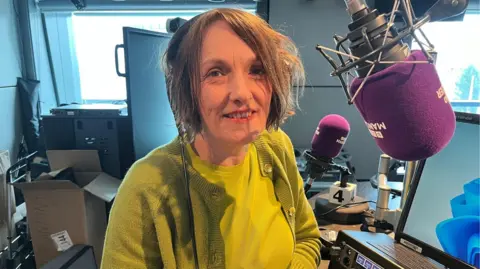
BBCWhen a BBC presenter received an email after the release of her true crime podcast, it was the beginning of a chain of events which led to a mother and son's reunion after 50 years.
Matthew, a listener to the Forgotten Dead series about an unidentified woman who had been found dead in a Bolton cellar in 1982, wrote to Jane Wilkinson to say it might be his missing mum.
While it was not his mother, Matthew went on to discover his real mum was still alive after she disappeared to escape an abusive relationship.
In a new episode of the BBC Radio Manchester podcast, Matthew revealed details of the life-changing moment he spoke to his mum for the first time.
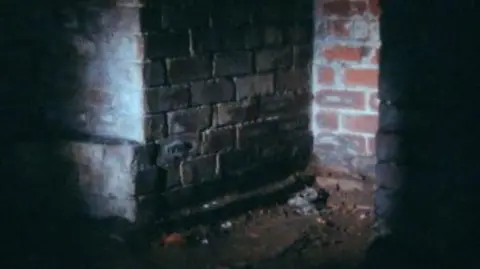
The podcast examines the case of a woman's body being discovered in the cellar at a house on Bromwich Street in Bolton in 1982.
Despite appeals, Greater Manchester Police never learned her name, so they called her Mary Ellen.
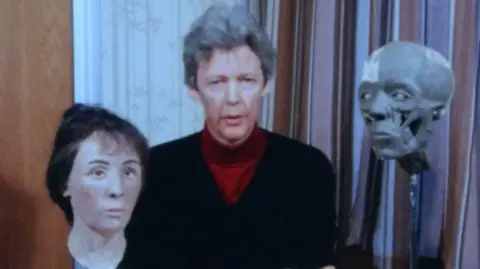
Over the last few years, a BBC investigation into the woman's real identity has become an obsession and inspired the podcast: The Forgotten Dead.
Then Matthew got in touch.
Could Mary Ellen be his mum, who had disappeared 50 years ago, leaving behind her three young sons?
"I've been told that my mother had mental health issues and that she'd abandoned us," he said.
"And then that was it. She was never seen again. Just completely dropped off the face of the Earth."
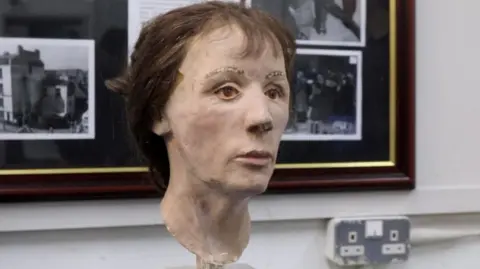
Mary Ellen was not Matthew's mum, however.
She was the wrong age, the wrong height, and the timing of her disappearance did not fit.
Even so, Matthew stayed in touch with the podcast team, who wanted to help him.
A week after he had given a DNA sample to Bolton police, an officer got in touch.
"He said 'Look, are you at home? Are you sat down?'
"And then he said 'I've just spent the last hour-and-a-half talking to your mum…she's alive!'"
Months later, Wilkinson said she could still remember the joyful disbelief in Matthew's voice as he told her, as well as her "absolute shock".
They then arranged to meet, and Matthew wrote a letter to give to the police, who passed it on to his mum.
He said he then he waited for weeks.
"My mum phoned when I was in the supermarket and I had to take this enormous phone call and it's quite surreal," he explained.
"You're surrounded by people, and yet something enormous is happening in my life, right in that very moment."
'Just hell'
The story Matthew learned over the next 18 months was a difficult one.
In the early 1970s, his mum had been in an abusive relationship with a violent man.
"It started off [with] little things," she recalled.
"One time I was dancing with somebody and he grabbed my arm and I said I didn't want to see him anymore. And he pushed my face.
"He said 'we'll finish when I tell you we're finished'. After that, it was just hell.
"Another time, he was punching me and it was like I was having a fit. I've got a wee mark when he stabbed my stomach with a kitchen knife.
"He said he would kill my children and he was going to put me in a field, bury me, and I'd never be found."
So she ran, leaving her sons behind with relatives.
The mother used different names, worked cash-in-hand and avoided official paperwork.
And then she spotted a handwritten message on the door of the women's toilets in a cafe.
"It said 'We are Women's Aid. Have you been physically abused by the man in your life?' and there was a phone number."
It was a stroke of luck, particularly because the charity had only officially been founded for a few weeks.
It also marked the beginning of her recovery - physically and mentally.
She made one failed attempt to make contact with her family, but then she never told anyone.
"That's how I've lived my life," she said. "I have no children. I loved them to bits, but you're punishing yourself every day."
Until, after 50 years, Matthew found her and they were reunited.
"I opened the door and I saw flowers," she remembers.
"Then he put his arm around me and said 'Hello mum'. I loved it."
Inevitably, there has been a lot of catching up to do, and some difficult conversations.
"I've said to my mum, I forgive her," Matthew said.
Now they seem relaxed in each other's company, comfortable and familiar.
"I feel like I know him really well now. I feel like he's mine," she said.
Matthew said it was the same for him.
"I call her mum. Before, I only ever referred to her by her first name but now I'm sat here with my mother? My mum."
The new episode of The Forgotten Dead – 'I had to run': A Mother's Story - is out now on BBC Sounds
Listen to the best of BBC Radio Manchester on Sounds and follow BBC Manchester on Facebook, X, and Instagram. You can also send story ideas via Whatsapp to 0808 100 2230.