AI tool helps doctors prescribe antidepressants

 BBC
BBCA tool that uses artificial intelligence has been shown to effectively help doctors prescribe antidepressants.
Developed by the University of Oxford, it looks at all available data about depression alongside a patients' personal information, including their preferences for things like what side effects they can live with.
The tool predicts the best medicine, and in a major international trial researchers demonstrated doctors can then better tailor the right drug to people with depression.
It can currently take years to select the correct treatment and it is estimated that about 80% of the millions of people prescribed antidepressants stop their medication within a few weeks.
Since university, 45-year-old Henry Winchester from Bristol, has lived with bouts of depression.
"It has been very challenging at times. I get quite bad anxiety about things. I can get in quite a low mood about things," he said.
"That can limit how much I can do with my life, there's a lot of things that I'd like to do but I can't because I feel that I'm held back by my brain."
He is one of 500 adults that have Major Depressive Disorder (MDD) to take part in the trial in the UK, Brazil and Canada
Winchester said: "It involved competing a survey, that was quite interesting, a lot of questions about my health and the side effects I didn't want to have.
"And then there was quite an exciting moment when it finally revealed the antidepressant that suited me best."
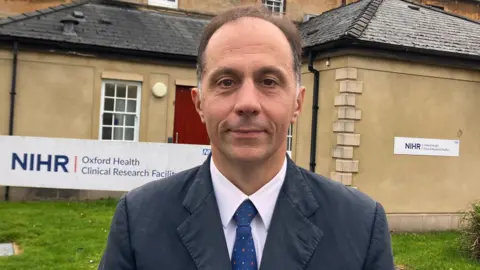
Research Professor Andrea Cipriani, from the University of Oxford, was lead investigator of the Personalising Antidepressant Treatment for Unipolar Depression Combining Individual Choices, Risks and Big Data (PETRUSHKA) study that was conducted across 47 sites around the world.
"The PETRUSHKA tool is a revolutionary approach, because until now when we prescribe an antidepressant to a person with depression, we use trial and error based on the experience of the clinician," he said.
"The trial and error is a lengthy process and also it is harmful for patients."
Cipriani said the findings show that people whose antidepressant was selected using the AI tool were much more likely to stick with their treatment.
He said: "The results of the tool are outstanding because if we use the PETRUSHKA tool, we increase by 40% the probability of continuing the medication.
"And this is important because continuing the medication means that the medication is effective and tolerable.
"And if you continue taking the medication the symptoms improve and this is what we demonstrated in the PETRUSHKA trial, reducing both depressive and anxiety symptoms."
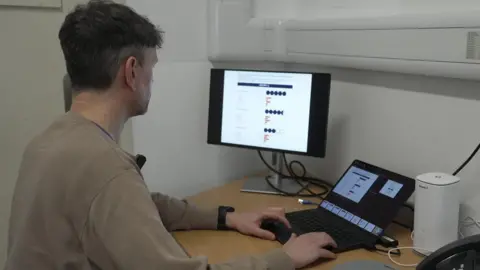
Until he took part in the study, Winchester said he spent five years trying different medications but found the side effects too severe.
"I feel much more optimistic because I feel like, a lot of the things that bothered me before, don't bother me as much now," he said.
"I just have an inner confidence that I've never really had before."
The findings, that have been published in the Journal of American Medical Association, are the first time a mental health clinical prediction tool has been demonstrated as effective.
The team now hope it can be applied to other mental health conditions with the ambition to have it rolled out to GPs UK wide.
You can follow BBC Oxfordshire on Facebook, X, or Instagram.