Cyprus leader calls for frank discussion on 'colonial' UK bases
The UK's two military bases on Cyprus are a "colonial consequence" on the island and talks on their status and future need to take place, Cypriot President Nikos Christodoulides has told the BBC.
"When the situation is over in the Middle East we are going to have an open and frank discussion with the British government," he said as he arrived for an EU leaders' summit in Brussels.
Under the 1960 treaty establishing Cypriot independence from Britain, the UK was given sovereignty of bases at Akrotiri and Dhekelia.
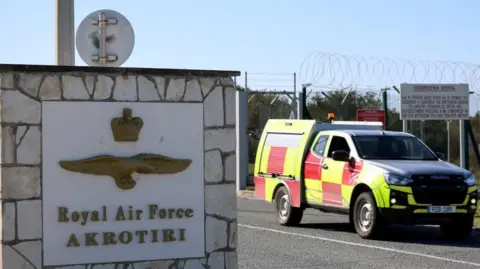
However, RAF Akrotiri was targeted by drones this month shortly after the start of the US-Israeli war with Iran and the UK has faced some criticism for its response to the attack.
The drones are thought to have been fired from Lebanon or Iraq and protesters have complained that the British bases on the island have made Cyprus a target.
One drone hit Akrotiri, punching a hole in an aircraft hangar reportedly used by US spy planes. Two others were intercepted. A British naval destroyer dispatched in response to the drone strike is on its way to the island.
The two sovereign bases in the south and south-east of Cyprus have not been used for US operations against Iran, however on a visit to Cyprus on Wednesday, Europe Minister Stephen Doughty said British jets based on the island had been "flying regular defensive missions alongside our allies to protect our people and our interests".

 Reuters
Akrotiri and Dhekelia make up 98 sq miles (254 sq km) of Cyprus and are a significant source of employment.
"We have more than 10,000 Cypriot citizens within the British bases. We have responsibility for those people," Christodoulides said.
Any potential negotiations on the future of the bases would be very complicated given the founding agreements involved the UK, Greece, Turkey as well as representatives from the Greek and Turkish Cypriot communities.
Asked if he wanted the bases to go, the Cypriot leader said: "We have a clear approach with regard to the future of the British bases... I'm not going to negotiate publicly."
Responding to a BBC request for a response to the remarks, the UK's Ministry of Defence said the bases on Cyprus "play a crucial role in supporting the safety of British citizens and our allies in the Mediterranean and in the Middle East".
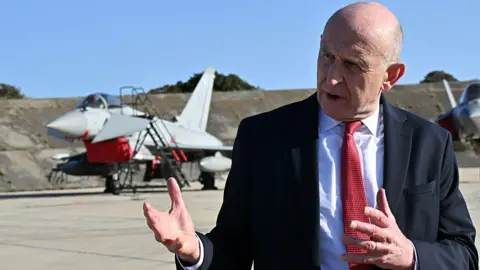
"We have been deploying additional defensive capabilities to Cyprus since January, including radar systems, counter-drone systems, F-35 jets, ground-based air defence, and 400 extra air defence personnel."
 Leon Neal/Getty Images
Opinion was divided in the Cypriot port city of Limassol on Thursday, with some residents suggesting that it was time for the British bases to go.
"Close and leave, please," Konstantina told the BBC.
"The British decided some bases should remain in Cyprus. It was not done to protect us," said Kyriakos Panayiotou. "The bases benefit the United Kingdom not Cyprus."
For Rebecca, it was important to have a bigger ally's help: "I don't think we will be strong enough ever for them to leave, so I think it's safer for us to have somebody that has our back. So, I'd like them to stay."

Her partner Damianos argued that Cyprus was independent, "but not strong enough to be alone".
UK Defence Minister John Healey visited the UK's air defence team on Cyprus earlier this month and said UK support there was backed up by Nato allies including the US, France, Greece and Germany.
He later told the House of Commons that the head of Cyprus's National Guard had told him that their "military co-operation has never been closer".
The UK said it had boosted its presence its military presence in response to the attack on Akrotiri, although it was not until this week that HMS Dragon, which was deployed to boost defences in Cyprus, entered the Mediterranean.
Two Greek frigates and a French naval ship arrived off Cyprus within days of the attack, and Spain also deployed a frigate, as part of a broader response to help their European ally.