Prank or plot? Cook's error angers king and bishop

 Getty Images
During the reign of King Henry VIII, a cook's ill-planned prank ended with him being accused of a political plot and his own gruesome death.
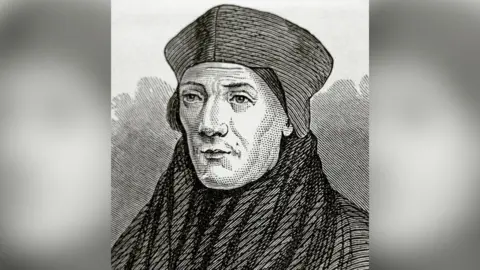
Neil Tonge, author of the Terrible Tudors, said the events all began with the Bishop of Rochester John Fisher inviting guests to supper at his London residence in April 1531.
Mr Tonge said the cook, Richard Roose, "wanted to play a prank" and laced the broth with a "certain medicinal compound".
"Roose said he thought the powder would give the guests diarrhoea, but at least two people died," Mr Tonge told Secret Kent.
"Roose claimed the white powder had been given to him by an unknown figure, so the whole thing is highly suspect."
The incident sparked rumours of a political plot involving the Boleyn family, said Mr Tonge.
The Bishop of Rochester was said to have been critical of Henry VIII divorcing Katherine of Aragon to marry Anne Boleyn.
"John Fisher was virtually told by the Boleyn family 'don't come to Parliament' because something nasty would happen to him," Mr Tonge said.
On that night of the poisoning, the bishop did not eat anything as he claimed to be fasting, which was possibly because of the warning, he added.
In the same year, a cannonball was fired at the bishop's residence in London.
Mr Tonge said it was allegedly carried out by the Boleyn family.
"We are not certain of this but the consequences were terrible," Mr Tonge said.
In an attempt to quash the conspiracy rumours, Henry VIII passed the Poisoning Act 1530, whereby anyone who attempted to poison their master or mistress would be committing a treasonous offence.
'Cook the cook'
Roose was found guilty of poisoning and condemned to death in an "imaginative and somewhat ironic way", said the author.
"The king decided to boil Roose alive. Henry VIII exclaimed he would '"cook the cook!"' Mr Tonge said.
The execution took place at Smithfield, London, and many people came to see the "entertainment".
"Even pregnant women attended. It was said during the execution, some women screamed and shouted, and had even delivered babies," he said.
He explained the executioners tied Roose to a gibbet - a gallows-type structure -and slowly lowered him into the pot.
"You can imagine the absolute agony and screams. He was lowered into the water until his flesh began to fall from his body. And of course he died," he said.
Mr Tonge said some historians believed "as many as 70,000" people were executed during Henry VIII's reign.
This included the Bishop of Rochester, who was beheaded at Tower Hill on 22 June 1535, aged 65.
The Poisoning Act 1530 was abolished after Edward VI came to power in 1547.
Follow BBC Kent on Facebook, on X, and on Instagram. Send your story ideas to southeasttoday@bbc.co.uk or WhatsApp us on 08081 002250.